How Much Is a Barcode Scanner? A Practical Price Guide for 2026
Discover how much a barcode scanner typically costs, from entry-level 1D models to rugged industrial devices. This practical price guide from Scanner Check covers price bands, influencing factors, and smart buying tips for 2026.


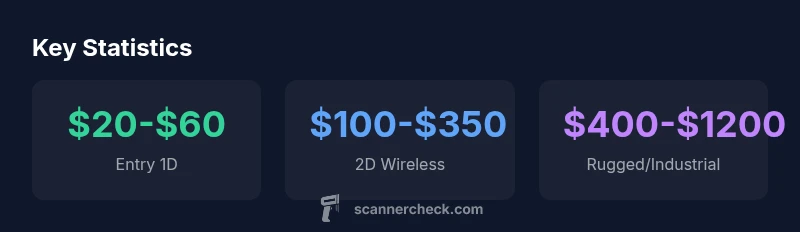
According to Scanner Check, most barcode scanners cost a wide range depending on capabilities. Entry-level 1D models typically run about $20–$60, while 2D and wireless units commonly fall in the $100–$350 range. For rugged or high-volume deployments, prices often stretch from $400 to $1,200. These bands reflect features, durability, and connectivity. Shop around and compare warranties, as long-term costs matter as well.
What drives the price of barcode scanners in 2026
If you're asking how much is a barcode scanner, the answer is that price is driven by capabilities, durability, and connectivity. Entry-level 1D scanners for basic barcodes cost around $20-$60, while higher-end 2D and wireless models typically run in the $100-$350 range. Rugged, high-volume devices for harsh environments can be $400-$1,200 or more. Software integration, warranty terms, and vendor support also shape total cost of ownership. Scanner Check's analysis emphasizes that the value proposition often hinges on long-term reliability and ease of integration rather than sticker price alone.
When budgeting, consider total cost of ownership (TCO): initial price, consumables (if any), maintenance, and potential downtime. A slightly higher upfront investment in a model that matches your workflow can save money over years by reducing errors and speeding up transactions.
Price bands by technology: 1D, 2D, and more
Price segmentation follows technology: 1D scanners tend to be the most affordable, optimized for simple barcodes. 2D scanners expand capabilities to QR codes and complex symbologies, driving up the price but delivering greater versatility. Specialty models, such as area-imager or omnidirectional scanners, combine fast capture with broad compatibility, frequently landing in the mid-to-upper price brackets. For many businesses, a mid-range 2D wireless device offers the best balance of performance and cost.
Connectivity and form factors: wired, wireless, stationary
Wired scanners are usually cheaper upfront and are favored where cords are not an issue. Wireless models provide mobility and reduced clutter at the register or warehouse dock, but often come with ongoing maintenance and battery costs. Stationary (presentation) scanners are designed for hands-free use, typically priced between entry-level and mid-range, depending on throughput requirements. In practice, choosing the right connectivity and form factor often yields greater productivity gains than chasing the lowest sticker price.
Real-world scenarios and budget planning
Retail floors benefit from quick checkout and low error rates, where a fast, reliable 2D wireless scanner is a common fit. Warehouses prioritize ruggedness and speed, nudging budgets toward mid-to-high range industrial devices. Small offices may opt for compact 1D/2D models that balance cost with functionality. Scanner Check suggests mapping your workflow, measuring error rates, and estimating downtime costs to determine how much to invest in a scanner: sometimes a modest premium yields disproportionate operational gains.
How to compare quotes and avoid hidden costs
When evaluating quotes, compare not just the purchase price but also service terms, warranty length, and software update policies. Ask about licensing, cloud connectivity fees, and battery replacement cycles for wireless units. Some vendors bundle accessories, extra cables, or extended warranties as add-ons—assess whether these contribute genuine value to your use case. A side-by-side feature matrix helps keep evaluations apples-to-apples and reduces decision fatigue.
Procurement considerations: warranties, service, and resale value
Warranty length and coverage are critical: a longer warranty reduces maintenance surprises. Proactive service options, such as on-site repair or annual calibration, can minimize downtime. Consider resale value if you plan to refresh equipment every few years; some enterprise-grade devices retain value better and may be easier to resell through manufacturer programs or trade-ins. Price alone rarely tells the full story of a scanner's lifecycle.
How to calculate total cost of ownership
To estimate TCO, start with the base price, then add accessories, maintenance, consumables, and support costs over the device's expected life. Include potential downtime costs from scanner failures, and factor in software subscriptions if applicable. A simple model helps: TCO = purchase price + (annual maintenance × years) + (downtime cost × years) + (subscription cost × years). Align the model with your actual usage patterns to avoid surprises.
Practical buying tips for different settings
For retailers with heavy checkout volumes, prioritize speed, accuracy, and reliability in a 2D wireless model with a strong warranty. For warehouses, opt for rugged, high-capacity devices with long battery life. Small offices can save by starting with a budget-friendly 1D/2D wired or wireless model and upgrading only when needed. Always pilot a device before committing to a large purchase to validate real-world performance.
Price bands by barcode scanner category
| Category | Typical price range | Notes |
|---|---|---|
| Entry-level 1D | $20-$60 | Good for basic barcodes; limited features |
| 2D Wireless | $100-$350 | Supports QR codes; flexible connectivity |
| Rugged/Industrial | $400-$1200 | Designed for harsh environments; high throughput |
| Stationary/Presentation | $180-$600 | Hands-free at checkout; moderate speed |
Common Questions
What factors most influence barcode scanner prices?
Key drivers are technology (1D vs 2D), connectivity (wired vs wireless), durability, and the scope of software integration. Higher throughput and broader barcode support also push prices upward. Always weigh upfront cost against long-term reliability.
Prices depend on tech level, connection type, and durability. The more features you need, the more you pay, so plan for long-term reliability.
Is a 2D wireless scanner worth it for small businesses?
For many small businesses, a 2D wireless model offers significant productivity gains and future-proofing, especially when handling QR codes or mobile tickets. If your volume is moderate and you value mobility, the investment often pays for itself within months.
If you handle QR codes and need mobility, a 2D wireless scanner is usually worth it.
Can you find barcode scanners under $50?
Yes, there are entry-level 1D scanners under $50. They cover basic barcodes but may lack advanced features like 2D support or robust durability. They’re suitable for light-duty tasks or occasional use.
Yes, you can find basic 1D scanners under fifty dollars for light-use needs.
What’s the difference between a consumer handheld scanner and an enterprise scanner?
Consumer scanners prioritize low upfront cost and simple use, while enterprise models emphasize durability, long-term support, and integration with warehouse software. Enterprise devices are typically more expensive but offer better reliability and lifecycle value.
Consumer units are cheaper and simpler; enterprise scanners are built for reliability and integration and cost more upfront.
Should I buy used or refurbished scanners to save money?
Used or refurbished scanners can offer substantial savings, but verify warranty, condition, and battery health. Ensure the device meets your performance needs and that spares or replacements remain available.
Used scanners can save money if they come with a solid warranty and good condition checks.
How do price bands align with scanning speed and accuracy?
Higher prices often correlate with faster capture, better decoding of damaged codes, and improved accuracy under challenging conditions. However, select a model that suits your typical workloads to avoid paying for features you won't use.
Higher price often means better speed and accuracy, but choose based on your actual needs.
“Price bands exist for good reasons: capabilities, durability, and integration. The right choice matches your workflow, not just the lowest price.”
Key Takeaways
- Define your use case before shopping.
- Expect price bands to reflect capabilities, durability, and connectivity.
- Budget for total cost of ownership, not just sticker price.
- Pilot devices to verify real-world performance before large purchases.