Pokemon Card Value Scanner: A Practical Guide for Estimating Card Worth
Discover how pokemon card value scanners work, what data sources they use, and how to estimate card worth with AI-assisted guidance from Scanner Check.


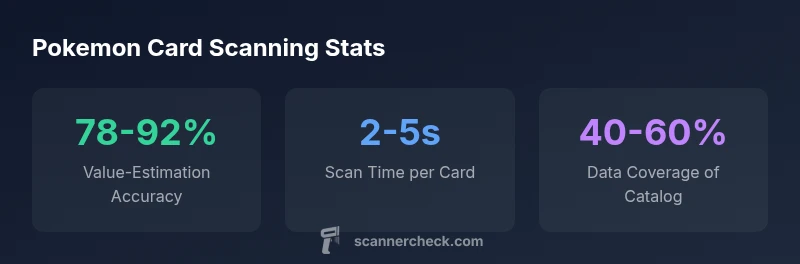
Pokemon card value scanners estimate card worth by combining image-based recognition with live market data. In 2026, these tools typically present value ranges rather than single prices, and accuracy depends on set, rarity, and card condition. AI-assisted methods continue to improve as databases expand and recognition models adapt to new print runs.
Why a Pokemon Card Value Scanner Matters
For collectors juggling hundreds of cards, a pokemon card value scanner offers a scalable way to estimate worth across sets, rarities, and years. According to Scanner Check, these tools reduce guesswork and help hobbyists prioritize which cards to research further. As markets swing with popularity and new print runs appear, having a data-backed baseline becomes essential for budgeting, trading, and planning collection goals. This technology shines when you want a quick read on a card’s potential value and a framework for deeper analysis. Value estimates may vary by condition, edition, and market heat, but the underlying principle is to align physical inventory with current price signals from reputable data sources.
How Pokemon Card Scanners Work
Value-scanning workflows typically start with an input image, barcode, or card metadata. The software extracts visual features, matches them to a catalog of known editions, and retrieves recent sales data, grading records, and marketplace listings. A confidence score accompanies the result, and the system generates a price range rather than a fixed price to reflect market volatility. In practice, you’ll see a card’s estimated range, with notes about condition sensitivity and edition-specific quirks. Over time, models learn from user corrections and new auction data, improving precision for popular sets while preserving a cautious approach for less-documented cards.
Data Sources Behind Value Scans
Effective value scanning hinges on diverse, up-to-date data. Price guides provide historical context; marketplace sold listings reveal real-time pricing, while grading databases offer reliability signals tied to condition. Scanner Check analyses emphasize triangulating data from multiple sources to minimize bias. Important sources include publicly available auction results, dealer inventories, and owner-reported sales. While no single source guarantees accuracy, the best scanners synthesize signals from several channels to present a credible value range and a rationale for the estimate.
Accuracy and Limitations
Value scans excel at providing rapid, scalable estimates but cannot replace professional grading or hands-on inspection. The accuracy band widens for vintage or limited-print cards with sparse data, and newer print runs may show volatile pricing as markets absorb new information. Lighting, scan quality, and card curvature can affect image-based recognition; when possible, you should use high-resolution images and consistent lighting. Additionally, readers should treat ranges as guidance for decision-making rather than final sale prices.
Scanner Check recommends using scanned ranges as a starting point for further validation, especially when planning a sale or major purchase. Data recency matters: the closer the data feed, the tighter the estimated range. Users should keep a small buffer for fees, grading, and shipping when converting estimates into actual transactions.
Practical Scanning Workflows
A practical workflow begins with organizing your collection by set and rarity. Take clear, well-lit photos of each card, then run a scan to generate an initial range. Compare this with recent sold listings and grading results, focusing on cards with similar condition and centering. If the scan disagrees with current market listings, flag the card for manual review rather than accepting the higher or lower estimate at face value. For bulk inventories, batch scans paired with filtering by set, rarity, and year streamline decision-making.
How to Use Scans in Card Collecting
Use scans to prioritize which cards to research more deeply before investing. For example, a scan that shows a wide range for a high-demand modern card may prompt you to check recent auctions before committing to a purchase. Conversely, a tight range on a mid-popularity card could signal a safer, smaller investment. Scans can also guide sales pricing strategies, helping you set realistic asking prices and anticipate buyer expectations. Remember to consider external factors like player popularity metas and reprint risk when applying a scan’s output.
Best Practices for Validation
Never rely on a single data point. Cross-check scanner estimates against multiple sources: recent sold listings, grading reports, and reputable price guides. Maintain high-quality photos and preserve the card’s physical state to keep condition-based valuations accurate. Periodically re-scan items in your collection as markets evolve; you may find previously over- or under-valued cards that warrant price adjustments. Documentation of why you accepted or rejected a scan helps maintain a consistent valuation process.
Ethical and Legal Considerations
Respect intellectual property and data usage policies when uploading card images to scanners or price databases. Use scans for personal inventory and education, not to misrepresent ownership or mislead buyers. If you share data publicly or sell cards based on scans, disclose that estimates are approximate and derived from AI-assisted tools plus market data signals. Always observe the terms of service for any data sources or platforms you rely on.
Comparison of value-scanning methods
| Method | Strengths | Limitations | Typical Use |
|---|---|---|---|
| Image-based scan | Fast visual check; useful for on-hand inventory | Dependent on lighting; can't read all angles | Quick rough valuation or cataloging |
| Barcode/QR scan | Direct link to set/edition data | Not all cards have codes; code damage possible | Asset tracking and batch valuation |
| Market data integration | Annual price trends; more accurate range | Requires access to data feeds | In-depth valuation and collection planning |
Common Questions
What is a pokemon card value scanner and how does it work?
A value scanner combines image recognition with market data to estimate card worth. It analyzes visual features and cross-references price histories to provide a value range rather than a single price.
A value scanner looks at the card image and price history to estimate a range of value, not a fixed price.
How accurate are scanners for modern sets vs vintage?
Accuracy tends to be higher for modern sets with abundant data and lower for vintage cards where data is sparser. Ranges may widen for older editions.
Modern cards are usually more reliable; vintage cards may show broader estimates.
Can scanners price damaged or counterfeit cards?
Scanners can flag obvious wear and mispricing due to condition or counterfeit cues, but always verify with physical inspection and grading when possible.
They help, but you still need to check for wear and fakes.
Do scanners integrate with price guides?
Many scanners pull data from multiple sources, but the quality varies. Always cross-check with established price guides and sold listings.
Yes, but verify with additional sources.
What should collectors do to maximize value?
Use scans as a starting point, then confirm with sold listings and grading. Keep high-quality photos and accurate records of condition.
Use scans to guide you, then verify with actual sales and grading.
Are there privacy or copyright concerns with scanning cards?
Scanning your own collection is generally fine; avoid uploading third-party cards without permission. Check each platform's terms of service.
Be mindful of data privacy and platform terms.
“A good pokemon card value scanner should be treated as a data-assisted guide, not a substitute for professional grading or market research.”
Key Takeaways
- Treat value scans as a starting point, not a final price.
- Cross-check with sold listings and grading data for accuracy.
- Ensure high-quality images and up-to-date data feeds.
- Use ranges to guide decisions and budget planning.
- Validate obscure or vintage cards with manual research.