What If FASTag Scanner Is Not Working? A Practical Troubleshooting Guide
Urgent, practical troubleshooting guide to diagnose and fix a FASTag scanner that won't read, including step-by-step fixes, diagnostic flow, safety tips, and prevention.


This troubleshoot guide shows that the most likely cause for a non-working FASTag scanner is a power or connection fault, not a malfunctioning tag. Start with a quick reboot, verify power supply and data cables, and re-connect every connector. If that doesn't help, follow the diagnostic flow and targeted fixes in the BODY to identify the exact fault and prevent repeats.
what if fastag scanner is not working
When a FASTag scanner fails to read a tag, it is almost always a field issue rather than a bad tag. The Scanner Check team has analyzed dozens of failures and found that power or connection faults top the list of culprits. This section unpacks the problem in plain terms, so you can respond quickly at the toll plaza or service desk. Expect to encounter a few common symptoms: no response from the reader, intermittent reads, or an error message on the scanner’s display. The goal is to isolate whether the fault is electrical, mechanical, software-based, or related to the tag itself. By tackling root causes first, you avoid wasted trips and unneeded tag replacements. Keep safety in mind and proceed methodically.
Quick checks you can do before calling support
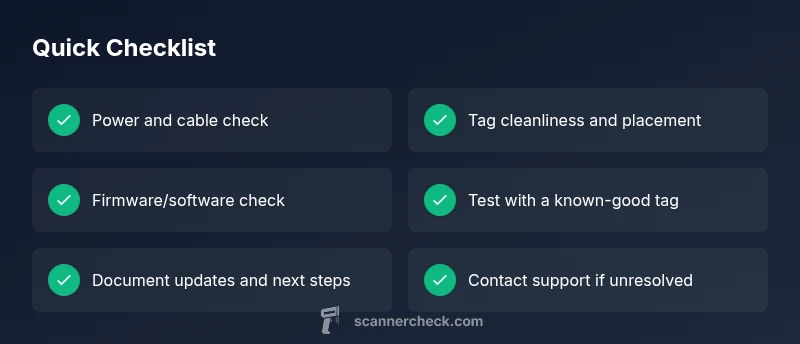
Most issues are resolved with a disciplined, low-risk approach. Start with the basics and work outward. Check that the scanner is powered and that all power indicators show normal status. Inspect the power cable, data cable, and any adapters for looseness or visible damage. Re-seat connectors firmly and ensure no corrosion or dirt touches the contacts. If possible, test the same scanner with a known-good tag to confirm whether the fault lies with the tag or the reader. Document any error codes or lights to share with support. Finally, perform a simple reboot or reset if the device allows it. These steps are quick, non-destructive, and often fix the majority of faults. Scanner Check recommends keeping a small log of each test for future reference.
Common failure modes and how to spot them
Understand the patterns: (1) Permanent no-read state with steady power often points to power or sensor faults; (2) Intermittent reads can indicate loose cables, dirty contacts, or environmental interference; (3) Incorrect or delayed reads may reflect firmware or software conflicts; (4) Physical damage to the reader or antenna usually requires replacement. Differentiating these modes helps you direct your actions efficiently. Early detection of environmental factors—like rain, heat, or dust—can also explain sudden changes in performance. Always verify that the tag is clean and correctly placed on the windshield or mount.
Diagnostic flow overview
A structured diagnostic flow prevents guesswork. Start with symptom confirmation, then check for power and connectivity, followed by tag condition, then firmware/software status. If the symptom persists, escalate to more advanced checks such as reader calibration, antenna alignment, or a test with alternate hardware. The flow ends with a recommended action step: fix, update, replace, or seek professional support. This approach minimizes downtime and ensures you consider all plausible causes. According to Scanner Check, following a defined diagnostic flow reduces unnecessary replacements and speeds up resolution.
Firmware and app considerations
Firmware or software mismatches can cause a reader to misinterpret or fail to recognize a tag. Check for the latest firmware version or software driver compatible with your scanner model. If available, perform an in-place upgrade or rollback to a stable release. Ensure the scanner is communicating with the central system as expected; verify network connectivity if the reader relies on cloud-based validation. Some issues are resolved by re-enrolling the tag in the system or re-assigning its account. Avoid performing updates during peak traffic hours to prevent partial outages.
Environmental and usage tips to prevent issues
Preventive care reduces recurring faults. Keep the scanner enclosure clean and free from dust that can obstruct sensors. Ensure proper mounting and minimize vibration that could loosen connections. Use surge protection and a stable power supply to prevent voltage dips. Regularly inspect cables for wear and replace damaged parts promptly. Train staff to handle the device correctly—gentle connector seating, anti-static precautions, and avoiding excessive force when plugging or unplugging. Consistent maintenance creates a reliable scanning experience.
When to escalate to professional support
If basic checks and firmware updates do not restore correct operation, escalate promptly. Document all steps taken, error codes, and the exact environment (toll booth, weather, and time). Professional support may involve tester tooling, calibration, or hardware replacements that exceed routine troubleshooting. Do not operate a visibly damaged reader; shut it down safely and arrange specialist service. The goal is to restore service with minimal downtime and clear records for future troubleshooting.
Preventive maintenance checklist
- Schedule quarterly inspections of power and data cables.
- Keep firmware up to date and maintain a changelog of versions.
- Clean tag surfaces and ensure proper mounting geometry.
- Train operators on safe handling and reboot procedures.
- Maintain a spare parts kit for common wear items (cables, connectors, fuses).
- Create a quick-reference guide with error codes and next steps.
- Log recurring faults to identify pattern-based issues early.
Steps
Estimated time: 20-25 minutes
- 1
Power cycle and verify basics
Disconnect the scanner from power, wait 30 seconds, and reconnect. Check that the power indicator lights up as expected and that any status LEDs show normal activity. If the device has a reset option, perform a soft reset as instructed by the user manual.
Tip: Document the exact power-on sequence you used for reference. - 2
Inspect and reseat cables
Unplug and re-seat the power and data cables at both ends. Look for wear, frills, or bent pins. If possible, swap in known-good cables to rule out a faulty lead.
Tip: Never yank cables; use the connector grips and avoid twisting. - 3
Clean the tag and contact surfaces
Wipe the FASTag tag surface with a clean microfiber cloth; avoid liquids. Ensure the tag is properly aligned with the reader’s antenna and not covered by the windshield mount or debris.
Tip: Use a dry microfiber only; moisture can cause read errors. - 4
Update firmware/software
Check the vendor site or device UI for firmware updates. Follow on-screen prompts to install, then reboot and re-check tag reads. If a rollback option exists, test stability with the previous version.
Tip: Back up configuration before updating when possible. - 5
Test with a known-good tag
Try a tag that is confirmed working in a different lane or reader. If it reads there but not in this unit, the issue is likely device-specific. If it still fails, move to hardware inspection.
Tip: Keep a log of which tags worked where for future routing decisions. - 6
Document and escalate if needed
Record error codes, date/time, environment (weather, traffic), and steps taken. If the problem persists after all fixes, contact support with your diagnostic notes for faster resolution.
Tip: Include a snapshot of LED indicators and recent firmware version.
Diagnosis: FASTag scanner won't read at toll plaza or shows error
Possible Causes
- highPower issue or faulty adapter
- mediumLoose or damaged data cables
- mediumTag unreadable due to dirt/wear
- lowOutdated firmware or software conflict
Fixes
- easyInspect and reseat power supply and data cables; replace if damaged
- easyPower cycle to reset the scanner
- easyClean the FASTag tag gently with microfiber and reapply
- mediumUpdate firmware or software to latest version
- hardIf still failing, test with a known-good tag or consult support
Common Questions
What is a FASTag scanner and how does it work?
A FASTag scanner is a reader that communicates with RFID tags embedded in FASTag, allowing automatic toll collection. It verifies tag data and authorizes the transaction. If the reader fails, the toll plaza may require manual payment or tag replacement. Routine checks and firmware updates often prevent common failures.
A FASTag scanner reads an RFID tag to pay tolls automatically. If it stops reading, try basic checks or firmware updates; otherwise contact support.
Why won't my FASTag scanner read at toll plazas?
Several factors can cause a read failure: power or cable issues, a dirty or damaged tag, firmware conflicts, or antenna misalignment. Start with power checks and re-seating cables, then test with a known-good tag. If issues persist, update firmware or consult support.
Common causes are power or connection problems, tag cleanliness, or firmware conflicts. Start with basic checks and then escalate if needed.
Should I replace the tag if the scanner won't read?
Tag replacement is typically a last resort. First validate the reader, clean the tag, and test with another tag. If all else fails, check account status and replacement options with the issuer.
Usually you try fixes first; replacing the tag is a last resort after reader checks fail.
Can software updates fix scanner reading problems?
Yes, firmware or software updates can resolve compatibility and fault conditions. Always ensure you’re on the latest stable version, and back up settings before updating. If the problem continues after updates, proceed with more diagnostics or professional support.
Firmware updates can fix lots of issues; make sure to update carefully and test afterward.
When should I contact support for a FASTag scanner issue?
If you’ve exhausted power checks, cable reseating, tag cleaning, and firmware updates without resolution, contact support. Provide error codes, environment details, and a summary of steps taken to speed up diagnosis.
If basic fixes don’t work, reach out to support with your notes.
Is there a safety risk when troubleshooting FASTag scanners?
Yes—work with the device powered down when inspecting cables. Avoid contact with live electrical parts and use insulated tools if necessary. Follow manufacturer safety guidelines to prevent shocks or damage.
Yes. Always power down before inspecting, and use proper safety practices.
Watch Video
Key Takeaways
- Check power and cables first—most failures start here
- Follow a diagnostic flow to avoid guesswork
- Update firmware and test with known-good tags
- Escalate to professionals when needed to prevent downtime