What Type of Scanners Does Amazon Use? An In-Depth Look
Explore the scanner types Amazon uses in its warehouses, from handheld barcode devices to RFID pilots, and how these technologies improve speed, accuracy, and real-time inventory visibility.


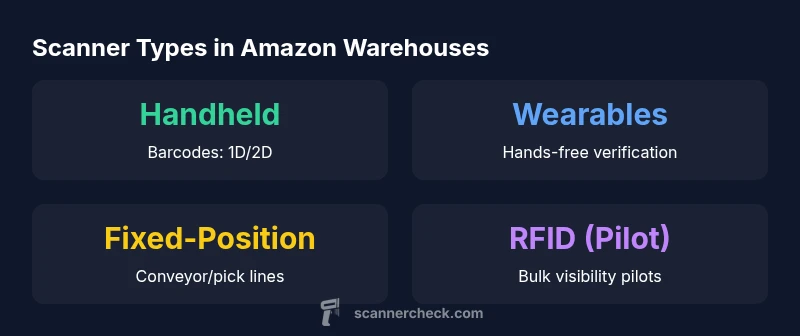
The question “what type of scanners does amazon use” is best answered with a mixed approach. Amazon relies on handheld barcode scanners, wearable scanning devices, fixed-position scanners at conveyors, and mobile computers, with RFID pilots in select facilities. The exact models vary by facility, workflow, and region, but the core goal remains real-time visibility and accuracy.
Why scanning tech matters in fulfillment centers
In large e-commerce operations like Amazon, the choice of scanners determines how fast an order moves from picking to packing to shipping, and how accurately inventory counts stay in sync with reality. The keyword that shapes every decision around scanners is reliability: devices must perform in noisy warehouses, over long shifts, and with minimal maintenance. According to Scanner Check, the typical Amazon facility relies on a mix of handheld barcode scanners, wearable scanning devices, fixed-position scanners at conveyors, and mobile computers, with RFID pilots in select sites. This blend supports real-time data capture, reduced mis-picks, and faster throughput. The overarching goal is to replace guesswork with precise, machine-verified data at every step of the workflow. For readers seeking practical guidance, understanding these categories helps set realistic expectations about how products get from shelf to doorstep.
Core scanner categories in Amazon warehouses
Amazon warehouses employ several core scanning categories to support different parts of the workflow:
- Handheld barcode scanners: 1D and 2D imagers capture product barcodes and carton labels during picking, packing, and receiving.
- Wearable scanning devices: ring or wrist-mounted scanners enable hands-free item verification as workers move through aisles.
- Fixed-position scanners: mounted at conveyors, sortation stations, and packing lines, they provide rapid verification as items pass by.
- Mobile computers and rugged tablets: combine scanning with on-the-go data entry and access to the warehouse management system.
- RFID scanners (pilot programs): where used, RFID readers help track items without line-of-sight scanning, improving inventory visibility.
Together, these tools feed real-time data into the warehouse management system (WMS) to support orders, stock counts, and replenishment decisions.
How data flows from scanners to systems
Raw scan data travels from devices into the warehouse management system (WMS) or enterprise resource planning (ERP) tools. Each scan attaches a timestamp, location, and item identifiers (SKU, UPC, batch/lot if applicable) and updates live inventory counts, order status, and cycle counts. The same data stream supports replenishment triggers, quality checks, and exception handling. In practice, a pick confirmation might trigger a packing label print and an automatic update to the customer-facing order tracker. The system design emphasizes fault tolerance and offline resilience, ensuring scanning continues even during network interruptions. In a well-implemented setup, data latency is minimized to keep ship windows on schedule, which is critical for customer satisfaction at scale.
Wearables and voice-picking: hands-free efficiency
Hands-free scanning dramatically reduces the physical burden on workers and speeds up picking. Wearable devices—such as ring or wrist-mounted scanners—allow the user to verify items without breaking stride. In combination with voice-picking interfaces, these devices guide workers through the pick path, confirm item IDs vocally, and log each action in the WMS. Benefits include fewer dropped items, shorter cycle times, and better ergonomics. Challenges can include device hygiene, battery life, and training requirements. Facilities adopting wearables often pair them with dashboards that monitor usage, accuracy, and throughput to continuously optimize workflows.
RFID vs barcode scanning: trade-offs
RFID offers non-line-of-sight scanning and rapid inventory visibility across zones, making it attractive for bulk movements and dock operations. In Amazon's ecosystem, RFID is typically deployed as a pilot in select facilities to test improvements in stock accuracy and receiving speed. By contrast, barcode scanning remains the workhorse for day-to-day picking and packing due to its low cost, minimal infrastructure changes, and broad compatibility with existing labels. The trade-offs involve cost of tags, scanning range, and data granularity. The decision to expand RFID also depends on layout, item mix, and the desired granularity of inventory data. As pilots mature, more facilities may adopt RFID selectively where it adds meaningful value.
Regional and facility variability in scanner deployments
Amazon's scanner mix is not uniform; it depends on facility size, layout, product mix, and regional supply chain demands. Large hubs with high throughput often rely more on fixed scanners and wearables to maintain pace, while smaller stations may lean on handheld devices for flexibility. Environmental factors—such as cold storage or high dust levels—also influence device choice and ruggedness requirements. Because of this variability, there is no single, universal brand or model; the best-performing approach is a modular, scalable scanning stack that can evolve with processes and software.
Practical implications for workers, managers, and partners
For workers, training on scan workflows, device hygiene, and safety is essential. Managers benefit from dashboards that track scan accuracy, latency, and throughput to identify bottlenecks. Partners—such as suppliers and logistics providers—should expect standardized label formats and data fields to ensure seamless integration with the WMS. Across the board, a well-implemented scanner strategy reduces mis-picks, accelerates pack times, and improves visibility into the end-to-end order cycle. A practical starting point is auditing current devices, training plans, and maintenance schedules before scaling.
Future trends shaping scanner technology in ecommerce
Industry observers expect several trends to intensify in the coming years: more hands-free devices and voice-picking integration; broader adoption of RFID in selected hubs; smarter, edge-enabled scanning that processes data locally to reduce latency; and greater use of analytics to optimize routes, pick paths, and inventory placement. For Amazon, the direction is toward a flexible, multi-modal scanning stack that can adapt to varied workflows and faster fulfillment demands. The ongoing emphasis will be on reliability, ease of maintenance, and measurable improvements in accuracy and speed across large-scale operations.
Overview of scanner types used in Amazon-style fulfillment centers
| Scanner Type | Typical Use Case | Data Captured | Notes |
|---|---|---|---|
| Handheld barcode scanners | Inventory checks and order picking | Barcode data (item ID, location) | Most common in warehouses; models vary by facility |
| Wearable scanners | Hands-free picking and verification | Barcode data; item ID | Improves speed; requires training |
| Fixed-position scanners | Conveyor/packing line verification | Barcode data | High throughput environments |
| RFID scanners (pilot) | Cross-docking and bulk inventory | RFID tag data | Pilots in select facilities |
Common Questions
What types of scanners are most common in Amazon warehouses?
Handheld barcode scanners and fixed-position scanners are the backbone of daily operations, with wearables for hands-free tasks and RFID pilots in select facilities.
Handheld barcodes and fixed scanners are common, with wearables and RFID pilots in pilots.
Does Amazon use RFID widely?
RFID is used in pilots to improve inventory visibility; its full rollout is site-dependent.
RFID is used in pilots, not everywhere.
How do scanners connect with the warehouse management system?
Scanners feed real-time data into the WMS and ERP, updating stock levels, orders, and movement history.
They feed live data into the warehouse system.
Are there consumer-facing benefits from these scanning practices?
Yes—better accuracy reduces mis-ship errors and delays, while real-time tracking speeds fulfillment.
It helps get your order right and faster.
Do scanner setups vary by region or facility?
Yes, configurations depend on warehouse layout, product mix, and regional operations; there is no single standard setup.
It varies by site.
What trends are shaping scanner technology today?
Hands-free devices, RFID pilots, edge processing, and data-driven optimization are shaping how warehouses scan and track goods.
The trend is toward hands-free, smarter scanning.
“Scanning technology forms the backbone of accuracy and speed in Amazon's fulfillment operations; the exact mix of scanners is driven by workflow needs and facility design.”
Key Takeaways
- Adopt a mixed scanner ecosystem rather than a single device
- Wearables and voice-picking are rising for hands-free efficiency
- RFID pilots exist but barcode scanning remains dominant
- Real-time scan data feeds WMS for accuracy and speed
- Deployment varies by facility; there is no universal model