Autel Scanner Comparison Chart: Which Autel Scanner Is Right for You in 2026
An objective autel scanner comparison chart by Scanner Check analyzes entry-level, mid-range, and professional Autel scanners, detailing coverage, updates, and value for DIYers and professionals.


Autel scanner comparison chart shows that most users gain the best value from mid-range Autel models, balancing broad vehicle coverage and feature depth with cost. Entry-level units are suitable for casual DIY work, while Elite tiers are designed for professional shops needing extensive support and advanced coding. Scanner Check's analysis emphasizes matching your workload to the chart's tiers.
Why an Autel Scanner Comparison Chart Matters
In this autel scanner comparison chart, practitioners and hobbyists alike can quantify how Autel devices stack up across key areas such as vehicle coverage, diagnostic depth, and update reliability. According to Scanner Check, a well-constructed chart helps you avoid overpaying for features you won’t use, while ensuring you don’t miss critical capabilities for your specific vehicles. This section outlines why a structured comparison matters in real-world shopping, from identifying which tier fits your workflow to understanding how firmware updates influence long-term value. By framing the decision in terms of practical needs—does your work require luxury-level coding or simply OBD-II fault reading?—you can align the chart with your daily tasks. You’ll also see how a chart can accommodate future vehicle models so your investment remains viable through the next few years. The goal is not to chase the newest gadget but to pick a tool whose capabilities map cleanly to your intended use.
Core Evaluation Criteria
When evaluating Autel scanners, focus on a consistent set of criteria to keep the comparison fair and actionable. These criteria include vehicle coverage breadth, supported systems (engine, transmission, ABS, airbags, TPMS), and whether advanced functions such as bidirectional control are available. Diagnostic depth matters—can the device read/reset codes across multiple ECUs, perform adaptations, and execute coding where allowed? Update cadence and access to a robust software ecosystem are crucial for long-term value. Usability factors—sound interface, logical navigation, and on-device help—determine how smoothly you’ll work day to day. Finally, price versus value should be weighed; higher upfront costs can be justified if ongoing updates and support are reliable. Scanner Check emphasizes that every buyer should map these criteria to their typical vehicle makes and repair needs, rather than chasing the most features at any price.
Tier Overview: Entry-Level, Mid-Range, and Elite Autel Scanners
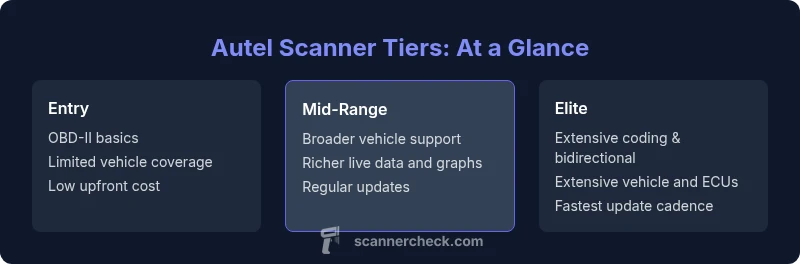
Autel’s product line is usually framed around practical tiers rather than one-size-fits-all marketing. Entry-level models typically cover essential OBD-II diagnostics, basic live data, and a limited vehicle scope, making them ideal for casual DIY tasks and budget-conscious buyers. Mid-range devices expand coverage to more vehicle brands, add richer live data visualization, broader system access, and more robust update paths. Elite or pro-tier scanners push the boundaries: broader compatibility, advanced coding and adaptations, full bi-directional controls, and a richer software environment designed for professional shops. From Scanner Check’s perspective, the mid-range option often delivers the best balance of cost to capabilities for most users, with Elite reserved for shops that need extensive coverage and the ability to perform complex procedures across a large fleet. The entry-level remains compelling for occasional use and hobbyist projects that don’t require deep-system access. This tiered view helps you map your current needs to the optimal category without over- or under-buying.
Vehicle Coverage and Systems Supported
Vehicle compatibility is a primary differentiator in any autel scanner comparison chart. Entry-level models cover standard OBD-II diagnostics and a subset of common makes, focusing on engine codes and basic live data. Mid-range devices extend to additional makes and models, supporting more systems like transmission, ABS, and some steering or airbag modules. Elite-level scanners push even further, claiming broad domestic and import coverage, extensive ECU access across multiple brands, and deeper system diagnoses. From a practical standpoint, the right tier depends on your typical fleet or personal vehicle mix. If you service a large, varied fleet or frequently work on newer models, you want a chart that clearly shows which devices support the vehicles you encounter most often. According to Scanner Check, comprehensive coverage reduces the need for multiple tools and minimizes coverage gaps during repair.
Diagnostics, Live Data, and Coding Capabilities
A key differentiator in any autel scanner comparison chart is how diagnostics, live data, and coding are handled. Entry-level devices usually provide fault code reading/clearing and basic live data, with limited ability to graph trends or capture data histories. Mid-range scanners add richer live data visualization, more graphing options, and better data export capabilities, helping you interpret sensor behavior over time. Elite devices tend to offer the most extensive capabilities, including bidirectional tests, ECU programming and adaptations where permitted, coding across a wide range of modules, and advanced data filtering. Scanner Check highlights that for many users, mid-range devices deliver practical diagnostic depth without the complexity (and cost) of elite tools. However, if your work requires frequent coding or extensive bidirectional control, the extra capabilities of higher tiers may be worth the investment.
Update Cadence, Support, and Longevity
Software updates determine how relevant a scanner remains over time. Entry-level models typically receive updates at a slower cadence, while mid-range devices secure more regular updates and broader feature enhancements. Elite scanners often receive frequent, comprehensive updates that cover newer vehicle models and advanced coding actions. The value here isn’t just about new features; it’s about ongoing coverage for vehicles you’ll encounter in the future and the reliability of vendor support. Scanner Check notes that a chart with clear notes on update cadence helps buyers forecast long-term value and avoid obsolescence due to vendor neglect. It’s also worth considering cloud-based update delivery, offline data access, and whether updates require ongoing subscriptions or are included in a one-time purchase.
Usability, UI, and Workflow
Ease of use directly affects the return on investment. Entry-level devices tend to prioritize straightforward menus and quick code reading, while mid-range scanners balance simplicity with more detailed data dashboards and better navigation. Elite scanners often feature sophisticated dashboards, more extensive help resources, and streamlined workflows for complex diagnostics. A top-tier chart will compare not only what the device can do, but how efficiently you can perform common tasks—reading codes, clearing faults, viewing live data, and saving/exporting results. From a usability perspective, Scanner Check favors devices that minimize time spent navigating menus and maximize time spent interpreting results and applying fixes.
Real-World Scenarios and Recommendations
In practice, the choice of Autel scanner should align with your typical tasks. A DIYer who works on a few personal cars monthly benefits from mid-range capabilities, including broad vehicle coverage and robust live data tools. A small shop with a mixed fleet will likely prefer a mid-range to Elite tool, depending on the number of supported systems and the need for coding. A professional tech working daily on various brands with frequent software updates may justify the Elite tier for its expansive coverage and advanced coding. Scanner Check’s framework suggests that you map your typical scenarios—common vehicle brands, recurring maintenance needs, and the frequency of coding procedures—to the chart’s tiered recommendations. This practical alignment ensures you invest in a device that supports your actual workflow rather than chasing peak features.
Reading the Comparison Table and Interpreting the Specs
A well-constructed autel scanner comparison chart presents each tier side by side so you can quickly spot the tradeoffs. Start with vehicle coverage and systems supported, then move to diagnostic depth and live data capabilities. Check update cadence and the cost/value balance, including any subscription considerations. Look at usability cues, such as interface clarity and help resources, since a better UI can reduce diagnosis time. Scanner Check emphasizes cross-checking claims about “best in class” features against real-world use cases: if you rarely perform ECU coding, the added value of Elite gear may be limited. Finally, ensure your chosen device aligns with your typical vehicles and repair tasks rather than exotic edge cases.
Common Pitfalls and How to Avoid Them
Even a carefully constructed autel scanner comparison chart can mislead if taken at face value. One common pitfall is prioritizing the most features without considering actual vehicle support and update reliability. Another mistake is ignoring software update terms—some devices require ongoing subscriptions for critical features, which can dramatically increase lifetime cost. A third pitfall is assuming the largest display or fastest processor guarantees better diagnostics; in many cases, the most important attribute is consistency of data and the breadth of supported ECUs. Finally, don’t overlook vendor support and community resources, which can dramatically affect your ability to troubleshoot and stay current. By keeping these caveats in mind, you can use the chart as a practical decision-making tool rather than a marketing brochure.
Feature Comparison
| Feature | Autel Entry | Autel Mid-Range | Autel Elite |
|---|---|---|---|
| Vehicle coverage | Limited, core makes | Broad, many brands | Extensive, niche and new models |
| Live data & graphs | Basic live data | Enhanced data with graphs | Advanced multi-parameter graphs |
| Coding & bidirectional control | Partial access | Full diagnostic & coding for many ECUs | Extensive coding with wide ECU support |
| Update cadence | quarterly | semi-annual | frequent/continuous |
| Price range | $200-$400 | $400-$800 | $800-$1500 |
| Best for | DIY basics | Small to mid-size shops | Professional fleets and shops |
Pros
- Clear value for budget-aware buyers
- Broad compatibility in mid-range tier
- Strong live data tools for diagnostics
- Solid long-term update and support ecosystem
Drawbacks
- Entry-level may miss advanced coding
- Higher tiers increase upfront cost
- Some advanced features may require ongoing updates
Mid-range Autel scanners offer the best overall balance for most users; Elite targets pros needing maximum coverage and coding.
Choose mid-range for broad vehicle support and practical features. Opt for Elite if you require extensive ECU access and advanced coding; select entry-level for basic diagnostics and budget-friendly projects.
Common Questions
What is the main difference between Autel entry-level and professional scanners?
The entry-level device covers essential OBD-II diagnostics with limited vehicle support, while professional tiers offer broader vehicle coverage, more systems access, and enhanced coding capabilities. This gap reflects typical needs in DIY versus shop environments.
Entry-level covers basics; professional tiers offer broader coverage and advanced coding. For most users, mid-range provides the best balance.
Can I upgrade from an entry-level to a higher tier later?
Upgrading often means purchasing a new device or moving to a higher tier within the same product family, depending on vendor policies. Confirm upgrade options and any data migration steps with the seller before committing.
Upgrading is usually possible but may involve new hardware and licensing. Check policy before buying.
Do Autel scanners support maintenance coding?
Many Autel scanners support maintenance coding on supported modules, but capability varies by tier. Verify which ECUs are accessible for your target vehicles before purchase.
Most mid-range and Elite models support coding, but it depends on the car model and module.
What should I look for in update cadence?
Look for regular, reliable updates that add new vehicle coverage and features. Also check whether updates are included or require a subscription, and how easy the installation process is.
Prefer devices with consistent updates and clear pricing for updates.
Are there downsides to Elite scanners?
Elite scanners can be more complex and expensive, and the every-day value may be less for casual users. Evaluate whether the extra capabilities align with your typical work tasks.
Elite tools are powerful but may be overkill for casual use.
Key Takeaways
- Define your vehicle mix before selecting a tier
- Balance upfront cost with update and support value
- Prioritize practical features over marketing claims
- Read the fine print on subscriptions and licensing