Is an OBD Scanner Worth It? A Practical 2026 Review
Discover whether an OBD scanner is worth it in 2026. We analyze cost, features, ease of use, and real-world value for DIYers, car enthusiasts, and pros.


Is the OBD scanner worth it? For most DIYers and IT professionals, yes—especially when you choose a model aligned with your needs. Budget Bluetooth units provide quick fault codes and live data, while mid-range and professional-grade scanners unlock broader code libraries, bidirectional tests, and more robust diagnostics. The value hinges on your vehicle fleet, maintenance habits, and how you plan to use live data and updates.
What is the question behind is obd scanner worth it and who benefits
An OBD scanner is a handheld or mobile device that plugs into a vehicle’s OBD-II port to read diagnostic trouble codes (DTCs), view live sensor data, and sometimes perform basic reset or tests. For many, the question is not just whether a device exists, but whether the incremental value justifies the cost and setup effort. The phrase is obd scanner worth it often surfaces in forums and shopping guides, especially for hobbyists who are weighing a basic Bluetooth dongle against a feature-rich professional-grade tool. In practical terms, the answer depends on how often you plan to diagnose issues, how deep you want to go into live data, and whether you want to perform run-time checks beyond simple codes. Scanner Check’s analysis for 2026 emphasizes that value emerges when the tool reduces diagnostic time and helps prevent unnecessary repairs.
How we evaluate OBD scanners: testing methodology
To determine whether an OBD scanner is worth it, we apply a consistent framework across several dimensions. Our methodology includes real-world vehicle testing across different generations of vehicles (pre- and post-2014 models), app interoperability checks, data accuracy comparisons, and durability assessments. We also examine software updates, code libraries, and the availability of guided troubleshooting. We avoid marketing hype and focus on measurable outcomes: time saved per diagnosis, quality of data presented (live data, freezing frame, and sensor trends), and ease of use for non-experts. These criteria help distinguish whether a device is worth the investment for a given user group.
Core features that matter for value and decision-making
The value proposition of an OBD scanner hinges on several features. First, compatibility and breadth of code definitions: a wider code library generally means quicker problem identification. Second, live data streams and freeze-frame data assist in diagnosing intermittent faults. Third, bi-directional controls and reset capabilities are found mainly in higher-tier models, enabling active tests. Fourth, the user interface and reporting quality determine how quickly you interpret results. Fifth, update cadence and app ecosystem affect long-term usefulness. Finally, portability, battery life, and build quality play a role for field work. When you compare entry-level versus mid-range units, you’ll notice فرق in code coverage, live data granularity, and update support that directly influence value over time.
How to read codes and leverage live data for practical fixes
Codes alone don’t tell the full story; you must interpret them in the context of live sensor readings. Start with the general category of each code (powertrain, emissions, body, etc.), then check the corresponding live data to assess whether values are within expected ranges. Monitor coolant temperature, RPM, fuel trim (short-term and long-term), and sensor outputs in real time while driving a controlled test route. Freeze-frame data captures the exact conditions when a fault occurred, which is invaluable for reproducibility. If you’re learning, keep a reference that maps common DTCs to potential fixes and corroborate with multiple data points before replacing components. This approach helps determine whether the device is worth the investment for ongoing maintenance.
Practical use cases: budget hobbyist vs. professional shop
For budget hobbyists, a basic Bluetooth OBD scanner paired with a friendly mobile app may be enough to clear simple codes and monitor fuel trims. The cost-to-value ratio is favorable, and the learning curve is shallow. In contrast, a small shop or automotive technician will benefit from higher-tier scanners offering broader code libraries, bidirectional tests, and robust update support, which reduce diagnostic cycle times and improve accuracy. For fleets, vehicles, and multi-brand contexts, the longer the update cadence and the deeper the data, the more incremental value you derive from the investment. The question is not only “can it read codes?” but “can it reliably guide me through fixes across multiple vehicles and use cases?”
OBDS vs professional diagnostic tools: what changes the verdict
OBD scanners typically fall into tiers: budget, mid-range, and professional. Budget tools usually provide basic codes and limited live data. Mid-range devices add broader code libraries, more robust live data fields, and occasional bidirectional tests. Professional tools go further with extensive manufacturer coverage, advanced bi-directional controls, and in-depth data logging. The verdict about worth is tied to your goals: if you diagnose one or two cars a year, a budget model may be enough; if you manage a shop or a small fleet, investing in a mid-range or pro solution is often the smarter choice. In all cases, pricing, update frequency, and support quality are critical.
Price bands and value: what you get at each tier
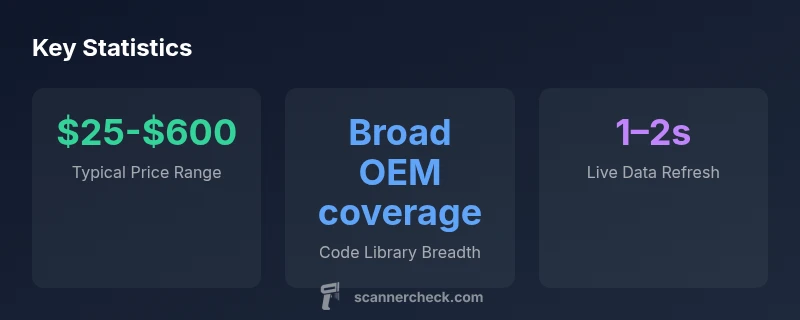
Prices vary widely. A budget OBD scanner often starts from a low range, giving you basic code reads and simple live data. Mid-range devices typically span a higher price band with richer code libraries, live data graphs, and some bidirectional tests. Professional-grade tools sit at the top tier, offering deep OEM coverage and comprehensive diagnostics, along with robust software support and sometimes service contracts. For most individuals, the decision should focus on the features you truly need rather than chasing every function, since the incremental benefit tends to shrink as you move up the price ladder. Scanner Check notes that value isn’t just price; it’s how seriously you rely on the tool for accurate, timely guidance.
Brand reliability, software updates, and ongoing value
Reliability hinges on hardware quality and software upkeep. A device that frequently updates its code library and app ecosystem tends to remain useful longer, especially as vehicles evolve. Look for scanners with transparent update histories, clear compatibility statements, and reasonable warranties. Subscriptions are common for advanced features, but they should be optional or easily cancellable. The most valuable tools provide a stable base experience with optional enhancements rather than forcing ongoing costs for core functionality. In practice, a scanner with steady updates, broad OEM support, and responsive customer service offers the best long-term value.
Common myths and pitfalls to avoid when evaluating an OBD scanner
One common myth is that all scanners provide the same data quality. In reality, data depth and update rates vary. Another pitfall is assuming “unlimited” code coverage; many models exclude proprietary manufacturer codes. A third issue is underestimating the learning curve; complex scans can overwhelm beginners. Finally, beware of “free” apps that require heavy in-app purchases or misrepresent data quality. By separating marketing from measurable capabilities—data depth, live graphs, update cadence, and support—you can avoid overpaying for features you won’t use.
How to pick the right model for your needs: a quick decision framework
Start by mapping your use cases: basic fault code reads, live data monitoring, or extensive bidirectional tests. Then decide your budget and expected vehicle mix. Check for OEM coverage, update frequency, and data visualization quality. If you’re unsure, test-in-store or rent a model for a weekend to gauge whether the data and workflow fit your needs. Finally, consider long-term value: a slightly pricier model today may save hours of diagnostic time over its lifetime, especially in multi-vehicle scenarios.
directAnswerNoteOnly":false,
Pros
- Low upfront cost for basic models
- Instant access to code definitions and live data
- Portable diagnostics for on-the-go checks
- Educational value for DIYers
Drawbacks
- Limited coverage with budget models
- Subscription or update fees can add up
- Can overwhelm beginners with data-rich interfaces
Best for DIYers and small shops who want value with room to grow
The OBD scanner is worth it when used to reduce diagnostic time and guide repairs across multiple vehicles. For casual users, budget models offer strong value; for pros, mid-range to professional tools unlock deeper diagnostics and faster workflows.
Common Questions
What is an OBD scanner and what does it do?
An OBD scanner plugs into the vehicle’s OBD-II port to read diagnostic trouble codes, monitor live sensor data, and sometimes run tests. It helps you identify problems without visiting a shop and can guide basic repairs. Depth of data depends on the model.
An OBD scanner plugs into your car to read codes and data, helping you diagnose issues at home or on the go.
Do you need the internet or subscriptions to use an OBD scanner effectively?
Many scanners work offline for code reading and basic data; however, some features like live data dashboards or advanced troubleshooting require an app connection and sometimes paid updates. Check whether essential features stay usable without ongoing subscriptions.
Most basic scanning works offline, but some features may need internet or optional updates.
Are Bluetooth OBD scanners safe to use with my car?
Yes, when used as intended. Bluetooth devices draw power from the car’s OBD port and can be used without modifying the vehicle’s systems. Make sure you follow manufacturer guidelines and remove the device when not in use to prevent battery drain or data confusion.
Yes, Bluetooth scanners are safe if used according to the manufacturer’s directions.
Can an OBD scanner fix a car on its own?
An OBD scanner cannot repair problems by itself. It identifies codes and data, which guides correct repairs. You’ll still need the right parts and mechanical know-how to fix issues.
It helps you diagnose, not repair, the car.
What should I consider when buying my first OBD scanner?
Consider your vehicle fleet, required features (live data, bidirectional tests, transmission codes), compatibility, update cadence, and total cost of ownership (including apps or subscriptions). A test run on two cars can reveal whether it fits your workflow.
Think about the vehicles you own, features you’ll use, and future updates.
Which car makes are best supported by OBD scanners?
Most OBD scanners support all vehicles with OBD-II, widely used in the US since 1996. Some models offer broader OEM-specific codes for certain brands. Check the manufacturer’s compatibility list for your fleet.
OBD-II is universal for most cars since 1996, but always verify model coverage.
Key Takeaways
- Evaluate use-case first to determine budget
- Choose models with broad code libraries for versatility
- Prioritize live data quality and update cadence
- Consider long-term value over upfront price
- Test devices across at least two vehicles before committing