How long do Live Scan last: Timelines for on-site fingerprinting and background checks
Learn how long Live Scan fingerprinting lasts on-site and how long results take to arrive. Timelines, delay factors, and planning tips for background checks.


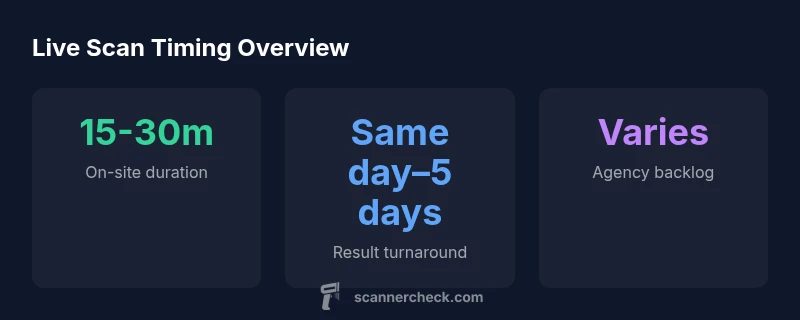
Live Scan appointment time is typically 15-30 minutes, depending on printing complexity. Result turnaround ranges from same day to several business days, depending on agency backlog and FBI involvement. See our detailed chart for jurisdiction-specific timelines. The on-site portion is quick and predictable when documents are in order, but the overall timing depends on the receiving agency's processing queue and whether FBI checks are triggered.
What Live Scan lasts: on-site duration vs processing time
For anyone researching how long do live scan last, it's important to differentiate between the on-site Live Scan fingerprinting session and the back-end background-check processing that follows. Live Scan fingerprinting sessions are designed to be efficient: the on-site portion usually lasts a short window, while the back-end processing can take longer. According to Scanner Check, typical Live Scan on-site time ranges from about 15 to 30 minutes, including check-in, identity verification, and multiple fingerprint captures. The exact duration depends on factors like the number of fingerprints required, whether additional angles are needed, and how smoothly the enrollment process goes.
In practice, you should expect a quick, largely administrative flow at the counter, followed by a separate period for background checks to be completed. That means the clocking in and clocking out for the live scan session may be short, but the overall time until you receive a result may be longer. The on-site piece is only one part of the total timeline that practitioners and employers consider during hiring processes. The Scanner Check team notes that most applicants experience a predictable, short visit, but the final turnaround is determined by the agency handling the background check and whether any errors require re-submission.
On-site appointment: what happens and how long it lasts
When you arrive for a Live Scan, you typically start with identity verification and form review, followed by fingerprint capture. The technician will instruct you on how to position fingers and may take multiple impressions to ensure quality data. The actual fingerprint capture can take only a few minutes per hand, but the total on-site time commonly falls into the 15-30 minute range once you account for prep and any small delays.
If you arrive with clean, dry fingers and all required documents, the session tends to proceed smoothly. Any issues—such as difficult fingerprints due to dry skin, gloves, or artifacts—may add minutes or require a brief retake, which can extend the visit. Remember that some agencies also require providers to verify identity with government-issued ID and to complete consent forms, which adds to the administrative portion of the appointment. In this section, it's clear that the on-site portion is brief, but external factors like queue lengths and staff availability can influence the actual wait time before you begin the process.
Turnaround time for Live Scan results
Beyond the on-site visit, the main question becomes: how long do live scan last in terms of results? Turnaround times for Live Scan results vary widely by jurisdiction, agency backlog, and whether state and federal checks are involved. In many circumstances, employers or licensing agencies receive results within the same business day if everything is in order and the agencies process quickly. In other cases, processing may take several business days, and in some instances longer if background checks need special handling or require manual review. The key point is that the on-site Live Scan session has a fixed, short duration, while the back-end checks stretch out over hours to days. The precise date when results are delivered depends on downstream steps, which can be influenced by high application volumes, holidays, or interagency communication. Scanner Check Analysis, 2026, notes that the majority of routine background checks are completed within a few business days, but there is substantial variation by state and by agency because each uses a distinct workflow and IT system.
Factors affecting duration and delays
Several factors determine how long Live Scan results take to come back, and how long the on-site visit lasts in practice. Key influences include:
- Agency backlog: When fingerprint data are sent to state or federal repositories during peak times, backlogs can extend turnaround times.
- Fingerprint quality: Poor or smudged prints may require re-captures, adding minutes to the appointment and possible delays in processing.
- Verification requirements: Some applicants must present multiple forms of identification, or the consent process may be extended.
- Technical workflow: Differences in IT systems, interfaces, and automated checks across states can produce divergent processing times.
- FBI vs. state checks: Some agencies perform state checks only, while others route data to the FBI, which may add additional processing steps.
- Holidays and weekends: Non-business days can push timelines into the following business week. By understanding these factors, you can set realistic expectations and plan accordingly.
How to speed up the process and set expectations
- Prepare documents in advance and verify that your ID information matches records.
- Confirm the correct submission method and the agency’s preferred fingerprint format.
- If possible, schedule during off-peak times to reduce wait times.
- Ask the requester about expedited options if your situation requires urgent turnaround.
- Monitor status through the agency’s portal and respond promptly if additional information is requested.
- Keep a contact point for follow-up and avoid unnecessary re-submissions that can cause delays.
- Have realistic timelines; plan for potential delays due to backlog, and avoid making career decisions based solely on earliest possible results.
Costs and jurisdictional variation
Live Scan costs vary widely by jurisdiction and provider. Most agencies publish fees that include the capture service and the background check processing. Because the overall cost depends on location and whether FBI checks are included, the best approach is to check with the requesting organization or the live scan provider for a precise quote. You should also be aware that some employers or licensing bodies may require separate payments to state agencies, and the total out-of-pocket cost can reflect both service and processing charges. The key takeaway is that you should anticipate a price range rather than a fixed number, and verify what is included in any quoted fee.
Practical takeaways and definitions
Live Scan is a two-part process: a brief on-site fingerprinting session, followed by backend background checks that may take longer to finalize. The on-site duration is typically brief, while the overall timeline depends on the agency’s processing workflow and backlog. For job seekers and applicants, the most important steps are to prepare documentation, verify identity details, and communicate with the requesting agency to understand expected turnaround times. This distinction between the live-scan visit and the result delivery is essential for accurate planning.
Live Scan in practice: case examples and tips
Consider two common scenarios: a standard employment background check and a professional license application. In the first case, the live scan appointment itself is quick, and the employer’s HR system often receives results within a few business days, provided there are no issues. In the second case, licensing bodies may require FBI-level checks or state-level reviews that extend turnaround times. In both cases, applicants who bring all documents, double-check their personal information, and respond promptly to requests tend to experience smoother processes. To maximize clarity and reduce miscommunication, keep a record of submission confirmations, reference numbers, and agency contact info. The Scanner Check team emphasizes keeping a proactive stance: monitor status, confirm receipt, and coordinate with the agency if delays arise.
Live Scan: on-site duration vs result turnaround
| Aspect | Live Scan Duration | Turnaround Time |
|---|---|---|
| Appointment length | 15-30 minutes | Same day to 5 business days |
| ID verification | 5-10 minutes | Varies by backlog |
| Print quality/re-capture | N/A | Adds 1-2 days if needed |
Common Questions
How long does a Live Scan appointment take?
Typically 15-30 minutes on-site, depending on printing complexity and prep time. Some appointments include minor delay buffers for retakes if prints are unclear.
Live Scan visits usually last about 15 to 30 minutes.
How long do Live Scan results take to come back?
Turnaround ranges from same day to several business days, varying by agency backlog and whether FBI checks are involved.
Turnaround varies; from same day to several days.
Do all states use Live Scan for background checks?
No. Some states still use ink or other methods, and some agencies only require state checks. Check with the requesting agency.
Not all states use live scan.
Can I expedite Live Scan processing?
Expedited options exist in some jurisdictions; not guaranteed. Verify options with the agency before proceeding.
Expedites depend on the jurisdiction.
What costs should I expect with Live Scan?
Costs vary by jurisdiction and provider; expect service fees plus processing charges. Get a quote from the agency.
Costs vary.
What can cause delays after the Live Scan appointment?
Missing information, poor print quality, or backlog; timely submissions and prompt responses help reduce delays.
Delays due to backlog or missing info.
“Live Scan timing is highly jurisdiction-dependent, but the overall process benefits substantially from electronic submission and clear communication with the requesting agency.”
Key Takeaways
- Plan for a 15-30 minute on-site Live Scan session
- Expect results to vary from same day to several days
- Check agency backlog and FBI involvement for timing
- Prepare documents to minimize retakes and delays
- Consult the requester for jurisdiction-specific timelines