How Many Types of Scanners Are There? A Practical Guide
Explore the five main scanner types, their ideal uses, and how to pick the right device for photos, documents, film, and mobile scanning.


There are five broad scanner types commonly recognized by industry guides: flatbed, sheet-fed, handheld, drum, and film/slide scanners.
What counts as a scanner? Defining the landscape
If you're exploring how many types of scanners are there, most industry guides group the devices into five broad families. Each family shares core capabilities—capturing light and converting it into digital data—yet they target different tasks, work environments, and budget ranges. This landscape includes devices originally designed for standalone use as well as those embedded in multifunction printers. Understanding these categories helps you map your needs to the right tool without overpaying for capabilities you won't use. The five broad families encompass a spectrum from tiny, portable phone-connected scanners to heavy-duty professional systems designed for archives or high-volume workflows. Once you accept that there are common families, you can drill into specific models and features with confidence, knowing you aren't chasing an out-of-date classification or missing essential capabilities. Scanner Check's framework, which we reference here, aligns with typical industry practice while remaining practical for real-world buying decisions.
Five broad categories of scanners
-
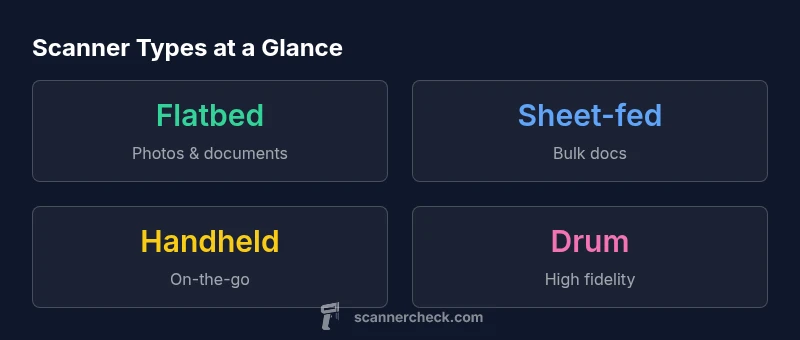
Flatbed scanners: The standard for high-quality scans of photos, documents, fragile pages, and bound materials. They offer larger bed sizes, excellent color fidelity, and flexible support for non-standard originals. The tradeoff is slower speed compared with sheet-fed models and a larger footprint.
-
Sheet-fed scanners: Designed for speed and bulk document handling. An automatic document feeder (ADF) enables you to scan many pages without manual reloading. They tend to be compact and affordable but can show slightly lower image quality on delicate originals and can struggle with thick or irregular pages.
-
Handheld scanners: Ultra-portable options that let you capture text or receipts on the move. They are convenient for fieldwork or travel, but image quality and alignment depend on the operator’s steadiness, and OCR can be less reliable on small text.
-
Drum scanners: Niche, high-end devices historically favored by professional photographers and archives. They deliver exceptional dynamic range and color accuracy but require specialized setup and come at a premium price.
-
Film/slide scanners: Specifically tuned for negatives, slides, and film strips. They excel at color depth and grain preservation, turning analog media into digital files with faithful tonality, at the cost of specialized hardware and often higher price.
Together, these five families cover most user needs, from quick receipts to professional film restoration.
How classification varies by use case
The way scanners are classified shifts with the user’s goals. A casual home user prioritizes ease of use and cost, often leaning toward flatbed or mobile solutions that pair with cloud storage and simple software. A small office might favor sheet-fed models if document volumes are predictable and routine, because the feeder and automatic processing cut labor time. Photographers and archive projects demand color fidelity, dynamic range, and support for delicate originals, pushing them toward flatbeds with larger glass beds or drum-based solutions. Large organizations handling archives, legal documents, or medical records typically require robust deduping, OCR accuracy, and high duty-cycle scanners that can run all day with minimal maintenance. In practice, many users end up with a hybrid setup—one flatbed for special tasks and a sheet-fed or mobile option for routine capture. These subtleties illustrate why the simple question of the number of types hides a deeper truth: “types” are gateways to use-case fit, not rigid classifications alone. Scanner Check analyses emphasize matching workflow, not chasing novelty.
The practical count: five types, plus hybrid and niche variants
Despite the five-family framework, the practical universe includes hybrids and specialized variants. Some devices blend features—flatbed bodies with built-in sheet-fed readers, for example—offering flexible use without sacrificing much footprint. Niche devices exist for microforms, large-format scanning, or archival work, targeting libraries, museums, and restoration labs. For most buyers, five core types remain a reliable baseline; hybrids and specialized models should be evaluated only if your workflow clearly demands them. Budget, maintenance costs, and software ecosystems also shape decision-making. When comparing models, consider total cost of ownership across five-to-ten-year horizons, including consumables, service, and software updates. Scanner Check's practical approach advocates testing a few representative models and validating results with your actual documents and photos before committing to a long-term purchase.
Evaluating features that matter across types
Across all scanner types, some features consistently influence results. Resolution and optical density determine the sharpness and tonal range of scans, especially for photos and film. Dynamic range and color management affect how accurately colors reproduce in complex originals. For OCR-heavy workflows, true optical character recognition performance, language support, and bundled software drive efficiency. Speed is key for bulk work, but duty cycle and duty cycle reliability matter for high-volume environments. Connectivity matters too: USB-C, Ethernet, Wi-Fi, and cloud integration affect how the scanner fits into existing networks and workflows. Bed size, ADF capacity, and document handling features (automatic skew correction, double-feed protection) reduce manual intervention. Finally, driver stability and software updates from the vendor influence long-term usability. By pooling these considerations with your actual task set, you can chart a practical path to a scanner that delivers value without overbuilding capabilities you won’t use.
Myths and misconceptions about scanners
A common myth is that more expensive always means better for every task. In reality, your best fit depends on your use case. Another misconception is that you should avoid any mobile scanning for professional work; modern mobile apps can handle quick extraction tasks when paired with reliable cloud storage. Some buyers assume that dedicated film or drum scanners are the only option for archival work; in practice, restorers can achieve excellent results with flatbeds plus specialized software in many scenarios. Finally, many buyers believe that all scanners excel at both text and photos equally; in truth, the strongest devices optimize either document clarity or image fidelity, not both to the same degree. The right approach is to align the device’s strengths with the dominant activity in your workflow, then validate performance with your own test batch.
Practical buying guide: match features to tasks
To put the five-type framework to work, start from your primary tasks. If you scan thousands of documents weekly, a sheet-fed model with a high-duty cycle and robust OCR is likely best. If you digitize fragile photos, a flatbed with a high-quality color sensor will serve you well. For on-site fieldwork, handheld scanners provide portability, while film enthusiasts or archives will benefit from film/slide or drum scanners with excellent tonal range. Use a test batch that includes a mix of papers, photos, and film to compare color accuracy, grain preservation, and legibility. Check software compatibility with your preferred OCR engines and cloud workflows. Finally, account for maintenance and consumables—some devices use proprietary cassettes, glass cleaners, or warm-up times—so you can plan for ongoing costs beyond the sticker price. In short, fix your attention on what you actually scan and how you intend to use the results.
Comparison of common scanner types
| Scanner Type | Typical Use Case | Strengths/Tradeoffs |
|---|---|---|
| Flatbed | Photos and documents | High quality, versatile |
| Sheet-fed | Bulk document scanning | Fast, automated feeding |
| Handheld | On-the-go scans | Portable, easy to carry |
| Drum/Film | Film/slides scanning | Exceptional color fidelity |
| Mobile/Phone | Smartphone scanning apps | Ultra-portable, lower accuracy |
Common Questions
How many types of scanners are commonly recognized?
Five broad categories are commonly recognized: flatbed, sheet-fed, handheld, drum, and film/slide scanners. Each supports different workloads and quality goals.
There are five common scanner types you should know about.
What is the main difference between flatbed and sheet-fed scanners?
Flatbeds emphasize high image quality and versatility, ideal for photos and bound documents. Sheet-fed models focus on speed and bulk scanning, using an automatic feeder.
Flatbeds give you best quality; sheet-fed is for fast batch scanning.
Are mobile phone scanners reliable for professional work?
Mobile scanners are convenient for quick captures, but professional-grade results depend on lighting, steadiness, and software. For archival or high-precision work, dedicated hardware often delivers more consistent results.
Phone scanners work for quick tasks but may not replace dedicated devices for precision work.
Do I need a scanner if I have a multifunction printer?
MFP scanners are convenient for light to moderate use. For heavy volumes, film work, or archival tasks, a dedicated scanner offers better durability and quality.
MFPs are fine for light use; dedicated scanners excel under heavy workloads.
Which features matter most when comparing scanners?
Focus on resolution, optical density, OCR quality, speed, connectivity, and software support. These features determine how clean, legible, and usable your scans will be.
Prioritize resolution, OCR, speed, and connectivity.
What about rare types like drum or professional film scanners?
Drum and specialized film scanners exist for archival and high-fidelity work. For many users, a high-quality flatbed or sheet-fed with the right software can achieve excellent results at lower cost.
Drum and film scanners are for high-end needs; most users can start with flatbeds or sheet-fed.
“Understanding the five core scanner types helps buyers map their needs to the right device, avoiding overbuying or missing essential features.”
Key Takeaways
- Match the type to your primary task
- Five core types cover most needs
- Prioritize resolution, OCR, and connectivity
- Consider total cost of ownership over time
- Test with your own documents for best fit