When Were Scanners Invented? A History of Scanning Technology
Explore when were scanners invented and how scanning evolved from optical devices to barcode tech and smartphones. Learn milestones, types, and practical buying tips.


Scanners were not invented at a single moment. Early optical and mechanical scanning systems appeared in the late 19th and early 20th centuries, with electronic scanners becoming common in the mid-20th century. The barcode scanner entered widespread use in the 1970s, and modern scanning—OCR, imaging sensors, and smartphone apps—continues to evolve today.
When were scanners invented: A historical overview
Scanners are devices that convert physical images into digital or machine-readable data. The question of when were scanners invented spans multiple epochs, not a single moment in history. Early optical and mechanical scanning concepts appeared in the late 19th and early 20th centuries, paving the way for more compact, reliable electronic systems in the mid-20th century. Over time, imaging sensors, drums, and laser-based techniques advanced, enabling faster, higher-resolution scanning. The pivotal moment for mass adoption arrived with barcode scanning in the 1970s, followed by the rise of OCR, CCD-based imagers, and mobile scanning platforms in the 1990s and beyond. By tracing these threads, we see a continuum rather than a single invention.
From optical to electronic: The pre-digital era
Before digital pixels mattered, publishers and labs relied on optical and mechanical scanning methods. Drum scanners, which used rotating cylinders and photomultiplier tubes, enabled high-resolution reproduction for magazines and photography, laying the groundwork for modern image capture. In parallel, fax-like devices experimented with line-scanning and compression to transmit documents over telephone networks. These systems demonstrated a key idea: turning a line or frame of light into numerical data that a machine could interpret. While not digital in the sense we use today, these early approaches established the architecture of scanning: optically capturing, converting, and processing signals for storage or transmission. The 1950s to 1970s saw rapid improvements in sensors, optics, and electronics, setting the stage for the digitized scanners that followed.
Milestones in scanner history
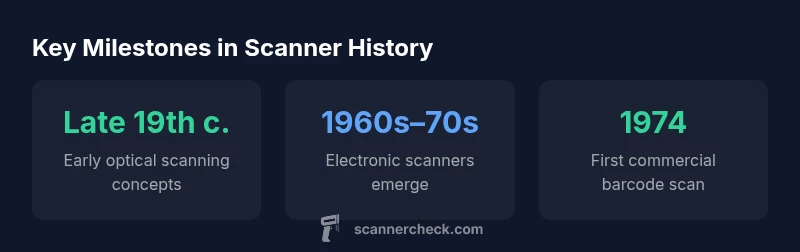
- Late 19th to mid-20th century: Optical and mechanical scanning concepts emerge for publishing, archiving, and data capture.
- 1960s–1970s: Electronic scanners (drum and line-scan) improve image quality and speed, enabling broader professional use.
- 1974: The first commercial barcode scanner helps retailers track inventory and streamline checkout.
- 1980s–1990s: Desktop scanners and OCR software bring document digitization to homes and offices.
- 2000s: Smartphone cameras and mobile apps turn scanning into everyday tasks like document capture and code scanning.
- 2010s–present: AI-powered OCR, cloud storage, and cross-device syncing expand scanning from a niche tool to a ubiquitous capability.
The impact of barcode scanning on commerce
Barcode scanning redefined how retailers manage inventory, pricing, and checkout. By standardizing product identification, scanners slashed human error and reduced processing times. Retailers could track stock levels in real time, trigger automatic reorders, and provide faster, more accurate checkout experiences. The broader adoption of scanning spurred the development of standards and ecosystems—GS1 barcodes, scanner firmware, and integrated point-of-sale systems. This financial and logistical efficiency helped scale modern retail to global proportions while enabling new business models like dynamic pricing and omnichannel fulfillment.
Today’s scanning: from OCR to mobile and cloud
Modern scanning blends optics, sensors, and software. Flatbed and hand-held scanners capture high-resolution images that OCR software converts into editable text, while mobile apps use the camera to scan documents, QR codes, and barcodes. Advances in CMOS sensors, LED illumination, and AI-driven image enhancement improve accuracy in less-than-ideal lighting. Cloud-based OCR and cross-device synchronization let users start a scan on a phone and finish on a desktop. The result is a versatile toolkit for personal productivity, enterprise workflows, and accessibility applications.
Practical guidance: what to look for when choosing a scanner
- Determine your primary use case: document digitization, barcode capture, or image archiving.
- Consider the type: desktop, portable, or mobile scanning; laser vs. CCD vs. CIS sensors.
- Check resolution, color depth, and bit depth to match needs such as OCR accuracy or photo quality.
- Look for AI-powered features: automatic deskew, glare removal, and on-device OCR.
- Verify compatibility with your devices and software ecosystems (Windows, macOS, mobile).
- Price ranges: budget options around $50–$200 for basic document capture; mid-range $200–$800 for higher-end image quality; professional-grade scanners exceed $800.
- Assess durability, feed options (ADF), and warranty to fit long-term use.
- For barcode scanning, ensure supported symbologies match your products.
- Explore post-scan workflows: export formats, cloud integration, and OCR accuracy reporting.
Comparison of scanner types across eras
| Scanner Type | Era | Core Function | Notable Milestone |
|---|---|---|---|
| Optical Drum Scanner | Mid-20th century | High-resolution image capture for publishing | Drum-based scanning enabled publishing workflows |
| Fax/Line-Scan System | Mid-20th century | Document capture and transmission | Early electronic line-scanning devices |
| Barcode Scanner | 1970s–1980s | Retail inventory & checkout | First commercial barcode scan in 1974 |
| Smartphone Camera Scanner | 2000s–present | On-device capture with OCR & codes | Mass consumer scanning via mobile apps |
Common Questions
When exactly were barcode scanners invented?
Barcode scanning emerged in the 1970s, with 1974 often cited as the first commercial scan. The technology built on earlier optical and data-capture developments.
Barcode scanning began in the 1970s; 1974 is commonly cited as the first commercial scan.
What is considered the first consumer-friendly scanner?
The first widely marketed consumer scanners appeared in the late 1990s with desktop scanners and OCR software making document digitization practical for homes and small offices.
Desktop scanners and OCR in the late 1990s brought scanning to homes.
Did scanners exist before digital computers?
Yes. Pre-digital optical and mechanical scanners existed, using analog processing and line scanning, before digital computers were widespread.
Yes, there were optical and mechanical scanners before digital computers.
How do older scanners differ from modern smartphone scanning?
Older scanners used dedicated hardware, higher cables, and desktop setups; modern scanning leans on mobile cameras, AI-driven OCR, cloud storage, and on-device processing.
Today, you scan with your phone or cloud-based tools.
Are laser scanners different from CCD/ CIS scanners?
Laser scanners project a focused beam for precise line scanning, while CCD/CIS units capture reflected light with image sensors; both are used for different accuracy and speed needs.
Laser scanners use a laser; CCD and CIS use image sensors.
What should I consider when buying a scanner?
Define use case, check resolution, color depth, feed type (ADF), connectivity, and software compatibility; consider price tiers and warranty.
Think about what you’ll scan, then pick features that fit that use.
“Scanning technology didn't emerge from a single invention; it evolved through parallel advances in optics, imaging sensors, and data processing.”
Key Takeaways
- Scanning history spans decades, not a single invention.
- Multiple families of scanners shaped the timeline (optical, barcode, imaging).
- Barcode scanning transformed retail and logistics.
- Modern scanning leverages AI, cloud, and mobile tech for everyday use.