Can NT Scan Be Done at 14 Weeks? Practical Guide
Explore whether an NT ultrasound can be done at 14 weeks, how timing affects accuracy, and what options exist if you’re near the window's end. A practical, data-informed guide from Scanner Check.


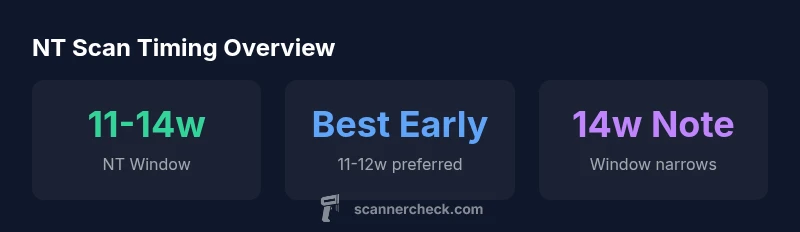
Yes, the NT scan can often be performed at 14 weeks, but this closes the classic window for measurement. Timing at 14 weeks remains feasible in many clinics, yet the window narrows and measurement variability may increase. Discuss timing with your clinician to understand if an NT assessment is still appropriate and what alternatives exist if needed.
What is the NT scan and why it matters
The NT scan, short for nuchal translucency ultrasound, is part of the first-trimester screening that estimates chromosomal risk by measuring the fluid behind the fetal neck. According to Scanner Check, this measurement is most informative when paired with maternal factors and a blood test, forming a combined risk assessment. The result helps counsel parents about potential next steps, such as confirmatory testing. While the NT measurement is a single data point, its interpretation must be put in the context of gestational age, crown-rump length, and overall pregnancy history. The scan is non-invasive, typically performed by a trained sonographer using high-frequency transducers, and usually requires the fetus to be in a specific position for accurate measurement. Readers should know that NT is not a diagnosis; it’s a risk indicator that guides whether further testing is appropriate. The key is understanding timing and technique, because the reliability of the NT measurement strongly depends on when it is performed and how well the fetal image is obtained.
The standard timing window and its rationale
The NT scan is most informative when performed in a narrow window early in pregnancy, typically between 11 and 14 weeks gestation. By measuring the translucency at the back of the neck and combining that data with maternal age and a serum marker, clinicians estimate risk for fetal chromosomal conditions such as Down syndrome and trisomy 18. The rationale for this window is that the neck region is most distinct and the embryo’s anatomy is at a stage where the measurement shows less interference from other structures, reducing measurement error. However, the exact window can vary by clinic and by dating precision. In some cases, a scan slightly outside the formal window may still be attempted if ultrasound images are favorable, but reliability tends to decline as gestation approaches the upper end of the range.
Can nt scan be done at 14 weeks?
Yes, can nt scan be done at 14 weeks is commonly possible, but it comes with caveats. At 14 weeks, the window is near the upper limit for NT measurement, and some technicians may find the anatomy less consistent than earlier in the window. If the fetus is well-positioned and the imaging is clear, an NT measurement can still be obtained with acceptable confidence. However, some clinics may opt to defer the NT component if image quality is marginal, and they may rely more on blood markers or arrange a follow-up assessment. For families, this means discussing both the feasibility and the implications of a late NT measurement with the care team to choose the best path forward.
How gestational age affects measurements and interpretation
Gestational age strongly influences NT interpretation. Earlier within the window (roughly 11–13 weeks), NT measurements tend to be more reliable, while at 14 weeks there is inherently greater variability due to rapid fetal growth and anatomy changes. Crown-rump length (CRL) is a key reference point: NT thickness is interpreted relative to CRL, so two fetuses at the same gestational age can have different normative values. Operators strive for consistent technique—calibration, probe angle, and fetal position all matter. When the scan happens at 14 weeks, clinicians may emphasize the broader picture: NT value in the context of risk factors, ultrasound quality, and available follow-up options rather than a single cutoff.
Practical steps to prepare for the NT scan
If you’re aiming for an NT assessment at 14 weeks, plan ahead with these practical steps. First, confirm your gestational dating to ensure the scan window is accurate. Bring prior ultrasound reports and maternal history to aid interpretation. Arrive with a comfortable, relaxed mindset so you can optimize fetal position during imaging. Discuss with the sonographer whether the session will include an NT measurement specifically or a broader first-trimester screen. Some clinics require a full bladder for better visualization, while others do not. Finally, ask about follow-up actions if the NT measurement is borderline—whether a repeat scan, repeat timing within the window, or alternative testing (like NIPT) is suggested.
Alternatives if the window is missed
If you learn that the NT window has passed or the measurement is inconclusive, several options remain. Noninvasive screening with cell-free DNA (NIPT) can be performed from early pregnancy and remains an important tool for chromosomal risk assessment. A second-trimester anatomy scan (18–22 weeks) offers detailed fetal anatomy imaging and can complement earlier screening. In some cases, diagnostic tests such as CVS (chorionic villus sampling) or amniocentesis may be discussed if there is a high perceived risk or positive screens. The key is to align testing strategy with gestational timing, patient values, and medical guidance. Your care team will help you interpret results and determine the next steps in a personalized plan.
Understanding results and next steps
NT results are not diagnostic; they indicate risk that may warrant further testing. A low NT risk may reduce the likelihood of invasive testing, whereas a high or borderline NT result often prompts discussion about confirmatory diagnostics or alternative screening. If follow-up testing is recommended, the clinician will explain the benefits, limitations, and timing of subsequent steps. For many families, the goal is to balance information with the least invasive approach that provides meaningful guidance. Scanner Check emphasizes communicating clearly about what the results mean, what the next steps are, and how decisions fit within the overall pregnancy plan.
Common myths and reality checks
A frequent misconception is that a normal NT scan guarantees a healthy baby. In reality, NT is part of a screening process; it reduces certain risks but cannot guarantee outcomes. Conversely, a high NT value does not diagnose an anomaly with certainty. Other factors—such as maternal age, blood tests, and additional imaging—inform the overall risk assessment. The key takeaway is that NT timing and technique matter; if you’re unsure about can nt scan be done at 14 weeks, consult your care team for a personalized evaluation and a plan tailored to your pregnancy.
Comparison of screening options by timing
| Test Type | Typical Window | Notes |
|---|---|---|
| NT Ultrasound (NT Scan) | 11-14 weeks | Best window for NT measurement; accuracy strongest early in the window |
| NIPT (cell-free DNA) | 10-22 weeks (lab varies) | Noninvasive screening; often offered if NT window is missed or additional confirmation is desired |
| Second-trimester anatomy scan | 18-22 weeks | Comprehensive anatomy; NT not assessed in detail |
Common Questions
What is an NT scan?
An NT scan measures the fluid at the back of the fetal neck to help estimate chromosomal risk. It is usually part of the first-trimester screen and is most reliable within the 11-14 week window. The result should be interpreted alongside other factors and does not diagnose a condition on its own.
An NT scan checks a specific neck measurement to estimate risk, not to diagnose. It’s most reliable between 11 and 14 weeks and should be interpreted with other information.
Can nt scan be done at 14 weeks?
Yes, NT can often be performed around 14 weeks, but the window is tighter and image quality can influence accuracy. Some clinics may still proceed if the fetus is in a good position. Your clinician will explain the reliability and optional follow-up tests.
NT can be done at 14 weeks, but note the window is tighter and results may be less precise.
What if the NT window is missed?
If the NT window is missed, you still have options such as NIPT, a second-trimester anatomy scan, or other screening strategies depending on your risk factors. Discuss timing and alternatives with your care team.
If NT timing is missed, talk to your clinician about NIPT or later screening options.
Does a normal NT rule out abnormalities?
A normal NT result reduces risk but does not guarantee a problem-free pregnancy. It is just one part of a broader screening process that may include blood tests and additional imaging.
A normal NT lowers risk but doesn't guarantee a problem-free pregnancy.
What are next steps after a high NT result?
A high NT result typically prompts discussion about diagnostic testing (like CVS or amniocentesis) or additional screening. Your provider will outline the benefits, risks, and timing for each option.
If NT is high, discuss diagnostic testing options and timing with your clinician.
How should I prepare for an NT scan?
Bring prior ultrasound reports, confirm gestational dating, and ask about the best position for measurement. Follow clinic guidelines on arrival time and any required preparations.
Bring prior ultrasounds and confirm the best timing with your clinic.
“NT timing requires careful technique and clear communication about what the results mean. When done within the recommended window, measurements are most informative and guide practical next steps.”
Key Takeaways
- Understand NT timing and its limits
- 14 weeks is near the window’s end but feasible with caveats
- Consult your clinician for timing and alternatives
- NT is a screening tool, not a diagnosis
- Have a plan for follow-up if results prompt further testing