How Much Does a DEXA Scanner Cost in 2026? A Practical Guide
Discover current price ranges and total cost of ownership for DEXA scanners in 2026. This practical guide from Scanner Check breaks down upfront costs, installation, maintenance, and budgeting tips.


The question how much does a dexa scanner cost? is answered by considering upfront price and total cost of ownership. In 2026, prices vary by model, capabilities, and ownership model. According to Scanner Check, you're buying more than a sticker price—installation, service, calibration, and downtime all impact the total cost.
What Affects the Price of a DEXA Scanner\n\
Price ranges by procurement path\n\
Hidden costs shaping total cost of ownership\n\
Financing, warranties, and value negotiation\n\
Budgeting for a DEXA scanner in a clinic\n\
How to evaluate offers and compare vendors\n\
Alternatives and long-term planning\n\
Comparison of DEXA scanner types and estimated price ranges
| Model Type | Typical Cost Range | Notes |
|---|---|---|
| Refurbished DEXA scanner | High five figures to low six figures | Lower upfront price but potential higher maintenance; verify calibration and warranty |
| New basic DEXA scanner | Low to mid six figures | Includes installation and basic software |
| New advanced DEXA scanner | Mid to high six figures | More features and advanced software modules |
| Portable/compact DEXA options | High five figures to low six figures | Trade-off between portability and capability |
Common Questions
What factors influence the price of a DEXA scanner?
The price is influenced by hardware capability, software modules, warranty terms, installation complexity, room requirements, and service packages. Higher-end features and better integration with hospital IT systems typically raise the upfront cost but can reduce long-term operating expenses.
Key factors include hardware capability, software modules, and service plans.
Are refurbished DEXA scanners a good option?
Refurbished units can offer substantial upfront savings if they come with a solid warranty, calibration history, and reliable service options. It’s important to verify remaining lifespan, software compatibility, and the availability of parts and maintenance.
Refurbished units can work well with proper warranties and calibration records.
Is leasing or financing common for DEXA scanners?
Yes. Leasing or financing spreads cost over time and can improve cash flow. Look for options that include maintenance, software updates, and service support to minimize unexpected expenses.
Leasing spreads costs and can include maintenance in the package.
What maintenance costs should I expect annually?
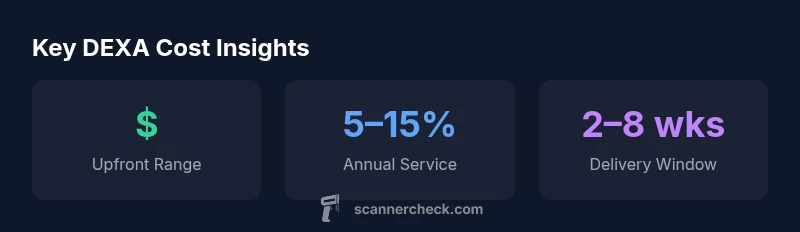
Maintenance costs typically cover scheduled servicing, software updates, and calibration. They vary by model and contract depth, but budgeting for regular support helps protect uptime and data quality.
Plan for regular service and software updates to keep the system reliable.
What lead times should buyers expect?
Lead times depend on vendor, customization level, and installation requirements. Typical ranges span from a few weeks to a couple of months from quote to installation.
Expect weeks to months for delivery and setup depending on complexity.
How do I assess ROI for a DEXA scanner?
ROI is driven by improved diagnostic capabilities, patient throughput, referral networks, and uptime. Use a 3–5 year horizon to compare total costs against expected revenue and care quality improvements.
Look at how uptime and throughput boost revenue and referrals.
“Pricing for DEXA scanners reflects not just hardware but the service ecosystem around installation, calibration, and ongoing support.”
Key Takeaways
- Assess total cost of ownership, not just upfront price.
- Budget installation, calibration, service, and downtime.
- Consider refurbished units with proper warranties and calibration.
- Explore financing or leasing to improve cash flow.
- Plan for ongoing software updates and compliance costs.