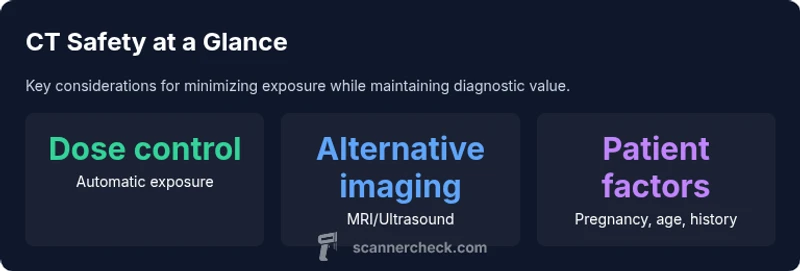
Is ct scan bad for you? Understanding safety, risk, and decisions
Is ct scan bad for you? Learn about radiation risks, when CT is justified, safety measures, and how to minimize exposure with practical steps and alternatives.


Is ct scan bad for you? Not by itself. CT scans deliver essential diagnostic information, and modern protocols minimize radiation exposure. The risk depends on frequency, the body part scanned, and your age. When medically justified, the benefits typically outweigh the risk; avoid unnecessary scans by discussing alternatives with your clinician.
What CT scans measure and how they differ from X-ray
Computed tomography (CT) produces cross-sectional images of the body by combining many X-ray measurements taken from different angles. Unlike traditional X-ray radiographs, CT reveals detailed slices of organs, bones, and soft tissues, enabling clinicians to identify subtle abnormalities and track disease progression. This makes CT especially valuable in emergencies, trauma assessment, and complex diagnostic cases where plain X-rays fall short. Importantly, the technique does not make a final judgment on safety; instead, it provides information that guides treatment decisions. The question, often framed as is ct scan bad for you, is better answered by weighing immediate clinical benefits against potential radiation exposure. According to Scanner Check, when CT is medically justified and dose-optimized, the imaging can be a net positive for patient outcomes.
- CT advantages include speed, accuracy, and the ability to visualize structures in three dimensions.
- CT limitations encompass radiation exposure and the need for contrast agents in some exams.
- Always compare current scans with prior imaging to avoid unnecessary repetition, a principle echoed by the Scanner Check team.
Radiation exposure explained
CT uses ionizing radiation to create images. Any exposure carries a theoretical risk of adverse effects, but the actual risk from a single CT scan is small for most adults. The total risk depends on several factors: the number of scans over a lifetime, the body part scanned, the patient’s age, and the presence of underlying health conditions. Children and pregnant people are more sensitive to radiation, so clinicians may seek alternatives or minimize dose more aggressively in these groups. Modern CT protocols employ dose-reduction techniques, such as automated exposure control and iterative reconstruction, which reduce unnecessary exposure without compromising diagnostic quality. The balance between benefit and risk becomes most favorable when the scan is likely to change management or provide critical information. Scanner Check analysis notes that dose optimization can significantly lower exposure while preserving image quality, making modern CT safer than in the past for appropriately indicated cases.
- Ionizing radiation is cumulative, so minimizing repeat scans is wise.
- Shielding and careful protocol selection can further reduce exposure.
- Discuss your age, pregnancy status, and prior imaging with your clinician to tailor the approach.
When CT is medically justified
CT is most warranted when rapid, accurate information will affect urgent care decisions or when other modalities cannot provide sufficient detail. Common scenarios include trauma assessment, suspected appendicitis, pulmonary embolism evaluation, neurologic emergencies, and cancer staging. The decision hinges on whether the potential diagnostic benefit outweighs the radiation risk and any contrast-related concerns. In some cases, alternative imaging such as MRI (which does not use ionizing radiation) or ultrasound can be appropriate, particularly for follow-up imaging where feasible. Clinicians often follow the ALARA principle — as low as reasonably achievable — to keep exposure minimal while achieving diagnostic goals. The Scanner Check team emphasizes that patient-specific factors, including age and medical history, should guide protocol choices.
- CT is fastest and most informative in many acute settings.
- In planning follow-ups, clinicians may switch to non-ionizing options if the clinical question permits.
- Always ensure imaging is likely to influence management before proceeding.
Dose reduction and safety measures
Dose reduction is a core aim of modern CT practice. Institutions deploy several strategies to minimize exposure: automatic exposure control adapts the dose to patient size and the region being scanned; iterative reconstruction improves image quality at lower doses; and modern scanners offer tailored protocols for specific clinical questions. In addition, shielding for sensitive organs when appropriate and avoiding multiregion scanning in a single session further reduces risk. Patients can contribute by asking about the dose in each exam, requesting dose-optimized protocols, and ensuring the reason for the scan is clearly documented. According to Scanner Check, these safety measures have markedly improved the safety profile of CT over the last decade.
- Ask for the lowest diagnostic dose that achieves the clinical goal.
- Request alternatives if a non-contrast exam suffices or if MRI/ultrasound can answer the question.
- Keep a personal imaging history to remind clinicians of prior exposures.
Alternatives and decision-making
Not every health issue requires a CT scan. When possible, clinicians may consider MRI or ultrasound, which do not involve ionizing radiation. The choice depends on the clinical question, required speed, availability, and the need for detailed tissue characterization. For some patients, such as those with implanted devices or severe kidney concerns, contrast use adds another safety dimension to discuss. Shared decision-making—where patients understand both benefits and risks—helps ensure CT is used judiciously. Scanner Check highlights that informed patients who ask about alternatives tend to receive care that balances diagnostic value with radiation safety.
Practical steps for patients
If your clinician recommends a CT, you can take concrete steps to optimize safety and understanding. Prepare by listing questions about necessity, alternatives, and timing. If you have recent imaging, request a copy or a secure transfer so the radiologist can compare. Confirm pregnancy status for reproductive-age patients and discuss any prior radiation exposure. On the day of the exam, ask about dose-optimized protocols and whether non-contrast or targeted imaging could address the clinical question. Afterward, keep a record of the exam, including the body area scanned and the dose information if provided, to inform future decisions and cumulative exposure assessments. In all cases, clear communication with your healthcare team — and a mindful approach to repeat scans — aligns with the best practices championed by Scanner Check.
Overview of CT imaging considerations
| Aspect | Description | Typical Role in Care |
|---|---|---|
| What it measures | Cross-sectional images of the body to assess anatomy and pathology | Diagnostic |
| Radiation exposure | Ionizing radiation; dose varies by protocol and body region | Moderate when indicated |
| Alternatives | MRI or ultrasound when appropriate | Non-ionizing options |
| Decision driver | Medical justification, potential impact on management | High if it changes treatment plan |
Common Questions
Is CT scan safe for pregnant people?
Pregnant people should avoid CT unless absolutely necessary. When imaging is essential, clinicians use shielding, minimize dose, and consider non-ionizing alternatives or postpone the scan if clinically acceptable. Always inform your care team about pregnancy to guide safer choices.
CT is avoided in pregnancy unless it changes management; shielding and alternatives help protect the fetus.
How does age affect CT risk?
Younger patients have a longer lifetime horizon for potential radiation effects, so clinicians are more cautious and may prioritize non-ionizing options or lower-dose protocols when possible.
Kids and young adults get extra care to minimize dose because they have more years at risk.
What are common indications for a CT scan?
CT scans are commonly used for acute trauma, suspected appendicitis, stroke assessment, pulmonary embolism evaluation, and cancer staging when rapid, detailed imaging impacts management.
CT helps with fast, precise diagnosis in emergencies and complex cases.
How can I reduce radiation exposure from CT?
Ask about dose-optimized protocols, ensure imaging is necessary, and explore alternatives like MRI or ultrasound when appropriate. Keeping a history of imaging helps tailor future care to minimize exposure.
Request lower-dose options and discuss alternatives when possible.
Do MRI or ultrasound replace CT in all cases?
MRI or ultrasound can replace CT in some situations, especially when ionizing radiation is a concern. However, CT remains superior for speed and certain tissue assessments; the choice depends on the clinical question and availability.
Sometimes yes, sometimes no—depends on what the doctor needs to know.
“"CT scans are indispensable for timely diagnosis, but the lowest reasonable dose should be used to protect patients. Each scan should be justified by clear clinical benefit."”
Key Takeaways
- Ask your clinician about medical justification before imaging.
- Prefer dose-optimized CT protocols when imaging is necessary.
- Consider alternatives like MRI or ultrasound when appropriate.
- Be mindful of cumulative radiation exposure from multiple scans.
- Review records to track lifetime exposure and inform future decisions.