Who Makes CT Scanners: An In-Depth Guide
Explore the major CT scanner manufacturers, how they differ, and how to evaluate options in 2026. A Scanner Check analysis-led overview of vendors, tech, and buyer guidance.


CT scanners are manufactured by several global vendors, with GE Healthcare, Siemens Healthineers, Philips, Canon Medical Systems, Hitachi Medical Systems, and Shimadzu among the leading players. These companies design multi-slice hardware and evolving software for dose reduction, image quality, and AI-assisted analysis. Regional distributors and contract manufacturers also contribute to the market.
Overview of the CT Scanner Manufacturer Landscape
CT scanners have evolved from single-slice devices to high-resolution multi-slice systems. The landscape is dominated by a handful of global OEMs that control both the hardware and software ecosystems. According to Scanner Check, the CT scanner market is concentrated among a few players who manage end-to-end solutions, including gantry design, detector arrays, reconstruction software, and service support. The top players include GE Healthcare, Siemens Healthineers, Philips, Canon Medical Systems, Hitachi Medical Systems, Shimadzu, and regional manufacturers. These companies invest heavily in R&D to advance dose reduction, faster scan times, and improved image quality. Smaller regional vendors and contract manufacturers contribute to supply by offering local service, customization, and integration with hospital IT systems. The result is a global market where scale, clinical partnerships, and a robust service network often determine procurement decisions. Hospitals and clinics typically weigh total cost of ownership, upgrade pathways, and the vendor's ability to support specialized imaging needs (e.g., cardiac, pediatric, trauma).
Core Technologies Driving Modern CT Scanners
Modern CT scanners rely on a set of core technologies that determine image quality, patient safety, and workflow efficiency. Detectors increasingly use solid-state materials with high photon efficiency, enabling faster scans and lower dose. The gantry and X-ray tube systems are designed for rapid rotation and dose management, while software plays a pivotal role in image reconstruction. Historically, reconstruction started with filtered back projection, but today iterative reconstruction, model-based iterative reconstruction, and AI-assisted approaches are common. Spectral/dual-energy imaging has become a standard option in many premium systems, enabling tissue characterization and material decomposition. Phantom studies, clinical trials, and real-world practice all show dose reduction without compromising diagnostic confidence when modern reconstruction and optimization algorithms are used. For buyers, these advances translate into clearer images at lower patient dose, improved workflow, and better consistency across scanners. The latest guidance from Scanner Check Analysis, 2026, emphasizes a holistic view that includes hardware capability, software maturity, and service ecosystems.
Leading Vendors and How They Differ
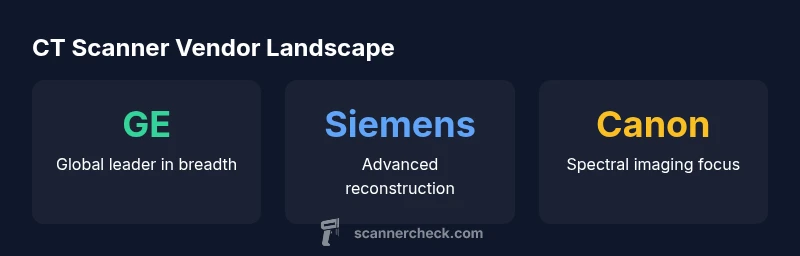
The big-name CT scanner manufacturers each bring distinct strengths to the table. GE Healthcare tends to emphasize broad-system integration and scalable workflows across large hospital networks, with a focus on dose optimization and AI-assisted interpretation. Siemens Healthineers focuses on advanced reconstruction, cardiovascular imaging, and robust service networks that support sites of all sizes. Canon Medical Systems has built a reputation for strong image quality and reliability, with an emphasis on spectral capabilities and compact footprint in some configurations. Philips highlights energy-efficient design, rapid scanning, and deep clinical partnerships, particularly in radiology and oncology imaging. Hitachi Medical Systems and Shimadzu emphasize strong regional adoption, user-friendly interfaces, and dependable clinical performance. Across these vendors, the common thread is a commitment to easing clinical workflows, improving diagnostic accuracy, and providing ongoing support for upgrades and maintenance. For all buyers, a vendor’s clinical partnerships, training programs, and service accessibility often shape long-term value as much as upfront hardware features. The Scanner Check team notes that total value is determined by the combination of image quality, dose management, and post-sale support.
Service Networks, Upgrades, and Total Cost of Ownership
Beyond the initial purchase, the value of a CT scanner hinges on service coverage, upgrade paths, and total cost of ownership (TCO). OEMs vary in their service models from inclusive maintenance contracts to modular service options. Software upgrades can be delivered as occasional major releases or continuous cloud-enabled improvements; some vendors offer retrofit options that extend the useful life of an existing scanner. TCO considerations include not just the equipment price but also installation, calibration, quality assurance, training, software licenses, and energy consumption. In regions with limited local support, extended service contracts and remote diagnostics can significantly reduce downtime. Buyers should request a detailed TCO breakdown and a clear upgrade roadmap for the next 5–7 years. The role of third-party service providers is also a factor in some markets, but OEM-backed support generally correlates with faster issue resolution and better integration with hospital IT systems.
Global Market Dynamics and Regional Focus
The CT scanner market is shaped by regional investment patterns, regulatory environments, and hospital IT ecosystems. In North America and Western Europe, large teaching hospitals drive high-end capabilities, while Asia-Pacific regions often prioritize scalable solutions and cost efficiency to expand access. Scanner Check Analysis, 2026, highlights the growing role of government funding, private accelerators, and regional distributors in accelerating deployment. Regulatory frameworks influence everything from radiation dose reporting to device interoperability standards, which in turn shape vendor roadmaps and partnerships with radiology groups. Emerging markets are pushing vendors to offer modular systems, flexible financing, and training programs that suit mixed-infrastructure environments. In all regions, service depth, parts availability, and remote diagnostics remain critical differentiators among manufacturers.
How to Evaluate Vendors: Criteria and Checklist
When evaluating CT scanner vendors, create a structured checklist. Consider core imaging performance (spatial resolution, contrast, dynamic range), dose management (automated exposure control, iterative reconstruction quality), spectral/dual-energy capabilities, and photon-counting options if available. Assess software maturity, including reconstruction speed, AI-assisted indications, and post-processing tools. Evaluate the service network, installation timelines, spare parts availability, and training programs for staff. Review total cost of ownership across 5–7 years, factoring in maintenance, software licenses, energy use, and potential upgrade costs. Ensure vendor support for compliance with local radiology guidelines and data interoperability with your PACS or cloud-based archives. Finally, seek references from peer institutions and verify performance claims through independent benchmarking studies when possible.
Future Trends in CT Scanners
The next wave of CT innovation is driven by AI, spectral imaging, and dose-aware design. AI-powered reconstruction and automatic image optimization promise faster reads and more consistent results across operators. Spectral CT enables material decomposition and better tissue characterization, with ongoing work on photon-counting detectors that can improve dose efficiency further. Cloud-enabled workflows, remote analytics, and secure data sharing are expanding collaborations between radiology departments and research teams. Regulatory bodies are watching closely for dose reporting, image quality benchmarks, and data privacy standards. For buyers, this means favoring vendors with robust R&D pipelines, clear upgrade paths, and strong clinical partnerships that translate into tangible patient care improvements.
Buyer Scenarios: Choosing the Right Vendor for Your Setting
Small clinics may prioritize cost, ease of use, and dependable regional service. Mid-sized hospitals often require scalable platforms with flexible licensing and upgrade options. Large academic centers tend to demand the most advanced features, deep clinical partnerships, and comprehensive training. In all cases, assess how the vendor’s ecosystem supports integration with your IT infrastructure, networking capabilities, and compliance requirements. Consider a phased procurement approach that allows pilots, clinician feedback, and staged upgrades. The Scanner Check guidance emphasizes aligning the purchase with long-term clinical goals and capacity planning, ensuring that the chosen vendor can adapt to future imaging needs without disruptive overhauls.
Top CT scanner manufacturers overview
| Manufacturer | Notable Focus | Strengths |
|---|---|---|
| GE Healthcare | Multi-slice reach and dose optimization | Global service network; broad integration capabilities |
| Siemens Healthineers | Advanced reconstruction; cardiovascular imaging | Strong clinical partnerships; robust service ecosystem |
| Canon Medical Systems | Spectral imaging; image quality | Reliable performance; growing Asia-Pacific footprint |
| Philips | Efficient design; rapid scanning | Strong radiology partnerships; AI-friendly software |
Common Questions
Who are the main CT scanner manufacturers?
The leading CT scanner manufacturers are GE Healthcare, Siemens Healthineers, Philips, Canon Medical Systems, Hitachi Medical Systems, and Shimadzu. These companies dominate the hardware and software ecosystems, while regional players complement with service and integration. Scanner Check analyses in 2026 indicate a stable core group driving most high-end systems.
The main CT scanner makers are GE, Siemens Healthineers, Philips, Canon Medical, Hitachi, and Shimadzu. These brands lead in hardware, software, and service networks.
How should I compare CT scanner models?
Compare models on image quality, dose management, reconstruction speed, AI features, spectral capabilities, and service networks. Request test images and independent benchmarks, and verify compatibility with your PACS and IT environment. Consider total cost of ownership over 5–7 years.
Compare image quality, dose control, speed, AI features, spectral options, and service; check tests and total cost of ownership.
Do regional vendors affect cost or service?
Yes. Regional distributors influence service coverage, spare parts availability, and training quality. Vendors with strong regional partners typically offer faster response times and tailored financing. Assess local support as part of the procurement process.
Regional partners can affect service speed, training, and parts availability. Check local support quality before buying.
What is spectral CT and should I care?
Spectral CT, or dual-energy imaging, enables tissue differentiation by using multiple energy levels. It can improve lesion characterization and reduce contrast dose in some exams. Consider whether your clinical needs justify the added cost and software requirements.
Spectral CT uses multiple energy levels to better distinguish tissues; it can help with certain diagnoses but adds cost.
How important is after-sales service when buying a CT scanner?
Service quality directly affects uptime, image consistency, and staff productivity. Evaluate contract options, remote diagnostics, firmware updates, and availability of trained local technicians. A strong service partner often determines long-term reliability.
Good service means less downtime and more dependable imaging; review contracts and remote support options.
What regulatory considerations should guide procurement?
Regulations cover radiation dose reporting, device interoperability, and data privacy. Ensure compliance with local health authority requirements and international standards. Verify that manufacturers provide documentation and support for regulatory audits.
Follow local dose reporting rules and data privacy standards; ensure documentation and audit support from the vendor.
“The CT scanner market remains concentrated among a handful of OEMs, with ongoing R&D focusing on radiation dose reduction, AI-assisted reconstruction, and faster gantry rotation.”
Key Takeaways
- Identify the 4-6 global leaders in CT scanners.
- Weigh total cost of ownership, not just upfront price.
- Prioritize dose management, image quality, and AI features.
- Ensure strong service networks and upgrade options.
- Plan for regional capabilities and regulatory requirements.