Body Fat Scanner Near Me: Find, Compare & Choose Wisely
Learn how to locate reliable body fat scanners near you, understand how they work, compare accuracy ranges, and choose a device or facility that fits your goals and budget.


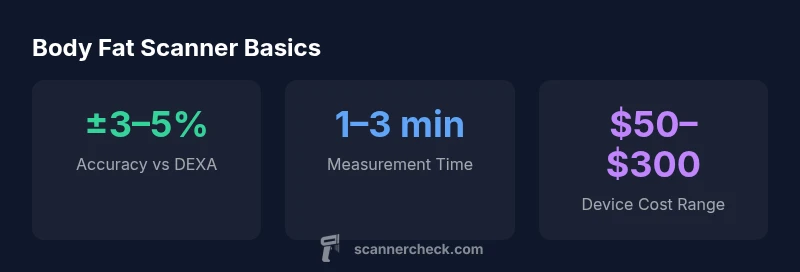
Most body fat scanners you’ll find near you rely on bioelectrical impedance (BIA) or optical measurements, with accuracy typically within ±3–5 percentage points of DEXA under controlled testing. Expect results to vary by hydration, recent exercise, and measurement method, and always treat single readings as part of a trend rather than a single diagnosis.
What is a body fat scanner?
Body fat scanners are devices or services that estimate your body fat percentage and related composition (lean mass, bone mass) using various measurement methods. For consumers searching for 'body fat scanner near me', the most common options you will encounter include bioelectrical impedance analysis (BIA) devices, screen-based or handheld sensors, and advanced optical or 3D scanning systems available at clinics and fitness centers. In clinical or research settings, DEXA scans provide a reference standard for body composition, though access is more limited. According to Scanner Check analysis, the practical goal of most near-me devices is to give you a reproducible trend over time rather than a perfectly accurate snapshot. Readings can be influenced by hydration, recent meals, caffeine intake, and even the time of day. Keeping these caveats in mind helps you use scanners as a useful guide for health and fitness goals rather than a definitive diagnosis.
Types of body fat scanners you might find near you
You will commonly encounter three broad families of devices: (1) Bioelectrical impedance analysis (BIA) devices, including handheld units and home scales; (2) DEXA-based scanners, typically found in clinics or research centers; and (3) optical/3D body scanners used in gyms or wellness centers. BIA devices send a small electrical current through the body and infer fat, muscle, and water content from resistance. DEXA uses low-dose X-rays to measure body composition with high precision, while optical scanners create a 3D model to estimate fat distribution. Each type has strengths and limitations, and your access often dictates which you’ll use.
How consumer devices measure body fat
BIA devices estimate body fat by measuring resistance to a tiny electrical current. Hydration status, recent meals, and even skin temperature can alter readings, so consistency is key: measure at the same time of day with similar conditions. DEXA, the gold standard for body composition, delivers high accuracy but is less accessible and more costly. Optical/3D scanners map body surfaces to estimate fat distribution, offering visual feedback and rapid results but sometimes with less precision than DEXA. When shopping for a scanner near you, look for transparency about the method, the calibration process, and the expected accuracy range for your body type.
Accuracy and limitations you should expect
No consumer body fat scanner is perfect. Most BIA devices tend to vary more as hydration changes, while DEXA remains the most precise widely available option, albeit at higher cost and lower accessibility. Expect cross-device discrepancies; two devices measuring the same person on the same day may show different values. Scanner Check analysis suggests focusing on trends over weeks or months rather than daily numbers. When interpreting results, consider the method used, the population the device was validated on, and any assumptions the device makes about hydration and lean mass.
Practical guide to finding and evaluating a scanner near you
Start with trusted facilities like medical clinics, university wellness centers, and reputable gyms. Call ahead to confirm the measurement method, price, and whether you can book a quick test without a full appointment. If you’re comparing devices, request the device model and validation data, and ask about calibration procedures. Bring your typical hydration state and be ready to repeat measurements to assess consistency. Use the device to establish a baseline and then track changes over several weeks to draw meaningful conclusions.
Using readings to support your health goals
Body fat readings are most useful when integrated into a broader health plan. Pair fat percentage data with activity levels, dietary intake, and waist measurements for a fuller picture. Set realistic targets and monitor progress over time; avoid placing undue emphasis on a single reading. If you’re pursuing weight management or athletic performance, use readings as one data point among many—strength, endurance, and metabolic markers matter too.
Tips for consistent measurements
For reliable results, stick to a consistent routine: measure at the same time of day, under similar hydration conditions, and after the same pre-measurement activities (e.g., no heavy exercise for 12 hours). If possible, record multiple readings per session and compute an average. Keep the device clean and properly calibrated, and ensure you’re following the manufacturer’s instructions. Document environmental factors like room temperature and recent meals to interpret changes more accurately.
Privacy, data handling, and safety considerations
Be mindful of how your data is stored and shared by clinics, gyms, or at-home devices. Review privacy policies and consent options, especially if readings are uploaded to cloud services. Physical safety is also important: DEXA uses radiation, though at very low levels; these scans are typically performed in medical settings with professional supervision. Optical and BIA devices pose no radiation risk but can still raise privacy concerns if data is used for marketing or research without consent.
Common myths vs reality about consumer body fat scanners
Myth: If a device says 12% body fat, that’s exact. Reality: most devices provide estimates with margin of error. Myth: All scanners are equally accurate. Reality: methods vary widely in precision; DEXA remains the benchmark. Myth: Measurements must be perfect to be useful. Reality: long-term trends matter more than single readings, especially when using the same device under consistent conditions.
Comparison of body fat scanner types and expected accuracy
| Scanner Type | Typical Method | Typical Accuracy vs DEXA | Best Use Case |
|---|---|---|---|
| DEXA | Dual-energy X-ray absorptiometry | ±1–2 percentage points | Clinical/Research settings |
| BIA handheld | Bioelectrical impedance (handheld) | ±3–5 percentage points | Home tracking, quick checks |
| BIA scale | Bioelectrical impedance (foot-to-foot) | ±3–6 percentage points | General wellness checks |
| 3D optical scanner | 3D body scanning (visual) | ±2–5 percentage points | Professional settings, gym assessments |
Common Questions
How accurate are body fat scanners near me?
Accuracy varies by method and device. DEXA remains the most precise option, while BIA-based devices can have wider margins depending on hydration and recent activity. Use readings as trends rather than absolute values.
Accuracy varies; use trends, not single readings.
Can I rely on my home BIA scale for tracking fat loss?
Home BIA scales are useful for tracking relative changes over weeks, but they often show variability day-to-day. Use the same device, under similar conditions, to observe trends.
Great for tracking trends over time with consistency.
Should I fast or hydrate before a measurement?
Hydration levels influence BIA results. Avoid measuring immediately after heavy meals or dehydration. For best consistency, measure under similar hydration conditions each time.
Keep hydration and timing consistent for better comparisons.
How often should I measure to see real changes?
Weekly or biweekly measurements can reveal trends, but avoid over-interpreting small fluctuations. Combine with other health metrics for a fuller picture.
Measure regularly, but interpret trends over bigger timeframes.
Are there safety concerns with DEXA scans?
DEXA uses low-dose X-rays with minimal risk for most adults. Discuss exposure and contraindications with a clinician, especially for pregnancy or certain medical conditions.
DEXA involves low-dose radiation; discuss safety with a clinician.
How do I interpret a single reading vs a trend?
A single reading can be misleading due to method and conditions. Prioritize consistent tracking with the same device to understand your trajectory over time.
One reading isn’t enough—look at the trend.
“For most people, body fat readings are best used as trends over time rather than standalone numbers. Understanding the method behind a scanner makes interpretation more reliable.”
Key Takeaways
- Track changes over time, not single readings
- Choose your method based on availability and goals
- Expect hydration and timing to affect results
- DEXA is the gold standard but not always accessible
- Ask about calibration and validation data before use