Pregnant at Airport Security: Body Scanner Options
Learn what to expect at airport security when pregnant, including screening options, how to request alternatives, and practical tips to travel safely.


Can you go through body scanner at airport when pregnant? The short answer is that you can usually avoid the body scanner by requesting alternative screening. Airports and security agencies provide accommodations to protect both safety and privacy for pregnant travelers. The Scanner Check team notes that many airports offer the option of a private pat-down or use of a walk-through metal detector instead of the Advanced Imaging Technology (AIT) scanners. The exact option may vary by airport and moment in the queue, but the principle is consistent: you should not have to proceed through a scanner if it makes you uncomfortable. When you approach the checkpoint, calmly communicate that you are pregnant and would like to discuss screening options. You are not required to share medical details, but you can reference a medical note from your OB-GYN if you wish. The goal is to keep the process efficient while preserving dignity and safety for you and your baby. If privacy is important, request a private screening area and a same-sex officer; those arrangements are commonly available on request.
What to expect at airport security when pregnant
Can you go through body scanner at airport when pregnant? The short answer is that you can usually avoid the body scanner by requesting alternative screening. Airports and security agencies provide accommodations to protect both safety and privacy for pregnant travelers. The Scanner Check team notes that many airports offer the option of a private pat-down or use of a walk-through metal detector instead of the Advanced Imaging Technology (AIT) scanners. The exact option may vary by airport and moment in the queue, but the principle is consistent: you should not have to proceed through a scanner if it makes you uncomfortable. When you approach the checkpoint, calmly communicate that you are pregnant and would like to discuss screening options. You are not required to share medical details, but you can reference a medical note from your OB-GYN if you wish. The goal is to keep the process efficient while preserving dignity and safety for you and your baby. If privacy is important, request a private screening area and a same-sex officer; those arrangements are commonly available on request.
Rights and options for pregnant travelers
Pregnant travelers have rights at the security checkpoint. You can request an alternative screening method, such as a private pat-down or the use of a walk-through detector instead of the body scanner. Officers are trained to handle these requests with professionalism and privacy. If privacy is a priority, ask for a private screening area and a same-sex officer. In many airports, you can choose to be searched by a female agent and behind a curtain or in a private room. If you choose a private screening, the officer will explain the steps and check for comfort cues. You should not feel pressured to remove clothing beyond what is necessary for safe screening. Medical documentation from your OB-GYN is optional but can help if you want to clarify a specific medical concern or restriction. Remember to arrive early to accommodate any additional time associated with these accommodations.
How screening technologies work and what that means for you
Air traffic security commonly uses two screening modalities: Advanced Imaging Technology (AIT) body scanners and walk-through metal detectors. AIT scanners use non-ionizing radio waves to generate an image that helps officers assess security risk without exposing private anatomy. Some travelers, including many pregnant travelers, may prefer private screening or a metal detector to avoid visual images. The decision does not affect security outcomes; it simply changes the method while maintaining safety for the traveling public. If you have concerns, ask for a private screening area, a same-sex officer, or a detector-based screening as an alternative.
How to request alternatives quickly
Approach the checkpoint with a clear plan: inform the officer you are pregnant and would like to discuss screening options. If privacy matters, request a private screening area and a same-sex officer. If you prefer to avoid the scanner, say: I would like to choose the private pat-down option, please. Have any medical documentation ready, but only share what you’re comfortable with. If you need a moment, step aside to collect belongings and speak with supervision. The officer will guide you through the next steps and ensure your comfort while maintaining security.
What to expect during a private screening
A private screening is conducted away from the public view, typically behind a curtain or in a private room. A trained officer of the same sex will perform the screening, which may involve a pat-down and a search of outer clothing. You will be informed at each step and your modesty will be protected as much as possible. If you have questions during the process, voice them calmly. The goal is to complete the screening with minimal disruption to your travel plans while ensuring safety.
If you choose not to go through any scanner
If you opt out of the body scanner, you’ll undergo a manual inspection or sensory inspection with a detector-based device. The officers will guide you through the process and ensure you are comfortable. In most cases, you can avoid the more invasive imaging steps entirely, provided there is no reasonable security concern in your case. The aim is to balance safety with personal comfort during pregnancy.
Practical travel tips for pregnant travelers
Plan ahead: review your airline’s policies on accommodations for pregnancy and pack any medical documentation you may want to share. Dress in comfortable, easily removable clothing, and wear slip-on shoes to minimize delays. Hydration, light snacks, and a calm mindset help manage stress at security. Arrive early to account for potential extra time and ask for support from a companion if needed.
Common myths vs facts
- Myth: Body scanners are dangerous for pregnancy. Fact: Most scanners use non-ionizing energy and do not expose the fetus to ionizing radiation.
- Myth: You must go through the scanner if you don’t want to. Fact: You can request alternatives like private screening or a metal detector.
- Myth: Medical notes are mandatory. Fact: They’re optional; share only what you’re comfortable with.
- Myth: Alternatives take forever. Fact: With planning, most alternative screenings are quick and smooth.
Tools & Materials
- Passport or government-issued ID(Required for identity verification at security.)
- OB-GYN medical note (optional)(Can help explain any pregnancy-related restrictions.)
- Comfortable, easy-to-remove clothing(Choose layers; avoid metal fasteners where possible.)
- Slip-on shoes(Reduce need to tie/unbutton; improves flow through security.)
- Water bottle and light snacks(Stay hydrated and comfortable during travel.)
- Medical letter or medication list (if applicable)(Helpful if you have a medical device or prescription needs.)
- Plan for private screening (optional)(Ask for same-sex officer and private space in advance if possible.)
Steps
Estimated time: Total time: 5-10 minutes (may vary with queue)
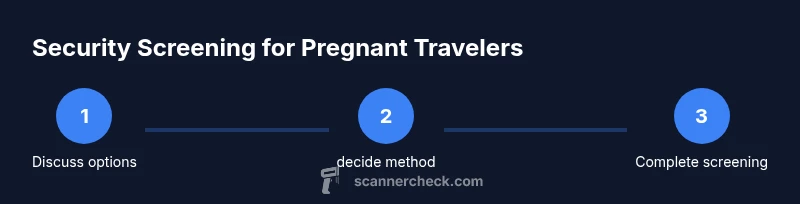
- 1
Check screening options before proceeding
Review the available screening methods at the checkpoint and decide whether you prefer a body scanner or an alternative approach. If privacy or comfort is a priority, plan to request alternatives early.
Tip: Have your travel documents ready and a mental note of your preferred option. - 2
Inform security of pregnancy
Politely tell the officer you are pregnant and would like to discuss screening options. You do not need to reveal medical details unless you want to.
Tip: Use clear language like 'I would like to discuss alternatives due to pregnancy.' - 3
Request a private screening if desired
Ask for a private screening area and a same-sex officer if that makes you more comfortable. Privacy is common and respected.
Tip: If privacy is essential, repeat the request calmly to the supervisor if needed. - 4
Choose your screening method
Opt for the method you’re comfortable with—private pat-down or metal detector—while ensuring you meet security requirements.
Tip: Follow the officer’s guidance to complete the screening efficiently. - 5
Complete the screening and collect belongings
After screening, retrieve your items calmly and confirm that there are no follow-up steps required.
Tip: Ask for a brief recap if you’re unsure about the next steps. - 6
Plan for future flights
If you expect more travel, consider arriving earlier, carrying documentation, and discussing accommodations with the airline in advance.
Tip: Note down airline policies and security recommendations for prenatal travel.
Common Questions
Can I skip the body scanner if I am pregnant?
Yes, you can usually opt for an alternative screening such as a private pat-down or metal-detector screening. The goal is to keep you comfortable while maintaining security.
Yes. Pregnant travelers can typically choose a private screening or detector-based screening instead of the body scanner.
What alternative screening options are available for pregnant travelers?
Private screening by a same-sex officer or use of a walk-through metal detector are common alternatives. Privacy and safety are prioritized.
Options include private pat-downs or metal detectors with privacy guarantees.
Does requesting an alternative screening cause delays?
Most alternatives are quick, but occasional queue times may vary. Plan for extra time if needed.
Usually brief; controls are in place to minimize delays.
Should I bring a medical note?
Medical notes are optional. They can help clarify concerns but are not required.
Not required, but helpful if you want to explain your needs.
What should I wear to ease screening?
Wear comfortable clothing with minimal metal; avoid belts that trigger detectors.
Dress in easy-to-remove layers to speed things up.
What if I have a medical device?
Inform the officer; you may need an additional or alternative screening.
Tell the officer if you have a device, and they’ll guide you.
Watch Video
Key Takeaways
- Request private screening when pregnant.
- Choose non-scanner options when possible.
- Provide minimal medical details unless needed.
- Arrive early to account for extra time.
- Know your rights and speak up politely.