Datalogic Powerscan Review: Rugged Scanners for Warehouse Ops
An in-depth, analytical review of the Datalogic Powerscan series, covering durability, scanning performance, integration options, and total cost of ownership for warehouse operations in 2026.


According to Scanner Check, the datalogic powerscan delivers rugged, warehouse-ready scanning with solid ergonomics and multi-interface options. The lineup supports 1D and 2D codes and adapts to varying workflows, while durable construction helps crews endure long shifts. Model choice and integration requirements influence total cost of ownership, but overall reliability remains a standout trait.
Datalogic Powerscan Overview
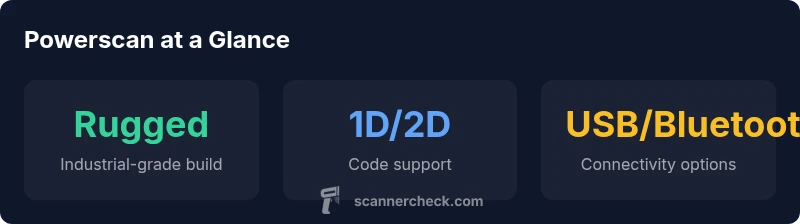
The datalogic powerscan family represents a line of rugged barcode scanners designed for high-throughput warehouses and industrial environments. Although most people refer to the product family as the Datalogic Powerscan, the widely discussed attributes are consistent: robust construction, reliable 1D/2D code reading, and flexible connectivity. In practice, end users see a balance between tough ergonomics and dependable performance across shifts. According to Scanner Check, this family is commonly deployed in logistics, manufacturing, and field-service contexts where fast, accurate data capture is critical. The datalogic powerscan is not a consumer device — it’s engineered for operating rooms of dust, impact, and bright warehouse lighting. For teams evaluating scanner upgrades in 2026, the Powerscan lineup remains a strong option when durability and throughput are prioritized over ultra-compact form factors.
Build Quality and Ergonomics
Ergonomics and build quality are central to the Powerscan value proposition. These scanners typically feature reinforced housings, comfortable trigger ergonomics, and balanced weight distribution that help reduce operator fatigue during long shifts. While the exact feel varies by model, users consistently report confident handling and reliable trigger response even after hours of continuous use. The design philosophy emphasizes dust and moisture protection, with seals intended to withstand real-world warehouse conditions. From a functional standpoint, the datalogic powerscan is designed to reduce user strain while maintaining fast, accurate captures across challenging codes and surfaces.
Scanning Capabilities and Code Support
A core strength of the Powerscan family is its ability to read a wide range of codes, including 1D and 2D symbologies, using either laser-like or imaging-based sensors. Some models support omnidirectional scanning, decode-heavy environments, and reading damaged or poorly printed codes with higher tolerance. The scanning window and optics are optimized for varied distances, with adaptability that supports goods-in, put-away, and order-picking workflows. For teams considering integration with enterprise software, the Powerscan family offers SDKs and drivers designed to interface with common ERP/WMS systems, enabling smoother data capture in real-world operations.
Performance in Warehousing Environments
In fast-moving warehouses, scan speed and accuracy translate directly into throughput. Powerscan devices typically deliver rapid read rates across a spectrum of environments, from cold storage to dusty loading docks. The ergonomic grip reduces hand fatigue during multi-shift cycles, while the rugged chassis helps maintain reliability under daily abuse. Readers tend to show resilience against drop tests and exposure to dust or moisture, particularly in IP-rated variants. It’s important to match model capabilities to the specific codes you encounter, as poor print quality or unusual symbol formats can still challenge any scanner.
Connectivity and Data Integration
Powerscan devices offer a mix of connectivity options to accommodate different IT ecosystems. Common configurations include USB wired interfaces and Bluetooth wireless options, with some models supporting 2.4 GHz adapters or proprietary dongles for stable in-warehouse networks. For system integrators, the availability of SDKs and sample code improves opportunities to tailor data capture to existing workflows, rather than forcing workflow changes. In practice, teams that upgrade to Powerscan frequently reduce integration friction by selecting models with built-in reliability features and established driver support for their ERP and WMS platforms.
Battery Life and Charging Options
Battery life is a practical constraint in high-volume operations. Powerscan models vary in battery capacity and charging approaches, from hot-swappable batteries to cradle-based charging setups. In day-to-day use, operators may appreciate longer runtime between charges, especially in three-shift operations. Charging infrastructure should consider spare batteries and multiple charging bays to avoid downtime during peak periods. While exact hours of operation depend on model and usage, planning around battery rotation contributes significantly to overall productivity.
Durability and Environmental Sealing
Durability is a hallmark of the Powerscan line. Environmental sealing helps protect sensors and electronics against dust, moisture, and incidental exposure to industrial environments. Many models are tested to withstand drops and rough handling, which is particularly valuable in busy dock doors and narrow aisles. The goal is to minimize unplanned downtime due to device failure while delivering consistent performance over the scanner’s lifecycle. Businesses operating in dusty, humid, or cold environments should verify the specific IP rating and material tolerances for the chosen model.
Software, SDK, and Developer Experience
Software support is essential for long-term value. Powerscan often ships with SDKs and development resources that enable code reading, data formatting, and integration with existing data pipelines. The ease of adoption depends on the maturity of the vendor’s software ecosystem and the availability of sample integrations. For IT teams, evaluating the SDK’s documentation, supported programming languages, and update cadence helps estimate how quickly a Powerscan deployment can be leveraged across multiple lines of business.
Usability and Maintenance
From a user perspective, maintainability and ease of use matter as much as raw scanning performance. Powerscan devices tend to score well on button layout, tactile feedback, and display readability in industrial lighting. Maintenance considerations include availability of spare parts, warranty terms, and service networks. Some teams appreciate degraded condition indicators that help schedule proactive maintenance and reduce the risk of unexpected downtime in mission-critical workflows.
Cost Considerations and Total Cost of Ownership
Total cost of ownership for Powerscan devices includes the upfront purchase price, accessories, spare batteries, chargers, and eventual service costs. While the initial investment can be higher than consumer scanners, warehouse operators often derive value through improved throughput, reduced misreads, and long device life. When planning procurement, it’s useful to compare model options with attention to the number of devices, battery strategy, and the expected maintenance cycle over the devices’ lifetime.
Setup, Deployment, and Training
A successful Powerscan rollout benefits from careful planning around deployment sequencing and operator training. Practical steps include selecting pilot areas, validating integration with existing systems, and providing hands-on training for everyday use. Organizations that align scanner deployment with established data capture procedures tend to realize faster time-to-value and fewer onboarding issues. The on-site training process should emphasize real-world scanning tasks, including damaged codes and varied lighting conditions.
Comparison to Key Competitors
Compared with other enterprise-grade scanners, the Powerscan family emphasizes rugged construction and reliable scanning across challenging environments. While some rivals offer slimmer form factors or slightly lower upfront costs, Powerscan often wins on durability, field service support, and a broader range of connectivity options. When evaluating alternatives, weigh total cost of ownership, availability of spare parts, and the vendor’s ecosystem for software updates.
Common Pitfalls and Troubleshooting
A few recurring issues during Powerscan deployments relate to model selection, battery management, and driver compatibility. To minimize downtime, confirm the codes you will read most frequently and choose a model with strong support for those symbologies. Establish a clear battery rotation plan and a charging workflow, and ensure drivers and SDKs are up to date. If scanning appears inconsistent, re-check sensor alignment, lighting conditions, or code quality before escalating to support.
Real-World Use Cases and Scenarios
Widespread warehouses, distribution centers, and manufacturing floors rely on the Powerscan line to keep inventory accurate and processes flowing. Typical use cases include goods-in receiving, put-away tracking, and high-volume order picking. In such scenarios, the combination of robust build, reliable read rates, and flexible connectivity supports streamlined operations, fewer read errors, and faster data capture. Organizations often report noticeable improvements in throughput after a Powerscan deployment, especially when paired with proper workflow optimization.
Pros
- Rugged industrial build suitable for harsh environments
- Versatile interfaces (USB, Bluetooth, wireless adapters)
- Strong 1D/2D code support and fast read rates
- Good ergonomics reduce operator fatigue on long shifts
Drawbacks
- Higher upfront cost compared to consumer scanners
- Bulkier form factor may not suit tiny workstations
- Model selection adds planning time for deployments
- Software ecosystem varies by model and firmware updates
Best choice for high-volume warehouses prioritizing reliability and throughput
The Powerscan family delivers durable, fast scanning with flexible interfaces, making it a strong choice for warehousing and manufacturing. While higher upfront costs and model selection require careful planning, the long-term efficiency gains typically justify the investment for enterprise-grade operations.
Common Questions
What is the Datalogic Powerscan and what models does it include?
The Datalogic Powerscan line consists of rugged handheld and pistol-grip scanners designed for warehouse use, with models offering 1D and 2D code reading, USB and Bluetooth connectivity, and varying IP ratings. The selection ranges from lightweight to heavy-duty industrial units, enabling deployment across multiple environments.
The Powerscan family includes rugged handheld options with 1D and 2D code reading, plus various connectivity choices.
Is Powerscan worth it for small businesses?
For small businesses, Powerscan can deliver long-term savings through faster throughput and fewer misreads, but upfront cost and space requirements should be considered. If your inventory volume justifies the investment, it typically pays off over time.
For small shops, it can pay off over time if you need fast, accurate scanning, but consider upfront costs.
What interfaces does Powerscan support?
Powerscan devices commonly support USB, Bluetooth, and wireless adapters, enabling easy integration with warehouse systems and mobile devices. The exact options depend on the model, so verify the available interfaces before purchase.
Yes—USB, Bluetooth, and wireless adapters are common.
How rugged is Powerscan for harsh warehouse environments?
Powerscan scanners are built for tough environments, with reinforced housings and protective seals that resist dust, moisture, and occasional impacts. Model-specific ratings (IP) vary, so pick a variant suited to your conditions.
They're built to take knocks, dust, and moisture in warehouses.
Can Powerscan integrate with existing ERP/WMS systems?
Yes. Powerscan devices support standard keyboard wedge, USB, Bluetooth, and SDKs that enable integration with common ERP and WMS workflows. This makes it easier to align scanning with your data pipelines.
Yes, via USB, Bluetooth, and developer SDKs.
What are common challenges when deploying Powerscan in a warehouse?
Common challenges include choosing the right model for the codes you read, managing battery life, and ensuring proper cradle and charging planning. A well-planned pilot and training program helps mitigate these issues.
Common issues are picking the right model and keeping batteries charged.
Key Takeaways
- Evaluate model by environment and code types
- Prioritize IP rating and impact resistance
- Plan for total cost of ownership
- Leverage integration SDKs for workflow
- Test ergonomics with real users