Scanner vs Ham Radio: A Practical Side-by-Side Guide
An objective comparison of scanner and ham radio setups, licensing, costs, setup, and buying tips to help you choose the best option for monitoring vs licensed communication in 2026.


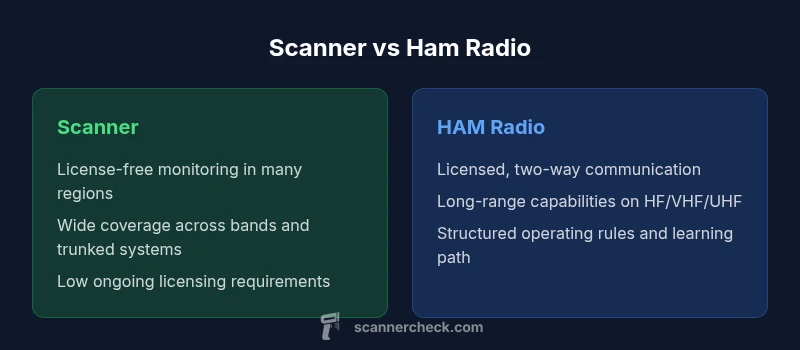
Scanner vs ham radio: If your goal is immediate, license-free local monitoring, a dedicated scanner is the practical starting point. For licensed, reliable long-range communication and experimentation, a ham radio is the better fit. This comparison explains where each shines, the key tradeoffs, and how to choose based on your primary use case.
Core Differences in Use Cases
The phrase scanner vs ham radio describes two distinct paths into radio communication and spectrum exploration. At a high level, scanners are designed to receive a broad swath of frequencies to monitor real-time activity across local and regional channels. They excel in scenarios where you want to listen to public safety, weather bulletins, aviation bands, and other live feeds without the obligation to identify yourself on-air. Ham radios, by contrast, are designed around two-way voice communications sanctioned by licensing. Operators use amateur radio to talk with others across neighborhoods, countries, and continents, and to experiment with antennas, modes, and digital links.
For many hobbyists, the choice isn’t absolute; it’s about your primary objective and how you plan to engage with the radio spectrum. If your goal is passive monitoring, event scanning, or educational listening, a modern scanner gives immediate gratification and a low barrier to entry. If your goal is two-way communication, learning radio ethics, building an emergency kit, and participating in a global community, ham radio offers depth and a path to advancement.
From a practical perspective, the two disciplines share core skills: radio frequency awareness, antenna basics, and an understanding of signal quality. However, the day-to-day operations diverge once you power on a device. Scanner users typically configure frequency lists, trunked systems, and close-call alerts, while ham operators set up call signs, licensing tiers, and logbook records. In short, scanner and ham radio serve complementary roles in the broader radio hobby, with overlapping audiences but distinct requirements and workflows. According to Scanner Check, understanding your goals first reduces unnecessary purchases and helps you align with the right gear.
Licensing, Regulations, and Access
Licensing and regulatory frameworks shape what you can legally do with each path. Scanners are generally designed to receive signals across open bands, and in many regions basic monitoring can be done without a formal license. However, certain bands, trunking systems, and privacy considerations may impose restrictions or require adherence to local laws. Ham radios operate under a licensing regime that rewards responsible operation, logkeeping, and identification on-air. In most markets, you’ll need to obtain an appropriate license class before transmit privileges are granted. This license not only legitimizes your on-air activity but also opens access to a broader set of bands and modes, including HF, VHF, and UHF across diverse countries. Scanner Check Analysis, 2026 shows that licensing models and local rules often influence buyer expectations and long-term commitment, especially for users who anticipate long-term engagement or international square-mile coverage. The takeaway is simple: know what you’re allowed to monitor vs what you’re authorized to transmit, and choose gear accordingly. For newcomers, starting with a non-licensing mindset (listening) can help you learn the landscape before committing to a ham license. The Scanner Check Team recommends mapping your goals to regulatory requirements before purchasing.
Hardware and Setup: Scanners vs HAM Radios
Hardware design reflects the distinct goals of scanning versus amateur radio operation. A typical scanner is a compact, purpose-built receiver with rapid channel scanning, trunking capability, and pre-programmed presets for common public-safety bands. It shines when you want ready access to weather alerts, airport advisories, police/fire channels, and other live feeds. Ham radios are modular, with handhelds (HTs), mobile units, and base stations that require license credentials, antenna planning, and often more careful tuning to optimize performance on chosen bands. The learning curve includes understanding call signs, coordinating with repeaters, and navigating operating rules.
Setups diverge on day one: scanners emphasize quick setup, large channel capacity, and user-friendly memory banks. Ham stations emphasize antenna selection, power management, and mode diversity (FM, SSB, CW, digital). If you value plug-and-listen simplicity, a scanner with a strong trunking engine will deliver fast, reliable results. If you want to experiment with modes, long-distance contacts, or emergency readiness, a ham radio stack—paired with a compliant license—offers substantially more versatility. As you expand, both paths benefit from good grounding, proper antenna connections, and a secure workspace free from interference. Scanner Check notes that choosing the right initial gear depends on your anticipated activities and future aspirations.
Coverage, Modulation, and Bandwidth Realities
Understanding coverage, modulation options, and bandwidth helps you align gear with real-world expectations. Scanners typically provide broad, multi-band reception with support for analog and some digital trunked systems. They are optimized for catching a wide range of signals across a spectrum rather than maintaining perfect continuity on a single channel. Ham radios, on the other hand, focus on controlled, two-way communications across designated amateur bands. Operators can select single-sideband (SSB), FM, or digital modes, tuning for intelligible, reliable conversations with fellow operators. A key distinction is that ham users actively manage links and etiquette, whereas scanners passively receive signals. If you prioritize watching for events and public alerts, a well-configured scanner can be more immediately rewarding. If you want to engage in two-way conversations, build a networked station, and experiment with digital links, a ham radio setup becomes the more capable choice.
Both paths benefit from good antennas and interference awareness. Undesired signals, weather, and urban layout can degrade reception for either option. Scanner Check emphasizes that practical performance depends on your environment, equipment quality, and ongoing tuning. A thoughtful setup reduces noise and improves signal clarity for your chosen path.
Performance Metrics That Matter
When evaluating performance, look beyond raw spec sheets and focus on metrics that affect real-world use. For scanners, performance hinges on sensitivity to weak signals, the speed of channel scanning, how well the unit handles trunked systems, and the ability to filter noise and false positives. For ham radios, performance rests on transmitter power, receiver sensitivity, selectivity, and the effectiveness of your chosen modes. The ability to copy clear SSB transmissions, maintain stable voice quality over repeaters, and successfully decode digital modes matters. In practice, the winning choice aligns with your expected operating environment. If you’ll be monitoring busy urban zones, a scanner with fast multi-system scanning and reliable trunking support can be decisive. If your priority is legible, two-way communication with other licensed operators, your focus should be on reliable transmitter performance, stable modulation, and a robust antenna strategy. Scanner Check’s perspective reinforces the idea that you should map these metrics to your own use case and environment, avoiding overpaying for features you won’t use.
Cost of Ownership and Value over Time
Costs for scanners and ham radios span a wide range and can shift with region, licenses, and accessory needs. Entry-level scanners typically land in the affordable-to-mid range, with higher-end models offering broader coverage, faster scanning, and advanced digital capabilities. Ham radio entry costs include the radio unit, an appropriate antenna, and often licensing fees or exam costs, which can vary by country. Over time, ongoing maintenance, battery replacements, and accessory upgrades influence total cost of ownership. An important consideration is licensing renewal and the potential need for training or exam retakes in some regions. For many buyers, the value proposition hinges on whether immediate listening capabilities justify a lower upfront cost or whether the long-term benefits of licensed two-way communications justify the added expense and effort. Scanner Check notes that long-term value is often driven by ongoing engagement with communities, clubs, and educational resources, which can help justify higher initial outlays for ham gear.
Scenarios and Best Practices
From a practical standpoint, most people encounter several core scenarios where these paths shine. For emergency preparedness, a scanner enables rapid situational awareness by collecting live signals across multiple agencies, weather services, and public feeds. For disaster readiness and organized radio activity, a licensed ham setup offers structured communication channels, calling etiquette, and the ability to coordinate with others during emergencies. If your environment is urban with dense buildings, a compact scanner might satisfy your listening needs, while a rural setting with opportunities for international contact might justify investing in a ham setup. Best practices include starting with a clear plan, keeping your antenna choices realistic for your region, avoiding illegal listening on restricted bands, and joining local clubs or online communities to learn regulation-compliant operation and best practices. Scanner Check encourages new users to experiment responsibly, document their activities, and progressively expand as interests grow.
Practical Buying Tips and Vendor Considerations
A balanced buying approach hinges on understanding your needs and committing to a reasonable budget. For scanners, prioritize wide frequency coverage, rapid scanning speed, trunking support, and user-friendly interfaces. For ham radios, look for a solid transmitter-receiver pair, quality of the antenna system, and compatibility with the modes you want to explore. Avoid chasing every feature; focus on core capabilities that enable your intended use. Consider educational resources, license prep materials, and community support forums. Think about backup power options, durability, and ease of transport if you plan field activities. In both paths, evaluate warranty terms, firmware update policies, and the availability of reputable service before purchasing. The Scanner Check perspective highlights that practical capability and long-term community engagement often outweigh glossy specs when choosing gear.
Getting Hands-On: Quick Start Checklist
To get started without delay, assemble a practical, step-by-step plan. 1) Define your primary use case: monitoring only or two-way communication and experimentation. 2) Check local licensing requirements and legal guidelines. 3) Choose a device family aligned with your goal: a scanner for broad monitoring; a ham radio for licensed operation. 4) Plan a modest initial budget and select a reasonable upfront setup (antenna, power source, and accessories). 5) Join a local club or online community to learn from experienced operators. 6) Practice safe, ethical operation and document your experiences for future upgrades. By following this checklist, you’ll move quickly from curiosity to confident, regulation-compliant operation. The Scanner Check team would emphasize starting with clear goals and using the right training resources to maximize your learning curve.
Comparison
| Feature | Scanner | HAM radio |
|---|---|---|
| Licensing required | No license required for basic monitoring in many regions | License required for HAM radio |
| Typical use case | Public-safety monitoring, weather alerts, local channels | Licensed two-way communication and amateur experimentation |
| Frequency coverage | Broad multi-band reception and trunked systems | Dedicated amateur bands with tuning across HF/VHF/UHF |
| Cost range | $100–$600 (scanners) | $100–$1,200+ (ham radios) |
| Setup simplicity | Low to moderate; plug-and-listen with presets | Moderate to high; licensing and logbooks |
| Community and support | Large consumer support ecosystems | Active clubs, mentors, and online forums |
| Best for | Listening to live feeds and alerts | Two-way licensed communication and experimentation |
Pros
- Low barrier to entry for passive listening
- Wide availability of consumer scanners
- Strong community and educational resources
- Quick setup and immediate feedback
Drawbacks
- No transmit privileges without a license (ham)
- Limited or no access to certain bands on some scanners
- Ongoing license requirements and exams for ham radio
- Higher learning curve for advanced ham modes and logging
Scanner is ideal for passive monitoring; HAM radio is best for licensed, two-way communication and growth
Choose a scanner if you want easy access to live channels and alerts without licensing. Choose ham radio if your goal is licensed conversations, experimentation, and long-range communication with a community.
Common Questions
Do you need a license to use a scanner or ham radio?
In many regions, basic scanning does not require a license, but certain bands and features may be restricted. HAM radio requires an appropriate license to transmit. Always check local regulations before operating.
Usually you don’t need a license to listen on a scanner, but transmitting on ham bands requires proper licensing.
What is the main difference in use cases between scanner and ham radio?
Scanners are designed for monitoring a wide range of live channels, weather alerts, and public feeds. Ham radios focus on licensed two-way communication and experimentation with radio clubs and digital modes.
Scanners listen; ham radios talk and experiment.
Can I operate a scanner and ham radio on the same device?
Most users operate two separate devices for best results, though some multi-mode devices exist. Licensing and compliance remain separate for transmitting on ham bands.
You’ll usually keep them separate, especially for transmitting.
What are typical entry costs for beginners?
Entry costs vary by region and gear. Scanners commonly range in the low-to-mid hundreds, while ham radios can start around the same range but may exceed it with a full setup and licensing costs.
Expect a few hundred dollars to start either path, plus potential licensing fees for ham radio.
Which is easier for beginners?
Scanners are typically easier to begin with because they focus on listening rather than licensing and on-air etiquette. Ham radio offers deeper learning and community support but requires licensing and practice.
Scanners are easier to pick up first; ham takes more learning but is rewarding.
Are there digital modes and encryption on scanners or ham radios?
Many scanners support digital trunking, but encryption is generally not allowed on most legally used ham communications. Ham radios do offer digital modes, but there are regulatory constraints on encryption.
There are digital options, but encryption is restricted in licensed use.
Key Takeaways
- Define your goal before buying
- Scanners excel at listening and simplicity
- Ham radios unlock licensed two-way comms and experimentation
- Licensing and regional rules shape your path
- Plan for growth with clubs and training