Stock Scanner vs Screener: A Practical Comparison
Discover how stock scanners differ from screeners, when to use each in trading workflows, and how to combine them for faster, more precise decision-making. Practical tips, setups, and common pitfalls explained.


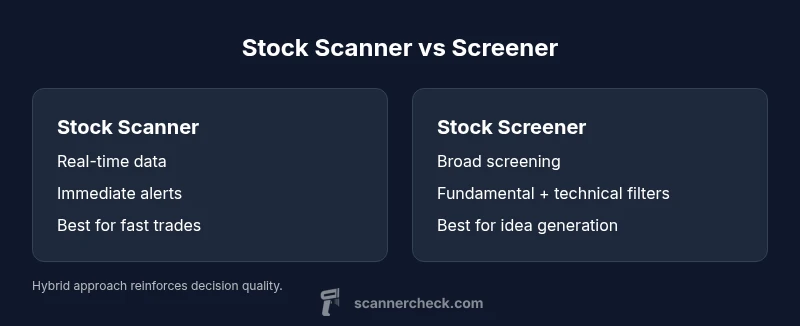
Stock scanners and stock screeners serve different purposes in trading: scanners filter real-time data to surface immediate opportunities, while screeners apply predefined rules to a broad universe to generate candidate lists for deeper review. The best approach combines both tools—use a scanner for rapid entry decisions and a screener for longer-term idea generation. This hybrid workflow reduces decision fatigue and improves signal quality.
What stock scanner vs screener means in practice
In trading, a stock scanner is a real-time filter that continuously watches price, volume, and other live sources to surface immediate opportunities. A stock screener, by contrast, applies predefined rules to a wide universe of stocks to produce a list of candidates for deeper review. The distinction matters because scanners are about speed and responsiveness, while screeners emphasize breadth and multi-factor filtering. For many traders, using both tools in a staged workflow yields the best results: scanners grab the fast trades, screeners identify longer-term ideas for further evaluation. According to Scanner Check, establishing a clear separation between these tools helps reduce decision fatigue and improves hit rates. To implement this, you might configure a high-signal scanner for intraday scans and pair it with a more conservative screener that screens on fundamentals and technicals across the market. In practice, the main difference is not the data type alone but how you interact with that data: real-time alerts vs batch-generated lists. By understanding this, you can tailor your dashboards, alerts, and watchlists to fit your trading style.
Core differences: live data vs static filters
The core difference is data dynamism. Scanners rely on streaming data and ultra-low-latency feeds to trigger alerts as conditions occur—price gaps, volume spikes, breakouts, or unusual options activity. Screeners evaluate static or semi-static criteria against a predefined universe and return a ranked list of candidates for manual review. This difference shapes risk, cost, and speed. Scanners are more sensitive to data quality and platform latency; screeners tolerate minor data gaps because they provide curated lists rather than immediate trade signals. In addition, the filtering criteria differ: scanners emphasize short-term technical signals (momentum, breakout patterns, or liquidity thresholds), while screeners combine technicals with fundamentals (valuation, growth metrics, sector strength) to support longer-term analysis. When evaluating tools, consider your time horizon, risk tolerance, and the capacity of your trading platform to handle real-time data. Scanner-heavy setups require robust hardware, reliable feeds, and a plan to manage false positives, whereas screener-focused setups benefit from clean, well-documented screens and a systematic review process.
Use case: day trading and scalping with scanners
For day traders, speed is essential. A stock scanner that updates in real time and can trigger alerts in milliseconds helps catch breakout entries and quick reversals. To optimize such workflows:
- Pick a set of 'hot' signals: price breakout above multi-day resistance, above-average volume, or a sudden surge in momentum indicators.
- Keep a tight risk rule: stop-loss per position and maximum number of trades per session.
- Create focused watchlists: a small number of stocks that frequently trigger your signals.
Example workflow: start with a broad live-price filter, move to intraday RSI or MACD cross, then review the candidate list for confirmation using price action on a 1-minute or 5-minute chart.
However, scanners are noisy; they can surface many false signals when markets are erratic. It’s crucial to enable latency-aware alerts (e.g., only when price moves by a certain percentage within a short window) and to backtest your signals on simulated data where possible. In practice, day traders who rely solely on scanners may miss context; thus, they pair scanners with quick rule-based reviews or a secondary screener to filter out low-probability entries.
Use case: longer-term investing with screeners
Stock screeners shine when you are scanning for ideas across hundreds or thousands of names with multi-factor criteria. For long-term investors or position traders, a screener can filter by fundamentals (earnings growth, debt levels, cash flow) and technicals (trend strength, relative strength, valuation multiples) to surface higher-conviction candidates. The workflow often looks like this: run a broad screener to identify momentum leaders or solid fundamentals, export a list, then perform in-depth due diligence on each candidate. Because screeners operate on historical data snapshots and predefined rules, you can build repeatable, auditable processes. The trade-off is that screeners may miss rapid, transient opportunities that a live scanner would catch, so alignment with your time horizon is essential.
Common pitfalls and how to avoid them
One of the biggest risks with stock scanners is chatter: too many signals leading to overload. Mitigate by tiered alerts, filtering by minimum price movement, and only activating signals during liquid trading sessions. For screeners, the pitfall is overfiltering: using overly strict criteria can prune away good ideas. Maintain transparency in your criteria, document tolerances, and periodically recalibrate screens to reflect changing market regimes. Data quality matters for both tools; ensure you rely on reputable data feeds and keep latency in check. Finally, avoid relying on a single tool for decisions. Always validate scanner or screener outputs with price action analysis, news awareness, and risk controls.
Configuring your workflow: tips and steps
A practical setup starts with clarity on your goals and time horizon. Decide whether you primarily trade intraday, swing, or invest long-term. Then configure a flagship scanner for immediate signals and a separate screener for broader screening. Create a dashboard that surfaces only the most relevant signals for quick reviews, and establish a routine for deeper evaluation of the top candidates. Document your rules, keep a trade log, and iterate based on performance. Finally, consider automation where appropriate: auto-export lists to a watchlist, auto-suppress false positives, and build alerts that trigger your standard review checklist.
Integrating both tools for a robust process
The most resilient approach is a hybrid workflow. Start with a broad stock screener to assemble a candidate pool that meets your fundamental and technical criteria. Then apply a real-time stock scanner on that pool to identify immediate entry points. Use the screener’s results to prioritize the scanner’s alerts, ensuring you act on high-probability scenarios. This integration reduces noise, speeds decision-making, and creates a repeatable framework your team can audit. Training and routine reviews are critical: schedule monthly calibration of screens, test new signals on paper trades, and track performance to refine both tools over time.
Comparison
| Feature | Stock Scanner | Stock Screener |
|---|---|---|
| Data freshness | Real-time / streaming data | End-of-day or intraday data with delays |
| Filtering criteria | Live signals, speed-focused filters | Broad, multi-factor rules across a wide universe |
| Setup time | Quicker to configure real-time alerts | Longer to build multi-criteria screens |
| Best for | Day trading and rapid entries | Longer-term research and idea generation |
| Cost considerations | Often higher for real-time data feeds | Typically lower when bundled with platforms |
| Output | Immediate signals and action plans | Filtered candidate lists for review |
Pros
- Accelerates discovery of actionable setups
- Supports rapid decision-making in fast markets
- Helps manage large data pools with automation
Drawbacks
- Scanners can generate noise and false positives
- Screeners may miss rapid, transient opportunities
- Data costs and latency impact accuracy
Hybrid workflow: use a scanner for real-time signals and a screener for broad screening
Scanners excel at speed and immediacy, screeners excel at breadth and fundamentals. A combined approach delivers faster, more reliable decisions with auditable criteria.
Common Questions
What is the main difference between a stock scanner and a stock screener?
A stock scanner filters live market data to surface immediate trade opportunities, while a stock screener applies predefined rules to a broad universe to produce candidate lists for deeper analysis.
A stock scanner finds real-time opportunities, and a stock screener lists candidates based on preset rules for review.
Can stock screeners be useful for day trading?
Yes, screeners can identify potential intraday movers, but they work best when paired with real-time analysis and fast execution to take advantage of short-lived moves.
Screeners can help for intraday ideas, but pair them with real-time checks for quick moves.
Do I need expensive data feeds for scanners?
Real-time scanners generally require faster data feeds, which can increase costs. Delayed or mixed data can still support screening, but speed and accuracy may be reduced.
Fast data helps scanners, but delayed data can still work for screening with trade-offs.
Are there free stock screeners available?
There are free screeners, but they often come with limited filters, data quality, or export options. Paid tools typically offer richer screens and more robust data.
Free options exist but usually have limits; paid tools provide deeper screens and better data.
How should I choose between a scanner and a screener?
Choose based on your time horizon and workflow: use a scanner for quick entry in active markets and a screener for broad research and long-term idea generation. The best practice is to use both in a complementary sequence.
Pick scanners for speed, screeners for breadth, and use both together for best results.
What data sources do scanners typically use?
Scanners typically rely on real-time price, volume, and order flow data, supplemented by technical indicators. Screeners rely on historical price data plus fundamental metrics depending on the criteria.
They use real-time price and volume for scanners, and historical data plus fundamentals for screeners.
How can I reduce false positives from a scanner?
Tighten risk parameters, incorporate confirmation signals (price action or a secondary indicator), and limit alerts to liquid stocks to improve signal quality.
Tighten rules, add confirmations, and focus on liquid stocks to cut noise.
Is automation recommended for scanners and screeners?
Automation can help with routine filtering and alerting, but you should maintain human review for context, risk controls, and trade execution decisions.
Automation speeds filtering, but keep human review for risk and judgment.
Key Takeaways
- Use scanners for real-time opportunity spotting and fast entries
- Use screeners for broad idea generation and fundamentals-based screening
- Combine both tools to create a robust, repeatable workflow
- Regularly recalibrate screens and validate signals with price action
- Document criteria and track performance for continuous improvement