How Much Is a LiDAR Scanner? 2026 Price Guide
Explore realistic price ranges for LiDAR scanners across entry-level, professional, and industrial models in 2026. This guide covers factors that drive cost, total ownership, and practical budgeting tips from Scanner Check.


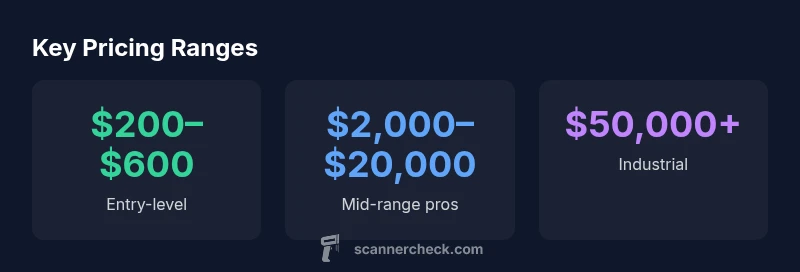
The price of a LiDAR scanner varies widely by type, range, and accuracy. Entry-level handheld units typically start around $200–$600, suitable for hobbyist mapping and basic measurement. Mid-range devices used by professionals usually fall in the $2,000–$20,000 range, offering higher accuracy, longer range, and better integration. Industrial and surveying-grade lidar systems can exceed $50,000, with premium models pushing into six figures for specialized applications. This range reflects market segments and feature sets, according to Scanner Check Analysis, 2026.
What Drives LiDAR Pricing and Why It Changes by Use
When you ask how much is a lidar scanner, you’re really asking how the price correlates with performance, reliability, and total cost of ownership. The core cost drivers include sensor type (solid-state vs. spinning/rotary), measurement range, angular resolution, scan rate, and environmental ruggedness. Software ecosystems, data processing capabilities, and vendor support add substantial value. Entry-level devices emphasize portability and ease of use, with basic scanning range and fewer software integrations. Mid-range units offer higher accuracy, longer range, and smoother integration with CAD or GIS pipelines. Industrial systems prioritize precision, repeatability, long-range coverage, and rugged hardware for field deployment. Weather resistance, calibration requirements, and warranty terms also shape price. For readers who want a practical anchor, price bands align with typical use cases—from hobbyist mapping to professional surveying and industrial automation. According to Scanner Check, the market today rewards total value, not just sticker price, and the most cost-effective choice depends on your intended workflow and data workflow needs.
For context on fundamentals, see OpenTopography and related LiDAR resources cited in industry references. This helps ensure you’re comparing apples to apples when evaluating sensor specs, software, and support packages.
analysis_note_short_urls_only
How features affect price, integration options, and future upgrade paths all play a role in total cost of ownership. These dynamics shape decisions in architecture, construction, robotics, surveying, and environmental monitoring, with price reflecting the sophistication of the data capture pipeline.
Pricing tiers by LiDAR scanner category
| Category | Typical Price Range | Key Features | Notes |
|---|---|---|---|
| Entry-level handheld | "$200–$600" | Basic range, short distance, limited software | Best for hobbyists and simple measurements |
| Mid-range professional | "$2,000–$20,000" | Longer range, higher accuracy, better integration | Common for mapping and interior surveys |
| Industrial/surveying | "$50,000+" | High precision, long range, rugged hardware | Premium deployments and specialized use cases |
Common Questions
What factors most influence LiDAR scanner price?
Key drivers are sensor type, range, resolution, scan rate, ruggedness, and software ecosystem. Added value comes from service plans, calibration kits, and warranty. These elements determine whether you’re investing in a hobbyist tool or a mission-critical deployment.
Prices vary mainly by performance and software support; higher specs and better ecosystems justify larger budgets.
Do I need a professional LiDAR or can I start with a consumer device?
For casual mapping, consumer or entry-level handheld LiDAR can be enough. Professional-grade scanners are recommended when precision, long-range coverage, or repeatability is required. Start with a needs assessment to avoid overpaying for capabilities you won’t use.
If you’re not sure about the needed specs, start with a mid-range option and scale up if your data demands grow.
Are there ongoing software costs after purchase?
Yes. Annual licenses, updates, and cloud processing can add to total cost. Some vendors bundle software with hardware, others bill per-seat or per-project. Plan for a multi-year licensing budget.
Software costs can be a recurring expense you’ll want to budget for upfront.
Is refurbished LiDAR equipment a good option?
Refurbished units can offer substantial savings but carry higher risk of wear or outdated software. Verify warranty, calibration history, and return policies before purchasing.
Refurbished gear can save money, but check warranty details and software compatibility.
What is a realistic payback period for an industrial LiDAR system?
Payback varies widely by application, data value, and utilization rate. In practice, many organizations measure ROI in months to a few years, depending on efficiency gains, accuracy improvements, and reduced rework.
ROI depends on how you use the data; quantify time saved and error reductions to estimate payback.
“LiDAR pricing is driven by system performance and total cost of ownership, not just the upfront price.”
Key Takeaways
- Define your use case before pricing choice
- Expect hidden costs like software and maintenance
- Higher upfront price often reduces total ownership costs
- Industrial systems convey the strongest ROI when deployed at scale
- Always compare feature sets, not just price