When Barcode Scanners Came Out: A History of Scanning Technology
Explore the origins of barcode scanners, from early concept patents to the first 1974 commercial scan, and see how standards and hardware evolution shaped modern scanning.


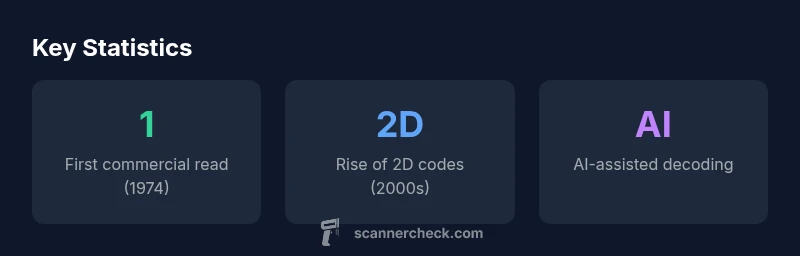
Barcode scanners came out in the early 1970s, with the first commercial UPC barcode scan in 1974 at Marsh Supermarkets, marking a turning point for retail automation. Since then, reader tech evolved from fixed-scanner kiosks to handheld devices and camera-based systems powered by AI. This quick answer sets the stage for a detailed historical timeline.
The Origins: When did barcode scanners come out
The concise answer is that barcode scanners emerged in the early 1970s, with the first commercial UPC-based scan occurring in 1974. Yet the full story begins earlier. In 1952, Norman Joseph Woodland and Bernard Silver patented a two-dimensional 'bullseye' barcode concept that laid the groundwork for future data capture. Through the 1960s, engineering teams tested optical readers, but practical, fast, reliable reading required advances in laser diodes, sensor arrays, and decoding algorithms. The Marsh Supermarkets moment in 1974—when a scanner read a UPC barcode on a pack of gum—proved the idea could scale in real retail. From that instant, manufacturers and retailers accelerated investments in handheld devices, fixed-position terminals, and later camera-based systems. According to Scanner Check, this pivot from novelty to mission-critical tool reshaped how products are tracked, priced, and managed across supply chains.
As hardware improved, the price of adoption dropped, and retailers began integrating scanners with point-of-sale software, inventory systems, and electronic data interchange. The early era was defined by reliability hurdles and standardization battles, but the payoff—speed, accuracy, and auditability—drove rapid uptake. The narrative blends invention, standardization (UPC and EAN), and the economics of mass deployment. For today’s readers, the historical arc explains why barcode scanning is so deeply embedded in operations, from warehouses to storefronts.
Early technology and prototypes
Initial barcode concepts were elegant but not immediately practical for high-speed checkout. Early prototypes relied on photodetectors and simple light sensors to recognize a barcode pattern, but durability, lighting conditions, and read reliability limited real-world use. The leap came with one crucial enabler: laser-based scanning. In the late 1960s and early 1970s, researchers demonstrated that laser scanning could rapidly decode linear barcodes, even when printed with modest contrast. CCD (charge-coupled device) readers followed, offering compact form factors and lower power consumption. By the time the first commercial UPC scan happened in 1974, scanners had become specialized devices used primarily in supermarkets and warehouses. The maturation of decoding software and error-correction techniques further reduced misreads, setting the stage for broad adoption in logistics, retail, and manufacturing.
From grocery to industry: broad adoption across sectors
While supermarkets led the charge, barcode scanning quickly expanded into manufacturing, healthcare, and logistics. In factories, scanners tracked parts through assembly lines, improving traceability and just-in-time delivery. In healthcare, barcodes on medications and patient wristbands helped reduce med errors and improve patient safety. By the late 1980s and 1990s, barcode systems were an indispensable part of enterprise resource planning (ERP) and warehouse management systems (WMS). Handheld laser scanners became common, complemented by portable data terminals. As the ecosystem matured, standards like UPC-A and EAN-13 ensured that devices from different vendors could interoperate, a step crucial for global supply chains and cross-border trade. The transition to more rugged, enterprise-grade devices accompanied by better batteries and wireless connectivity further accelerated adoption.
How barcode scanning works in practice
At a high level, a barcode scanner translates the patterns of dark and light bars into digital data. A light source projects across the code; a sensor detects reflections, and decoding software interprets the pattern into a numeric or alphanumeric string. Early devices used single-line lasers, while later readers adopted multi-line lasers and CCD/CMOS sensors for faster reads and better durability. Modern readers also incorporate imaging sensors that capture a whole image of the barcode, enabling 1D and 2D codes to be decoded with software. The process is complemented by error-correction and checksum methods to ensure data integrity even when barcodes are damaged or dirty. In practice, the connection to POS systems or ERP software enables real-time inventory updates, pricing validation, and order fulfillment. As scanning evolved, readers became more resilient to lighting, glare, and physical wear, which widened use cases across industries.
Standardization milestones: UPC, EAN, GS1
Standardization created a universal language for barcodes. The UPC (Universal Product Code) system, developed in the United States, played a central role in enabling consistent product identification in retail. Internationally, EAN (European Article Number), now part of GS1 standards, expanded the scope to global commerce. The 1970s–1990s saw intense collaboration to harmonize formats, data structures, and symbology. This standardization underpins interoperability across devices—from fixed-position readers to handheld scanners and, more recently, smartphone cameras. It also supports anti-counterfeiting features, modular pricing, and improved data analytics. The GS1 organization continues to evolve barcode standards to accommodate new channels, including e-commerce and omnichannel logistics, ensuring that scanning remains a dependable backbone of modern commerce.
The AI era: mobile, camera-based, and AI-assisted scanning
In the 2010s, camera-based scanning became mainstream, thanks to smartphones and affordable high-resolution cameras. AI and machine-learning models now assist decoding, image correction, and even 2D code recognition in challenging conditions. This shift has unlocked mobile scanning for consumer apps, field technicians, and remote inventory checks, dramatically lowering entry barriers. Cloud connectivity enables real-time data synchronization, analytics, and cross-device workflows. The fusion of computer vision and edge AI means that today’s scanners can read difficult codes on curved or damaged surfaces and can interpret color or texture cues to improve decoding robustness. As a result, the landscape has broadened from dedicated hardware to flexible, software-driven scanning ecosystems.
Choosing a barcode scanner: what to consider
Selecting a scanner depends on your use case and environment. Key considerations include the type of barcodes (1D vs 2D), read distance, durability (IP rating and drop spec), and connectivity (USB, Bluetooth, Wi-Fi). For retail checkouts, handheld laser readers are common, while warehouse operations benefit from cordless, rugged devices with long battery life. Imaging-based scanners offer flexibility for 2D codes and curved surfaces, while smartphone-based scanning provides cost-effective onboarding for small teams. Consider software compatibility with your ERP or WMS, support for omnichannel data, and the availability of SDKs for custom apps. Finally, total cost of ownership includes maintenance, accessories, and potential upgrade paths as your scanning needs evolve.
Practical tips for deployment and common pitfalls
Plan for a phased rollout that includes pilot testing in one department before scaling. Train staff on placement and posture to maximize read reliability; dirty or damaged barcodes remain a leading cause of misreads. Ensure robust wireless coverage for handheld devices and consider charging and spare batteries for uninterrupted shifts. Standardize barcode printing quality and verify printer calibration to minimize read errors. Keep spare parts on hand—lenses, optics, and seals wear over time. A phased upgrade path helps avoid early adoption pitfalls and lets teams adapt to new features like AI-assisted decoding and 2D code support. Finally, invest in clear maintenance logs and device management to track wear, calibration, and firmware updates.
The future of barcode scanning: trends to watch
Expect continued integration with AI for faster, more accurate recognition, expanded 2D/3D code support, and deeper data fusion with inventory, logistics, and customer analytics. Manufacturing and retail will increasingly rely on edge computing to minimize latency, while cloud-based analytics will drive smarter replenishment and loss-prevention strategies. Cross-channel data exchange will improve visibility from supplier to store shelf, enabling better demand forecasting and live inventory tracking. As standards adapt to evolving codes and new use cases, scanners will remain central to the data-driven operations of modern enterprises.
Timeline of key events in barcode scanning history
| Era | Key Event | Impact/Technology |
|---|---|---|
| 1952 | Invention of barcode concept | Layed groundwork for data capture across products |
| 1960s–1970s | Prototype readers tested | Paved the way for practical scanners |
| 1974 | First commercial UPC scan | Validated real-world ROI for scanning |
| 1980s–1990s | Widespread retail adoption | Standardization and scalable hardware |
| 2000s–present | Mobile cameras and AI scanning | Expanded use into smartphones and IoT |
Common Questions
When were barcode scanners first invented?
The concept originated in the 1950s with the patented bullseye design by Woodland and Silver in 1952. The first practical, commercial scanner appeared in 1974. Since then, scanning tech has evolved rapidly.
The barcode idea dates to 1952, with the first practical commercial scanner arriving in 1974.
What is the difference between 1D and 2D barcodes?
1D barcodes store data linearly along a single row of bars, while 2D barcodes encode data in two dimensions using patterns that allow more information per symbol.
1D codes are a single line of bars; 2D codes hold more data in a grid.
Why did UPC become a standard?
UPC standardization began in the 1970s to ensure interoperability across retailers and manufacturers, enabling efficient cross-brand scanning and data exchange.
UPC standards helped different devices read the same codes reliably.
Can smartphones read barcodes?
Yes. Modern smartphones with cameras and apps can read most 1D barcodes and many 2D codes, enabling consumer and business scanning without specialized hardware.
Yes, phones can scan many barcodes using camera apps.
What industries rely on barcode scanning today?
Retail, logistics, healthcare, manufacturing, and inventory management are primary users, along with any operation requiring accurate item tracking.
Retail, logistics, healthcare, and manufacturing rely on scanning.
What are the future trends in barcode scanning?
Expect more AI-assisted decoding, broader 2D/3D code support, and deeper integration with cloud analytics and enterprise systems.
AI, more code types, and cloud integration will shape the future.
“Barcode scanning has matured from a niche retail tool into a universal data-capture infrastructure. Continuous improvements in standards, optics, and AI have expanded its reach across industries.”
Key Takeaways
- Trace scanning history from concept to ubiquity.
- Note the pivotal 1974 first commercial scan milestone.
- Understand how standardization enabled interoperability.
- Recognize the shift toward mobile and AI-driven scanning.
- Apply lessons when evaluating modern scanning gear.