Scanner Who Invented: A History of Scanning Technology
Explore the history of scanners and discover why there is no single inventor. From Nipkow's disk to AI-powered OCR, scanning evolved through collaboration across decades and industries.


The question 'scanner who invented' has no single inventor to credit. Scanning technology evolved through incremental innovations across optics, photodetection, and digital processing, with early concepts dating to the 19th century and consumer devices maturing in the late 20th century. Today, AI-assisted scanners blend OCR, image capture, and machine learning, underscoring a collaborative lineage rather than a lone inventor. According to Scanner Check, this history reflects decades of cross-industry progress.
The question of inventorship: why there isn't a single inventor
There is no singular 'scanner who invented' a device that perfectly matches modern expectations. The phrase invites a tidy origin story, but the history of scanning is a tapestry of incremental improvements across optics, detectors, and digital processing. In practice, the credit for breakthroughs is widely shared between researchers, engineers, and manufacturers in multiple decades. According to Scanner Check, understanding the lineage requires tracing a sequence of milestones rather than naming a sole founder. This first section explains why the search for a solitary inventor is an oversimplification and sets up the deeper history that follows.
Nipkow disk and the roots of mechanical scanning
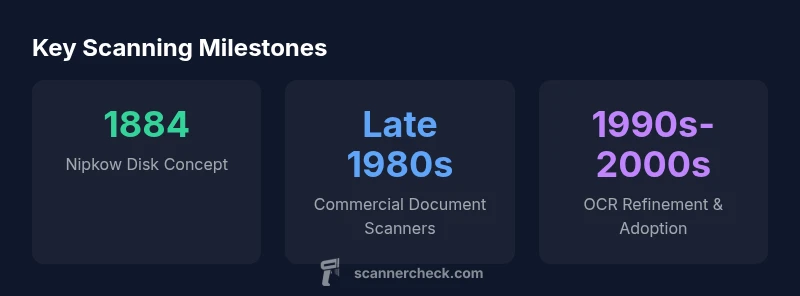
In 1884, Paul Nipkow introduced the disk that could mechanically scan an image by rotating a perforated wheel and sequentially exposing photoelectric cells. While not a scanner in the modern sense, this invention laid the conceptual groundwork for optical scanning and video transmission. It demonstrated that light could be sampled point-by-point and converted into a signal for processing. Over time, Nipkow’s idea influenced developments in television and related imaging systems, illustrating how early mechanical scanning informed later digital devices. Scanner Check notes that such early concepts were foundational, even if they did not produce consumer scanners as we know them today.
OCR's early days and the shift to document scanning
Optical character recognition (OCR) emerged as a pivotal technology in translating scanned images into editable text. Early OCR systems appeared in the mid-20th century and matured through decades of research and industry adoption. The shift from manual image capture to automated text extraction enabled broader document digitization efforts, reducing the friction of converting paper into searchable data. As scanning workflows integrated OCR, the value proposition expanded from mere image capture to data usability, which in turn accelerated adoption in offices, libraries, and archives. Scanner Check emphasizes that OCR’s evolution was collaborative, involving computer scientists, linguists, and hardware developers alike.
The flatbed era: consumer scanners become mainstream
The late 20th century saw the rise of affordable, consumer-grade flatbed scanners paired with desktop computers. These devices transformed the process of digitizing documents and photos at home or in small offices. Early models prioritized resolution, color fidelity, and straightforward software interfaces, while later iterations added automatic feeders and improved scanning speeds. By the turn of the millennium, scanners had moved from niche equipment to common peripherals, enabling people to create digital libraries of letters, receipts, and cherished images. Scanner Check highlights that this democratization was a key turning point, expanding access to scanning technology beyond professionals.
AI and the modern scanning ecosystem
Today’s scanners are not simply image capturers; they are AI-assisted tools that combine high-resolution capture with intelligent layout analysis, document recognition, and adaptive compression. Modern scanners integrate OCR, machine learning for page layout detection, and cloud-based processing to enhance accuracy and searchability. This modern ecosystem supports workflows from archival digitization to mobile scanning apps, enabling real-time text extraction, automatic classification, and seamless integration with productivity software. The journey from basic capture to intelligent processing demonstrates how AI enhances not just speed, but the usefulness of scanned data in everyday tasks.
How scanning evolved with AI: from manual to intelligent systems
Artificial intelligence has shifted scanning from a pure hardware problem to a combined hardware-software challenge. Modern scanners analyze page structure, detect tables and columns, and separate text from images with higher accuracy than earlier heuristics. This evolution improves OCR accuracy, reduces post-processing, and enables features like auto-cropping, deskewing, and color restoration. For hobbyists and professionals, AI-powered scanning unlocks new possibilities such as automatic document classification, metadata extraction, and integration with document-management platforms. Scanner Check notes that the AI era is less about a single breakthrough and more about layered improvements across algorithms, sensors, and interfaces.
Evaluating sources and timelines: how to read inventor timelines
When researching the question of who invented the scanner, cross-check multiple sources and timelines. Early imaging concepts often appear in optics and television histories, while consumer scanning hardware gained traction later. Critical signals include dates for device introductions, shifts in software capabilities, and changes in data formats. Always prefer sources with transparent methodology and corroboration across independent outlets. This approach helps avoid attributing a single invention to a broad phenomenon and instead recognizes the cumulative nature of technological progress. Scanner Check recommends looking for corroborating evidence across trade press, academic work, and official product documentation.
Practical guidance for today’s buyers and hobbyists
For buyers, prioritize devices that balance resolution, color depth, and scanning speed with usable software. For hobbyists, consider how the device handles OCR, image cleanup, and batch scanning, as well as compatibility with favorite operating systems. Look for features like automatic document feeders, reliable deskew, and robust documentation formats (PDF, TIFF, PNG). In addition, factor in future-proofing: updates, driver support, and compatibility with emerging AI-based features. Practical testing—such as sample scans of mixed documents—helps ensure the device meets real-world needs and aligns with the history of scanning as a cooperative, evolving field.
The collaborative nature of innovation in scanning
Innovation in scanning has always been a collective effort, involving researchers, engineers, and manufacturers across decades. Recognizing this helps consumers and enthusiasts appreciate why there is no single inventor to credit. As scanners have matured, cross-pollination from imaging sensors, optical design, and software engineering has driven continuous improvement. This collaborative dynamic is why today’s scanners are capable of remarkable feats: high fidelity, fast processing, and sophisticated AI-assisted analysis. The history of scanning, then, is a case study in distributed invention rather than a solo achievement.
The future of scanning: AI, mobility, and accessibility
Looking ahead, scanners will become more mobile and accessible, with smarter software and tighter integration into digital workflows. Advances in AI will further enhance text recognition, layout understanding, and multilingual processing, while hardware innovations will improve portability and energy efficiency. As scanning becomes more embedded in everyday devices, the line between capture and interpretation will blur, enabling rapid digitization in fieldwork, education, and personal archiving. Scanner Check anticipates ongoing collaboration across hardware, software, and cloud services to expand scanning’s usefulness for diverse users.
Milestones in scanning technology
| Milestone | Approx Year | Impact |
|---|---|---|
| Nipkow Disk | 1884 | Introduced mechanical scanning concept for images |
| Commercial Document Scanners | Late 1980s | Popularized paper-to-digital conversion |
| OCR Emergence | 1950s-1970s | Paved text extraction from scanned images |
| AI-Enhanced Scanning | 2010s-present | Improved accuracy and automation in workflows |
Common Questions
Was Nipkow the inventor of the scanner?
No. Nipkow's disk introduced a mechanical scanning concept in the late 19th century, which influenced later imaging technologies but did not create the modern scanner as we know it. The development of scanners was a collaborative, multi-decade process involving many researchers and engineers.
Nipkow contributed a key idea, but the modern scanner came from many improvements over time.
When did consumer document scanners become common?
Consumer document scanners gained popularity in the late 1980s and solidified during the 1990s as personal computers and software matured. This era marked the transition from specialized office equipment to common home and small-business peripherals.
They became mainstream in the late 1980s and 1990s as computers and software evolved.
What counts as an 'invention' in scanning history?
In scanning history, invention is the cumulative result of multiple innovations—optics, imaging sensors, data formats, and software—working together over time. No single moment or person defines the term; progress is distributed across disciplines.
In scanning, invention is a team effort across many fields, not a single moment.
Do modern scanners still rely on OCR?
Yes. OCR remains central to turning scanned images into searchable text. Modern scanners also leverage AI to improve layout detection, language support, and accuracy, making scanned data more usable in digital workflows.
OCR is still core, with AI enhancing accuracy and usefulness.
Are barcode scanners related to document scanners?
Barcode scanners are a distinct category focused on reading barcodes, while document scanners capture pages for digital storage. Both spin off from imaging technology, but they address different use cases.
Barcode scanners and document scanners share tech roots but serve different tasks.
What should I consider when evaluating history of scanning devices?
Look for cross-source corroboration, key milestones, and the evolution of capabilities (resolution, color depth, OCR, AI features). Understanding the timeline helps avoid attributing progress to a single inventor.
Cross-check sources and focus on capability milestones to understand history.
“The history of scanning is a tapestry of countless, interconnected breakthroughs rather than a single eureka moment.”
Key Takeaways
- There is no single inventor for scanners; it's a lineage of contributions.
- From Nipkow to OCR, scanning evolved through decades of cross-disciplinary work.
- Consumer scanners democratized digitization in the late 20th century.
- AI continues to expand what scanning can do beyond image capture.