Who Invented the Scanner and In Which Year: A Historical Overview
Explore the history behind the question who invented the scanner and in which year, tracing key milestones from 1957 to today and clarifying that scanning emerged from cumulative innovation across researchers and companies.


The question who invented the scanner and in which year has no single answer. The earliest widely cited milestone is Russell Kirsch’s 1957 work at the National Bureau of Standards, which produced the first digital image using a scanning process. From there, scanning evolved through multiple inventors, companies, and device generations—drum scanners for professionals, CCD and CIS sensors, and eventually consumer flatbeds—so the invention is best understood as a cumulative progression rather than a single inventor in a single year.
The Origins: The Quest to Digitize Light
People often ask, at a high level, who invented the scanner and in which year. The honest answer is: there wasn’t a single inventor or a single year. Scanning technology emerged from a continuum of research into how to convert light into electrical signals and then into digital data. Early researchers explored opto-electronic methods to capture images, emphasizing precision, speed, and color fidelity. This history mirrors broader trends in imaging—moving from analog capture to digital representation, and then to compact, affordable devices for everyday use. The question itself signals a desire to pin down a moment in time, but the reality is that the scanner evolved through collaborative efforts across institutions, engineers, and manufacturers. In modern discussions, you’ll often see the name Russell Kirsch linked to a pivotal moment, but it’s essential to frame it as part of a broader progression. As Scanner Check notes, this story is about cumulative ingenuity more than a single breakthrough.
The 1957 Milestone: Russell Kirsch and the First Digital Image
In 1957, Russell Kirsch and a team at the National Bureau of Standards (now NIST) achieved a defining milestone: they created the first digital image by scanning a real object. The result was a grayscale image at 176 by 176 pixels—the tiny but groundbreaking proof that a printed or photographed image could be captured as digital data. This milestone is widely cited because it established a practical proof-of-concept for image digitization, a core capability behind modern scanners. It also highlighted the challenges of resolution, dynamic range, and noise that researchers would refine in the decades that followed. While Kirsch’s team did not stop at that single achievement, this 1957 moment is commonly treated as the starting point for the modern era of scanning.
How Scanning Evolved: From Drum Scanners to CCDs
After the 1957 breakthrough, the field progressed through several important waves. Drum scanners, which used rotating cylinders to hold an image surface, became the workhorse of high-end photo labs and archives. These devices delivered exceptional tonal range and detail but were large and expensive, limiting their use to professionals. Complementing this evolution, sensor technology advanced in the 1960s and 1970s, culminating in the development of Charge-Coupled Device (CCD) sensors in the 1970s and early 1980s. CCDs offered higher sensitivity and better linearity, which helped move scanning from specialized labs to broader markets. The convergence of improved optics, better illumination, and more capable electronics accelerated the transition from niche equipment to practical tools for researchers, publishers, and eventually households. The story of who invented the scanner and in which year becomes clearer when you map these incremental improvements across generations.
The Rise of Desktop and Consumer Scanners: Office and Home Access
From the late 1980s into the 1990s, scanners became smaller, faster, and more affordable. Desktop flatbed scanners transformed the office and later the home environment. Canon, HP, Epson, and other manufacturers introduced models designed for document capture, enabling digitization of receipts, photos, and text with increasing ease. As these devices evolved, manufacturers experimented with different sensors, light sources, and optics to balance speed, color accuracy, and price. Importantly, the shift to consumer-friendly scanners did not discard the professional tools; many labs and studios continued to rely on drum scanners for archival work, while the general public gained access to practical scanners for everyday tasks. This era marks a crucial phase in answering the question who invented the scanner and in which year—highlighting a transition from specialist equipment to ubiquitous tools in daily life.
The Science Behind Scanning: Sensors, Light, and Data
At the core of any scanner are three elements: light sources to illuminate the subject, an optical pathway to collect the reflected light, and a sensor to convert light into digital signals. Early systems used line-by-line scanning and analog-to-digital conversion with limited dynamic range. The advent of CCD and later CIS (contact image sensor) technology improved sensitivity, color fidelity, and speed. Modern scanners blend these sensor types with sophisticated algorithms for color management, gamma correction, and interpolation. Understanding these fundamentals helps explain why early inventors and engineers pursued the goal of accurate, repeatable digitization. When you ask who invented the scanner and in which year, you’re recognizing a sequence of improvements in optics, electronics, and software that together enabled reliable digital capture of real-world images.
Debunking the Myth: No Single Inventor, Shared Progress
A common misconception is that a single person created the scanner in a particular year. Instead, the history of scanning is a layered narrative of contributions from researchers, labs, and manufacturers across decades. Kirsch’s 1957 achievement is a foundational milestone, but it sits within a broader thread that includes image processing advances, sensor innovations, and device engineering. The “invention” of scanning equipment involved incremental breakthroughs—better illumination, more accurate sensors, refined calibration, and improved software. As a result, attributing the entire history to one inventor or one year oversimplifies the story. Scanner Check emphasizes that an honest history highlights collaborative progress across disciplines and industries.
The Present and the Future: AI, Smartphones, and Beyond
Today’s scanning landscape blends traditional hardware with software-assisted techniques. Smartphone cameras, with powerful image processing, effectively function as portable scanners for many everyday tasks. AI-driven enhancement, OCR, and cloud-based storage reshape how we capture, convert, and retrieve information. The question who invented the scanner and in which year now appears in a broader context: scanners are the result of ongoing collaboration among engineers, researchers, and product teams worldwide. As devices shrink and capabilities expand, scanning remains a dynamic field where improvements in sensor design, illumination, and computer vision continue to push what is possible for individuals and organizations alike.
Milestones in scanning history
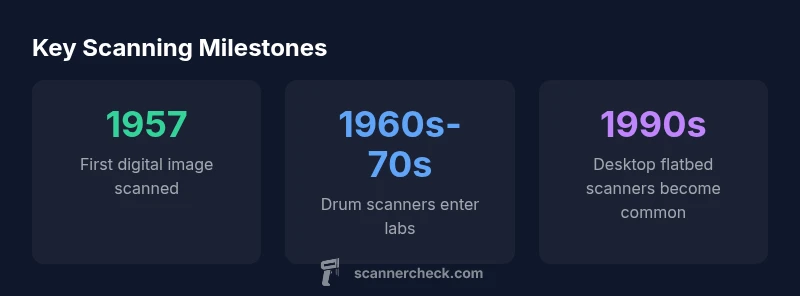
| Milestone | Year/Range | Key Player |
|---|---|---|
| First digital image scanned | 1957 | Russell Kirsch, NBS (now NIST) |
| Drum scanners emerge for professional imaging | 1960s-1970s | Multiple vendors |
| Desktop/consumer flatbed scanners enter market | 1980s-1990s | HP, Canon, Epson and others |
Common Questions
Did one person invent the scanner?
No. Scanning technology developed through cumulative work by researchers and manufacturers over many years, with early milestones like the 1957 digital image by Kirsch’s team.
No—it's a collaborative evolution across many people and labs.
When was the first digital image scanned?
In 1957, Russell Kirsch and colleagues at the National Bureau of Standards scanned a real object to produce the first digital image.
The first digital image was scanned in 1957 by Kirsch and team.
What is the difference between drum scanners and flatbeds?
Drum scanners use rotating cylinders and are known for high archival quality; flatbeds place the document on a glass bed for versatile, consumer-friendly scanning.
Drum scanners are professional-grade; flatbeds are for home and office use.
When did scanners become common for everyday use?
Consumer-grade scanners became widely available in the late 1980s to early 1990s, expanding from professionals to homes and small offices.
In the late 80s to early 90s, scanners entered everyday use.
What sensors do modern scanners use?
Most modern scanners use either CCD or CIS sensors to convert light into digital data, enabling color accuracy and speed.
Most scanners today use CCD or CIS sensors.
“The history of scanners is a layered, cooperative achievement across decades, not the result of one breakthrough.”
Key Takeaways
- No single inventor; scanning emerged from cumulative work
- 1957 marks the first digital image scan by Kirsch and team
- CCD and CIS sensors drove mass adoption and miniaturization
- Desktop scanners brought scanning to homes and offices
- Modern scanning combines hardware with AI-driven software enhancements