How Long Do CT Scans Last? Understanding CT Scan Duration
Understand CT scan duration, what affects it, and practical steps to prepare. Compare CT timing with MRI and X-ray, and learn how to plan your visit with confidence.


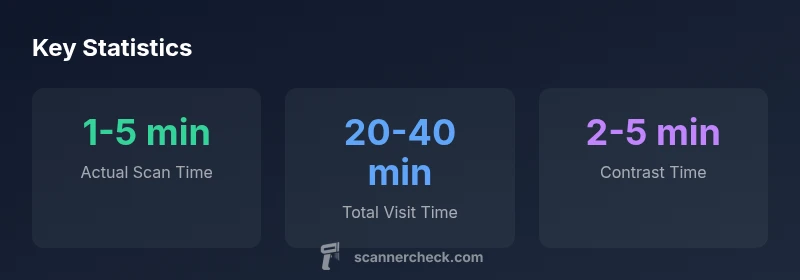
Most CT scans last roughly 1 to 5 minutes of actual exposure, but the full visit often runs 20 to 40 minutes when you include patient preparation, contrast administration (if used), positioning, and post-processing. The exact duration depends on the body area being imaged, the protocol, and any safety checks.
What happens during a CT scan
A computed tomography (CT) scan is a fast imaging procedure that uses X-ray beams and detectors to create detailed cross‑sectional images of your body. Before the scan begins, you’ll change into a hospital gown and remove metallic objects. A radiologic technologist positions you on the table and explains what to expect. If your clinician has ordered contrast, an IV line is placed to administer a contrast agent that helps highlight vessels and tissues. While the machine rotates around you, the scanner takes a series of thin X-ray slices. The actual exposure time is brief, typically a minute or two per body section, but the entire visit—from check‑in to getting the images reviewed—can take significantly longer. For people with anxiety or claustrophobia, techniques such as breath‑holding instructions and open bore scanners can ease the experience. In short, the core data acquisition is quick, but the surrounding steps determine the total time you’ll spend in the department.
How long CT scans last by region and protocol
The core imaging time in a CT study is usually quite short. Most scans take about 1–5 minutes of exposure, but the total visit time depends on the body region and whether contrast is used. head CTs often fall at the shorter end of the range, while scans that cover the chest, abdomen, or pelvis may require longer image acquisition and more slices. Multiplanar reconstructions and iterative reconstruction techniques also affect how quickly radiologists obtain the final images. If intravenous contrast is used, you should expect an additional few minutes for contrast injection, venous access setup, and monitoring for adverse reactions. When oral contrast is required, the process may add extra time before imaging begins. In daily practice, planned scans of multiple regions or phased protocols can extend the visit toward the upper end of the general range. Overall, plan for a total appointment time of about 20–40 minutes in most clinics.
Factors that influence duration and how to prepare
Duration is influenced by several practical factors. First, the imaging region and protocol determine how many series and how many slices are captured. Second, the use of contrast, timing of the contrast injection, and patient reaction to contrast can add minutes. Third, patient cooperation matters: breathing instructions, staying still, and following prompts for holding your breath help prevent repeat images. Fourth, the scanner type and software version can slightly alter timing outcomes; newer machines often complete acquisitions more rapidly. Fifth, staff workflows, check‑in times, and the availability of IV access or prior imaging can add variability. To prepare, confirm whether you need contrast, fast if instructed, bring prior imaging disks or CDs, and wear comfortable clothing. Arrive a bit early to complete forms, hydrate as advised, and communicate any implants or pregnancy status to the technologist.
What to expect at check‑in and during the scan
At check‑in, you’ll verify your identity, review medical history, and confirm the imaging reason. If contrast is planned, you may be asked about allergies and current medications. The technologist will explain the breathing cues and position you on the table. In the scanner, you’ll hear humming or buzzing as the machine rotates and captures images. The strongest moment for time is the actual data acquisition, which lasts only a few minutes per region. You may be asked to hold your breath for short periods to reduce motion. After the images are captured, you’ll move to a separate area where radiologists interpret the data, and results are usually communicated to your clinician within minutes to hours. If there are delays, it’s often due to sifting through clinical questions or adjusting for body habitus. Overall, most patients can expect a smooth and predictable workflow.
Tips to stay comfortable and reduce time
- Ask about the estimated total time when you check in, so you can plan accordingly.
- If you have claustrophobia, request a shorter, open‑bore option or talk to staff about anxiety management strategies.
- Wear comfortable clothing and avoid metal jewelry; you may be asked to change into a gown.
- Follow breath‑holding instructions precisely to avoid repeat images.
- Bring a companion to help pass the time in the waiting area, if allowed.
- Hydration can help if contrast is used, but follow clinic guidance on fluids before the scan.
- If you require multiple scans, ask about combined protocols to minimize total time.
CT scan workflow with time ranges
| Phase | Typical duration (min) | Notes |
|---|---|---|
| Reception & prep | 10-20 | Includes registration, IV access if contrast, patient prep |
| Actual CT scan | 1-5 | Depends on imaged area & protocol |
| Post-processing | 5-15 | Image reconstruction and reporting |
Common Questions
How long does a typical CT scan last?
A typical CT scan’s data acquisition lasts about 1–5 minutes, with total visit time often 20–40 minutes including prep and post-processing. Variations depend on region and protocol.
A typical CT scan lasts about one to five minutes for the actual imaging, with total time around twenty to forty minutes depending on what is scanned.
Does contrast affect scan time?
Yes. Contrast adds minutes due to injection, monitoring, and potential reactions, extending the overall visit by a few minutes.
Yes, using contrast usually adds a few minutes to the total time.
Can CT scan duration be shortened?
While the actual exposure time is fixed by protocol, preparation and processing times can be optimized with efficient workflows. Discuss options with your clinician and technologist.
You can’t speed up the actual imaging much, but good planning and asking about prep can cut total time.
Does the body region imaged change duration?
Yes. Scans of the head are usually shorter than chest, abdomen, or pelvis protocols because more slices or phases may be required.
Yes—more extensive regions tend to take longer overall.
How does CT duration compare to MRI or X-ray times?
CT is typically faster than MRI due to different imaging physics, and X-ray exams are usually quickest. Consider the clinical need when planning timing.
CT is usually faster than MRI, and X-ray is often quicker still.
“CT scan duration can vary, but clear communication with the technologist helps set accurate expectations. Short exposure times don’t always reflect total visit length.”
Key Takeaways
- CT scans are short during the exposure phase, but total time includes prep and post-processing
- Duration varies by body region and protocol
- Contrast use can add a few minutes
- Ask staff for an estimated time before your appointment
- Plan 30-60 minutes to accommodate check-in and recovery