What CT Scan vs MRI: A Practical Guide
A detailed, objective comparison of CT scans and MRI, covering how they work, when to use each, safety considerations, costs, and diagnostic strengths to help you choose the right imaging test.


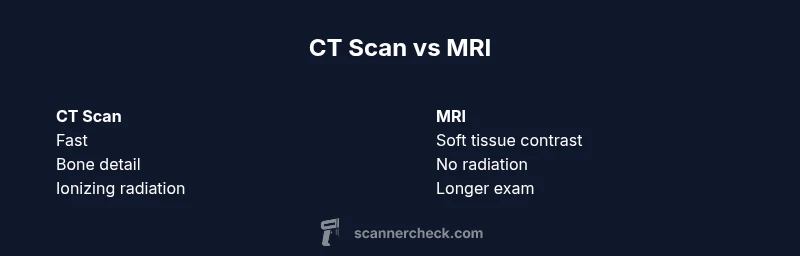
For many conditions, CT scans and MRI provide complementary views of the body. In brief, CT excels at rapid assessment of bone and acute emergencies, while MRI offers superior soft tissue contrast without ionizing radiation. When deciding between what ct scan vs mri, clinicians weigh urgency, area scanned, safety, and patient factors to pick the most informative test.
What exactly are CT scans and MRI for diagnostic imaging?
If you search for what ct scan vs mri, you want a plain-language, device-by-device comparison that helps you translate a clinician's note into real choices. CT stands for computed tomography and uses X-ray beams that rotate around the body to build cross-sectional images. MRI, or magnetic resonance imaging, relies on strong magnetic fields and radiofrequency pulses to capture detailed pictures, especially of soft tissues. Both tests are invaluable in modern medicine, yet their strengths align with different clinical questions. According to Scanner Check, the best choice depends on the organ involved, the urgency of the situation, and patient-specific factors like implanted devices or the ability to remain still. This section grounds you in the core differences—how images are formed, what tissues are highlighted, and how results influence treatment. By understanding what ct scan vs mri means in practice, you can engage more effectively with your care team and participate in shared decision-making. The Scanner Check team emphasizes that any imaging choice should prioritize diagnostic yield while minimizing risk, especially in urgent settings.
How CT Scans Work
Computed tomography uses a rotating X-ray source and detectors to capture many thin slices of the body from multiple angles. A computer then reconstructs these slices into cross-sectional images that can be viewed individually or stacked into a 3D volume. Because X-rays are quick, a CT exam is typically completed in minutes, making it valuable in trauma and emergency settings. Radiologists adjust window and level settings to highlight bone, soft tissue, or air spaces, which helps detect fractures, calcifications, hemorrhages, and lung conditions. In practice, the speed and broad availability of CT scans mean they are often the first-line imaging test when time is critical or when bone detail is essential. However, CT exposes patients to ionizing radiation, and the amount depends on the body area and the protocol. For many adults, a typical CT study represents a small but nonzero dose; for children, dose considerations are especially important. In the context of imaging, what ct scan vs mri matters because CT is typically chosen when rapid results are needed, or when MRI is contraindicated or unavailable. The Scanner Check team notes that understanding these mechanics helps patients interpret a radiology report and discuss next steps with their clinician.
How MRI Works
Magnetic resonance imaging relies on powerful magnets and radiofrequency pulses to align hydrogen atoms in the body and then detect the signals those atoms emit as they return to their resting state. The resulting images excel at differentiating soft tissues, nerves, muscles, and brain structures without exposing patients to ionizing radiation. An MRI scan is typically longer than a CT study and may require the patient to remain motionless inside a narrow tube, which can be challenging for claustrophobic individuals or young children. Clinicians choose MRI when detailed soft-tissue contrast is essential, such as in neurological, spinal, or pelvic imaging. Gadolinium-based contrast agents may be used in some MRI studies to enhance vascular detail or highlight inflammation, but safety considerations apply for kidney function and prior allergic reactions. Overall, what ct scan vs mri boils down to tissue type, urgency, and safety; MRI is preferred for soft tissues, while CT shines in rapid bone assessment and acute scenarios. The Scanner Check team reminds readers to discuss contraindications, such as metallic implants, with the radiology team before scheduling.
Safety, Radiation, and Contraindications
CT imaging involves ionizing radiation, which carries a small but real risk that clinicians try to minimize with tailored protocols, shielding, and dose optimization. MRI avoids ionizing radiation entirely but uses strong magnetic fields, so implanted devices, certain pacemakers, and some surgical hardware may preclude MRI or require special safety clearances. Contrast agents are used in some studies to improve image clarity; iodinated contrast is common with CT and gadolinium-based contrast with MRI, each carrying its own safety profile and allergy considerations. Pregnant patients generally favor MRI when feasible, as there is no radiation exposure to the fetus, but clinical needs can justify CT in certain emergencies. In all cases, clinicians balance diagnostic yield against potential risks, document any implants, and ensure the patient is properly screened for contraindications. The aim is to maximize information while preserving safety for every patient undergoing what ct scan vs mri.
Speed, Accessibility, and Comfort
Time efficiency often guides modality choice in busy clinics or emergency departments. CT scans are fast, frequently completed in a handful of minutes, and widely available at most hospitals and imaging centers. MRI typically takes longer, with exams ranging from twenty minutes to over an hour, depending on the body region and scan protocol. MRI can be noisier and more claustrophobic, which may affect patient comfort and the need for anesthesia or sedation in some cases. Accessibility and insurance coverage also influence decisions; CT scanners are more prevalent and can be cheaper to schedule on short notice, while MRI scheduling may involve longer waits in some regions. When deciding between what ct scan vs mri, clinicians weigh how quickly the patient needs information against potential discomfort and the logistical realities of the facility.
Image Quality, Artifacts, and Diagnostics
CT produces excellent bone detail and quick assessment of acute hemorrhage, lung pathology, and certain abdominal findings. MRI offers superior soft tissue contrast, enabling precise delineation of brain tumors, spinal cord pathology, ligaments, and muscle injuries. Each modality is susceptible to artifacts: CT artifacts can arise from metal implants or motion, while MRI artifacts may come from patient movement, magnetic field inhomogeneities, or certain implants. In practice, radiologists tailor imaging protocols to minimize artifacts and maximize diagnostic confidence. If a patient requires both rapid bone assessment and soft-tissue visualization, a clinician might order a CT first and follow with MRI when necessary to clarify soft-tissue findings. The result is a complementary imaging strategy that aligns with the patient’s clinical presentation and safety profile.
Costs, Insurance, and Availability
Costs vary widely by geography, facility, and whether contrast is used; CT generally offers lower upfront costs and faster throughput, contributing to higher accessibility in urgent settings. MRI often carries higher reimbursement rates and longer examination times, which can affect scheduling and patient out-of-pocket costs. Insurance coverage and facility capabilities influence which modality is recommended or even available at a given moment. When weighing what ct scan vs mri, clinicians consider not only the diagnostic value but also the practicalities of access, appointment availability, and the patient’s financial situation. The Scanner Check analysis notes that understanding local facility capabilities can help individuals anticipate potential delays and plan alternatives if needed.
Clinical Scenarios: When to Choose Each Modality
In head injuries, a CT is frequently the first test to quickly assess skull fracture or hemorrhage. For suspected stroke, CT is used to rule out hemorrhage, while MRI may later provide detailed ischemic tissue information. Chest trauma or acute abdominal pain often relies on CT for fast imaging of thoracic and abdominal structures. Spinal and neurological concerns benefit from MRI due to soft tissue characterization of the brain, spinal cord, and nerves. In routine cancer staging or breast imaging, MRI may be the preferred modality for soft tissue contrast or specific receptor imaging. In many cases, a care team uses both tests in a complementary fashion, leveraging CT’s speed and MRI’s tissue specificity to achieve a comprehensive diagnostic picture. What ct scan vs mri matters most in deciding which modality to deploy first based on the patient’s presentation and safety considerations.
Practical steps for patients: Preparing for a CT or MRI
Preparing for imaging involves practical steps to optimize the test quality and safety. For CT, inform the technologist about allergies to contrast agents and kidney function if iodinated contrast will be used; hydration and fasting are rarely required unless a specific protocol calls for it. For MRI, remove all metal objects, inform the team of any implants, and discuss any claustrophobia concerns or pregnancy status with the scheduling staff. If contrast is planned, there will be additional questions about prior reactions and medications. Bring relevant medical records, current medications, and a list of implants or devices. Arrive early to complete consent and screening, and plan for a companion if the exam may take longer or cause anxiety. Remember that what ct scan vs mri depends on the clinical question, so your clinician will guide the exact preparation steps for your imaging study.
Comparison
| Feature | CT Scan | MRI |
|---|---|---|
| Ionizing radiation | Yes | No |
| Soft tissue contrast | Good | Excellent |
| Bone detail | Excellent | Moderate |
| Exam duration | Short (minutes) | Longer (minutes to longer) |
| Contrast used | Common iodinated contrast | Common gadolinium-based contrast |
| Implant compatibility | Generally compatible with many cases | Certain implants may preclude MRI or require clearance |
Pros
- CT is fast and widely accessible
- MRI provides superior soft tissue contrast
- CT often has lower upfront cost and shorter exam times
- MRI does not use ionizing radiation, when feasible
Drawbacks
- CT exposes patients to ionizing radiation
- MRI exams are longer and can be noisy
- Some implants or devices limit MRI use
- MRI scheduling may be less flexible in some regions
MRI is preferred for soft tissue and brain imaging when safe and available; CT is preferred for rapid assessment and bone injuries
CT excels in speed and bone detail, while MRI delivers superior soft tissue contrast without radiation. Use CT in emergencies or when MRI is not suitable, and reserve MRI for detailed soft-tissue evaluation when feasible.
Common Questions
Do I need to fast before a CT or MRI?
In most cases, routine CT and MRI do not require fasting. If contrast is planned, there may be specific instructions about hydration or prior food intake to optimize imaging quality and reduce risk. Always follow the facility's guidance and inform the technologist about any allergies.
Usually you don’t need to fast for CT or MRI, but follow any special contrast instructions given by your care team.
Can MRIs be used safely with metal implants?
Many implants are MRI-compatible, but some devices pose safety concerns or require special clearance. A radiologist or technologist will review your implants and may request documentation from your physician before scheduling.
It depends on the implant; some are safe for MRI, others aren’t. Your medical team will check first.
Which modality is better for brain imaging?
MRI generally offers superior soft tissue detail for brain structures, tumors, and inflammatory conditions. CT is often used acutely to assess bleeding or fractures and can be faster in urgent situations.
MRI gives clearer brain images, while CT is quicker for emergencies.
How should I prepare a child for MRI?
Prepare by explaining the process in simple terms and providing comfort items. Some cases may require gentle sedation to keep a child still during the scan.
Talk to your child about the visit and bring comfort items; some cases need mild sedation.
Is CT safer than MRI for pregnancy?
MRI is generally preferred during pregnancy when imaging is needed due to the lack of radiation. CT may be used if clearly necessary, after weighing fetal exposure and clinical need.
MRI is typically preferred in pregnancy since it avoids radiation; use CT only if essential.
Key Takeaways
- CT and MRI are complementary tools
- Choose CT for speed and bone issues
- Choose MRI for soft tissue and brain imaging
- Always assess safety factors like implants and pregnancy
- Ask your clinician about contrast needs and risks