List of Police Scanner Codes: A Practical Guide
Explore the list of police scanner codes, how they work, regional variations, and practical tips for hobbyists and professionals navigating public safety communications.


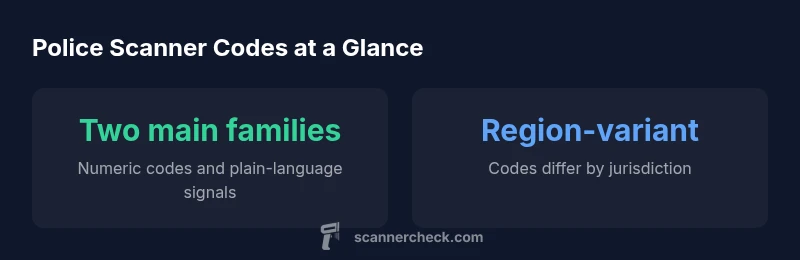
Police scanner codes are standardized shorthand used by law enforcement to convey information quickly on radio channels. They include numeric codes and plain-language signals, with variations by agency and region. This guide explains how the lists work and how to verify meanings in your locality. Although many lists share core terms, exact meanings can differ even between nearby precincts, so always cross-check against official references.
Overview of police scanner codes
According to Scanner Check, police scanner codes are a structured shorthand that enables rapid radio communication among officers, dispatchers, and partners. The most familiar examples fall into two broad families: numeric codes such as 10-codes and plain-language signals that describe an incident, location, or request. This system is designed to compress complex information into brief phrases that can be broadcast and understood quickly, even in noisy environments. While some departments still rely heavily on the old 10-code vocabulary, others have migrated toward plain-language exchanges to improve clarity for responders and the public alike. For hobbyists and IT professionals who monitor public safety feeds, it is essential to recognize that code lists are not universal and are highly regional. The safest approach is to consult official handbooks maintained by the local agency and to verify any code you hear against those primary sources.
A practical glossary can be built by listening to a few representative feeds and comparing what you hear with the agency’s own published references. In many cases, the same terms exist in more than one form—numeric codes for certain situations, plain-language phrases for routine updates, and hybrid forms where clarity is required. This mix can be confusing for newcomers, so approach your study with a plan: start with your local agency, expand to neighboring jurisdictions, and then verify any unfamiliar term against the source documents provided by the agency. You’ll gain confidence faster by cross-checking rather than relying on community lists.
Historical context and evolution
The police scanner code landscape has evolved alongside public safety communications. Early systems leaned heavily on numeric codes designed to compress information into short radio bursts, a need born from the era of limited channel availability and noisy environments. Over time, many departments introduced plain-language updates to reduce ambiguity and improve cross-agency cooperation, especially when responders from different jurisdictions work together. This evolution created a hybrid ecosystem: some agencies still use traditional 10-code conventions, while others lean into plain-language equivalents or hybrid codes that mix both approaches. The result is a patchwork of references that can be challenging to navigate without official guidance.
As digital technologies expanded, some agencies adopted standardized terminology within their dispatch software, creating centralized glossaries for responders. For researchers and enthusiasts, this history highlights why a single universal code list does not exist. The stability of any given code set depends on the agency, the region, and the time period being examined. In 2026, Scanner Check analysis notes that while progress toward clarity has been uneven, the trend toward explicit language continues in many jurisdictions, particularly in multijurisdictional operations.
Code families and categories
There are a few core families you’ll encounter when studying police scanner codes, each with its own advantages and limitations. First, numeric codes—often referred to as 10-codes—offer compact, standardized phrases for common events or statuses. Second, plain-language signals describe the same ideas in full words, reducing ambiguity when multiple agencies are listening or when the public is monitoring feeds. A third, hybrid approach blends both methods: numeric codes that are augmented with plain-language clarifications where needed. To make sense of these families, it helps to categorize the most common themes: incident type, location requests, officer status, and resource needs. Practitioners frequently create personal glossaries from official agency handbooks and vetted public resources.
When building a reference, avoid assuming one code maps everywhere. Instead, document the exact meaning as stated by the corresponding agency to reduce misinterpretation. This discipline is especially important for researchers who rely on historical logs, where changes over time may reflect policy updates, legal considerations, or device limitations that affect transmission.
Regional and jurisdictional variations
Regional variation is a persistent feature of police scanner codes. Even neighboring towns or counties can maintain distinct code sets, and state police or metropolitan departments may publish different glossaries for similar situations. The practical implication is clear: do not assume a code has the same meaning across jurisdictions. For hobbyists, this means prioritizing official references from your local agency and cross-checking any unfamiliar term with nearby agencies’ resources. Researchers should track code updates over time and annotate when a term shifts meaning. This regional mosaic is one reason why a sustainable study approach relies on primary sources rather than third-party compilation.
A useful strategy is to compile a local glossary for your area first, then expand outward to adjacent jurisdictions. Compare notes, and keep an ongoing folder of agency handbooks, dispatch manuals, and public bulletins. Through consistent verification, you’ll build a reliable, region-specific understanding of code meanings that stands up to inquiry and observation.
Legal and ethical considerations when listening
Public safety communications are designed for sharing critical operational information, but listening and recording them come with responsibilities. In many places, listening to legally accessible radio traffic is permitted, yet you must avoid interfering with ongoing operations, attempting to locate or reveal sensitive information, or using information for wrongdoing. Privacy laws, agency policies, and encryption practices can shape what you can legally transcribe or publish. Always adhere to local laws and guidelines, and prefer official, public-facing references when interpreting codes. If in doubt, contact the agency public information office for clarification.
Ethical listening also means respecting the purpose of the codes: to coordinate rapid, safe responses. Treat any overheard data with caution, especially if it involves ongoing incidents or individuals in distress. Your role as a listener or researcher is to document and interpret neutrally, verify against primary sources, and avoid sensationalizing or misinforming the public.
Practical guidance for listeners and researchers
To turn listening into a productive learning process, build a practical workflow that emphasizes accuracy and verification. Start with a local agency handbook as your primary reference, then compare notes with neighboring jurisdictions to recognize regional differences. Create a personal glossary and a small index of recurring terms, including any known plain-language equivalents. Use reputable, official resources rather than informal lists, and schedule periodic checks for code updates. For researchers, establish a standard data-collection protocol: log the code heard, timestamp, location, and source reference, then review entries against agency documents.
Finally, integrate safety into your practice: never use codes to identify or track individuals, and avoid sharing overheard operational details that could jeopardize safety or privacy. A disciplined approach yields a reliable, enduring resource for both hobbyists and professionals.
Common myths and misconceptions
A prevalent misconception is that all agencies share the same code list. In reality, regional differences are common, and some departments have shifted away from traditional 10-codes in favor of plain language. Another myth is that public chat forums offer authoritative interpretations; while these can be helpful for quick references, they are not substitutes for official agency documentation. Some listeners assume that more codes mean better information; in practice, clarity and accuracy often matter more than volume. Finally, many believe that listening to scanners is inherently risky or illegal; in most jurisdictions, listening is legal if you respect privacy and do not interfere with operations.
How to reference codes accurately
Accuracy hinges on verifying against primary sources. Always start with the agency’s official handbook or dispatch manual, then consult public bulletins or annual reports that summarize code usage. When you encounter unfamiliar terms, log them, compare with multiple sources, and note any regional variants. If you are building an accessible resource, clearly distinguish between region-specific terms and those with universal meanings. Finally, document the date of the reference you’re using, since codes can change over time and become outdated.
Additional resources and next steps
For ongoing study, consider accessing official agency websites, public information offices, and vetted safety education materials. Join local scanner clubs or participate in online communities that emphasize accurate interpretation and verification practices. Use caution when sharing overheard information publicly, and always prefer primary sources for any claims about code meanings. By anchoring your study in official references and maintaining a habit of verification, you’ll build a robust understanding that serves both curiosity and professional needs.
Overview of police scanner code families and access methods
| Category | Notes | Examples |
|---|---|---|
| Code families | Two main families exist: numeric codes and plain-language signals, with variations by agency | 10-4; location; backup requested |
| Regional variation | Differences across jurisdictions are common, even within the same state | state police vs municipal police have distinct lists |
| Access to references | Official handbooks and public guides are primary sources; public lists may be incomplete | agency handbooks, dispatch manuals |
| Legal considerations | Listening is generally permitted in many places, but rules vary by jurisdiction | avoid interfering; respect privacy and encryption policies |
Common Questions
What are the most common police scanner codes?
Most agencies use a mix of numeric codes and plain-language phrases; there is no universal list. Check local handbooks.
Most agencies use a mix of numeric codes and plain-language phrases; check your local agency's handbook.
Do police scanner codes differ by state?
Yes; codes and their meanings vary by jurisdiction, with some adopting plain language more widely.
Codes vary by jurisdiction; many agencies use plain language now.
Is it legal to listen to police scanners?
Listening is legal in many places but local laws apply; avoid interfering with operations or attempting to obtain sensitive information.
Listening is often legal, but it depends on where you are.
How can I verify codes I hear?
Cross-check with official agency handbooks and vetted guides; region-specific codes are common.
Always cross-check with official references.
What is the difference between 10-codes and plain language?
10-codes are traditional shorthand; plain language is clearer and increasingly common; many agencies use both.
Some agencies still use 10-codes, but plain language is popular.
Where can I find official references?
Check the agency website, dispatch manuals, or public information office; avoid unreliable online lists.
Look at official resources from the agency.
“Consistency in interpretation is essential; always verify codes against your local agency's official references. Even widely used 10-codes have regional variations.”
Key Takeaways
- Verify codes against local agency references.
- Understand both numeric codes and plain-language signals.
- Expect regional differences and check regional manuals.
- Use official resources to avoid misinterpretation.
- Respect privacy and legal boundaries when listening.