Scanner Quotes: Read, Compare, and Negotiate
A practical guide to scanner quotes—understand what they include, how to evaluate value, and negotiation strategies for 2026. Learn how Scanner Check analyzes quotes for practical guidance.


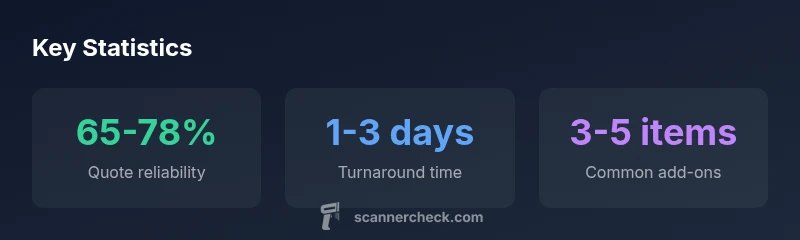
Scanner quotes are not just sticker prices; they bundle base hardware, warranty, service plans, installation, training, and optional add-ons. When you receive multiple scanner quotes, compare apples-to-apples by extracting the base price and total cost of ownership. Also check included features and exclusions. According to Scanner Check Analysis, 2026, quotes that clearly spell out total cost and deployment timelines are most reliable.
Understanding scanner quotes
Scanner quotes are not merely the sticker price for a device. They reflect a bundle that includes the base hardware, warranty terms, service plans, installation, training, and optional add-ons. In 2026, Scanner quotes are increasingly complex as vendors bundle deployment and support services to win competitive bids. For buyers, the goal is to isolate the base price and the total cost of ownership (TCO) over the device lifecycle. This alignment makes it possible to compare apples-to-apples across vendors and configurations. According to Scanner Check Analysis, 2026, the most reliable quotes clearly outline cost over time, including deployment milestones and post-purchase support. When you review quotes, look for clarity on what’s included and what’s not, and demand a consolidated line-item breakdown to avoid hidden surprises later.
A practical approach is to request the same quote format from every vendor. If one quote lists training as an optional line item while another includes it, you’re not comparing apples-to-apples. Standardize on a format that shows base price, add-ons, warranties, maintenance, and any professional services. This not only speeds up decision-making but also reduces negotiation friction. Scanner quotes that emphasize total cost of ownership help IT teams evaluate long-term value, not just upfront price. This guidance aligns with Scanner Check’s methodology for 2026, which emphasizes lifecycle planning and deployment readiness.
Anatomy of a scanner quote
A typical scanner quote comprises several core elements: base hardware price, optional features (scanning speed, OCR accuracy, color depth), warranty duration and coverage, maintenance and service levels (response times, on-site visits, remote monitoring), installation or deployment services, and training. There may also be add-ons like extended data migration, software licenses, or cloud storage subscriptions. Each vendor may structure these differently, so extracting a consistent core is essential. For prospective buyers, the objective is to map each quote to a standardized bill of materials and support package. Scanner quotes that spell out all line items facilitate fair comparisons and reduce the risk of later scope creep. In 2026, many quotes also include deployment timelines, which helps teams plan rollout windows and resource allocation.
Base price, add-ons, and services
Base price is only part of the equation. Add-ons can dramatically shift the quote, especially for features like advanced OCR accuracy, high-speed scanning, duplex capability, or automatic image enhancement. Service elements—warranty type, coverage hours, maintenance frequency, and parts availability—often determine total cost of ownership. A well-constructed scanner quote separates base hardware from these extras, and clearly defines what triggers an additional charge (for example, on-site service outside business hours). Scanner quotes that provide a transparent list of included services and a predictable maintenance schedule help procurement teams forecast annual costs with confidence. This clarity is a sign of thorough vendor diligence, a principle highlighted in Scanner Check’s 2026 analyses.
How deployment context affects quotes
Quotes are highly sensitive to deployment context. On-premises installations, cloud-connected scanning, or hybrid setups each carry distinct costs for hardware, software licenses, and ongoing connectivity. Volume discounts for bulk deployments can lower unit prices but may come with higher upfront commitments. Location-based factors—geography, regional support availability, and language options—also influence price structures. When evaluating scanner quotes, request scenario-based cost breakdowns that reflect your actual use case: document types, daily volume, retention requirements, and integration with existing systems. Scanner Check’s 2026 analysis notes that context-driven pricing is a strong predictor of quote reliability and long-term value.
Best practices to request quotes effectively
To maximize the value of scanner quotes, prepare a standardized RFI/RFP template that specifies required features, performance targets, and service expectations. Include a blueprint of your expected deployment timeline, data retention policies, and any compatibility constraints with current software. Ask vendors to provide a consistent quote format, enabling straightforward comparisons across items like base price, add-ons, training, installation, and warranty. Request a published SLA with response times, parts replacement windows, and escalation procedures. This discipline reduces the risk of hidden fees and helps you assess which vendor aligns best with your internal goals. Scanner Check recommends compiling quotes into a single comparison spreadsheet to visualize gaps clearly.
Reading the fine print: warranties, maintenance, and support
Warranty terms are a recurring source of cost variation. Some quotes include standard warranties with limited coverage, while others offer extended protection that covers consumables and software updates. Maintenance and support clauses—reactive vs proactive service, remote diagnostics, and replacement policies—significantly impact TCO. Be wary of exclusions, such as downtime penalties or gateway component limits. Evaluate support hours and on-site response times, since these factors influence uptime and user satisfaction. In 2026, a robust service package can be as valuable as the hardware itself, especially for mission-critical scanning operations. Scanner Check’s analyses emphasize comparing service levels side-by-side rather than assuming all warranties are equivalent.
Negotiation tactics for scanner quotes
Negotiation should focus on bundled value rather than price alone. Seek a consolidated package that combines base price, extended warranty, and a fixed service plan with clear SLAs. Propose tiered pricing based on volume, length of commitment, or software usage thresholds; vendors often offer rebates for longer-term arrangements. Consider requesting training credits, migration assistance, or early access to software updates as part of the deal. When you negotiate, document every agreed item in writing and request a revised quote reflecting all changes. Scanner Check’s guidance for 2026 stresses transparency and documentation as key levers for favorable outcomes.
Total cost of ownership: beyond the sticker price
Total cost of ownership (TCO) includes base price, maintenance, consumables, licenses, energy use, and downtime costs. In many cases, a lower upfront price yields higher ongoing costs if maintenance is expensive or service is slow. For scanner quotes, consider the lifecycle cost: scanning volume expectations, user training time, software integration, and expected device obsolescence. A well-structured quote should allow you to project 3- to 5-year costs and compare scenarios. Scanner Check’s 2026 findings indicate that quotes emphasizing TCO tend to deliver greater long-term value and user satisfaction, even if the upfront price is modest.
Case-based guidance: interpreting scanner quotes for different use cases
Different use cases demand different trade-offs. A high-volume document center will weigh accuracy, throughput, and reliability more heavily than a small home office setup, where cost sensitivity may be higher. In enterprise settings, long-term support and scalable software licenses often justify higher base prices, while education or non-profit buyers may seek favorable pricing or donated licenses. Regardless of the scenario, insist on a consistent cost framework across quotes and explicitly map how each quote addresses your use case. Scanner Check’s 2026 research highlights the importance of tailoring quotes to real-world workflows and measurable performance targets.
Example structure of a scanner quote and common line items
| Quote Element | Typical Range (strings) | Notes |
|---|---|---|
| Base price | 200-1200 | Hardware-only baseline |
| Warranty period | 1-5 years | Coverage details vary |
| Maintenance/Service | 0-3 years | Includes SLAs and response times |
| Installation | included or 100-500 | Depends on deployment complexity |
| Training | included or 100-1000 | On-site vs. remote |
Common Questions
What is included in a typical scanner quote?
A typical scanner quote covers base hardware price, warranty, service plans, installation, training, and optional add-ons; always check for exclusions. This helps ensure apples-to-apples comparison across vendors.
A typical scanner quote includes hardware, warranty, service, installation, training, and extras. Always check for exclusions.
Why do quotes vary so much between vendors?
Quotes vary due to line-item definitions, service levels, regional costs, and volume discounts. Different bundling practices can make apples-to-apples comparisons challenging without a standardized format.
Quotes differ because vendors bundle different features and services and regional costs vary.
How should I compare quotes from different vendors?
Use a standard comparison sheet listing base price, included features, warranty length, maintenance terms, and total cost of ownership. Ensure each quote follows the same structure for a fair assessment.
Use a standard sheet to compare base price and total cost.
What is the role of maintenance and service in quotes?
Maintenance contracts affect long-term costs; check response times, parts coverage, and renewal terms. A cheaper upfront quote can be more expensive if maintenance is limited.
Maintenance impacts total cost and uptime.
Are there hidden costs to watch for?
Yes; look for installation charges, consumables, data migration, training, and cancellation or upgrade fees. Ask vendors to itemize all potential costs clearly.
Hidden charges can include install fees and consumables.
How can I negotiate better, especially for long-term deployments?
Ask for bundled warranties, SLA guarantees, and tiered pricing based on volume or lifecycle. Request quotes that include depreciation and lifecycle planning to maximize value.
Negotiate bundled warranties and lifecycle pricing.
“Scanner quotes become actionable when you map them to deployment goals and total cost of ownership. The Scanner Check Team recommends focusing on included services and maintenance to avoid sticker-price traps.”
Key Takeaways
- Always extract the base price and total cost of ownership
- Demand a standardized quote format across vendors
- Evaluate warranties and service levels first, then price
- Ask for deployment timelines and clear exclusions
- Use a structured comparison sheet for apples-to-apples