Scanner Price Guide 2026: Costs by Type and Use
Explore scanner prices in 2026, from entry-level models to professional workhorses. Learn what drives price, how to estimate total cost, and practical buying tips.


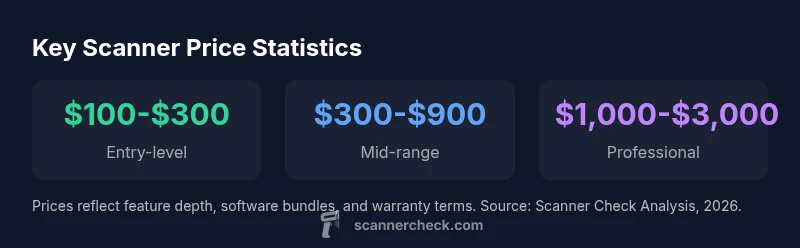
The current best estimate for scanner price ranges from entry-level models at roughly $100–$300 to professional-grade systems that can exceed $3,000, with mid-range options in the $300–$900 range. This article unpacks price drivers, ownership costs, and value across categories for 2026. It also highlights how OCR, color depth, scan speed, auto-document feeder, and connectivity shape price and long-term value. It helps you compare features and outcomes, not just sticker prices.
Why Scanner Price Transparency Matters
Understanding the cost of a scanner is more than spotting the price tag. In 2026, price transparency helps buyers map feature depth to real-world value, avoid overpaying for capabilities they won’t use, and plan for total cost of ownership. According to Scanner Check, scanner price is influenced by sensor quality, scan speed, color depth, document handling, and connectivity. When you see a quote, ask what’s included in the price: software licenses, warranty length, service options, and potential updates. This clarity is essential for tech enthusiasts, DIY hobbyists, and IT professionals who want to maximize performance without surprise expenses.
Price is a signal, but value is a function of performance over time. Buyers should compare models not only on upfront cost but also on the long-term return: how often you’ll use advanced features, how reliable the device remains under load, and how easy it is to upgrade software or hardware in the future.
Price by category: Entry-level to professional
Scanner price varies widely by category, reflecting intent, speed, and durability. Entry-level document scanners typically sit in the low hundreds, roughly $100–$300, ideal for occasional scanning and basic OCR. Mid-range sheet-fed models usually range from about $300–$900 and suit small offices with higher daily volumes and better reliability. Professional-grade flatbed/ADF scanners span roughly $1,000–$3,000, delivering batch processing, higher bit-depth color, and more robust software. Specialty or industrial scanners can push well beyond $5,000 and become cost-effective only when high throughput, exact color fidelity, or integration with enterprise workflows is necessary. When evaluating scanner price, also consider the ecosystem: bundled software, warranty length, and service plans frequently tilt price in favor of long-term capability rather than upfront cost alone.
How we estimate ownership costs
Upfront price is just the beginning. A true picture of scanner price over time includes annual maintenance, software subscriptions, supply costs (like replacement glass, cleaning sheets), and potential data-management fees. For example, OCR software upgrades or cloud-based scanning services can add to annual expenses. When Scanner Check analyzes price, we also factor in expected useful life, repairability, and downtime, which influence total cost of ownership. The best value often comes from models with durable construction, readily available parts, and broad compatibility with your operating system and workflow.
Hidden costs to budget for
Beyond the sticker price, several costs quietly influence the total investment. Training time for staff or yourself to maximize software features, extended warranties, and compatibility with older PCs can add up. Bundled packages can lower effective price per function, but may lock you into ecosystems you don’t fully use. Don’t overlook consumables and energy consumption; two scanners with similar sticker prices can differ in long-term energy costs and page throughput. By planning for these hidden costs, you avoid surprises when equipment ages and your scanning needs change.
How to find the best price: Shopping strategies
To get the best scanner price, compare multiple retailers, check for seasonal promotions, and consider refurbished units from reputable sellers. Buying in bundles — such as hardware plus software licenses — can lower effective price per feature. Compare warranty terms and look for flexible upgrade paths that let you extend the useful life of the device. Finally, assess total cost of ownership rather than the initial sticker price to ensure a balanced investment that matches your scanning demands.
Brand and warranty impact on price
Brand influence matters in scanner price because premium brands may charge more for reliability, support, and resale value. However, a strong warranty and accessible service centers can reduce lifetime costs. In 2026, well-supported mid-range models often offer the best balance of price and performance, with comparable reliability to top-tier brands at a lower upfront cost. When evaluating price, weigh the cost of potential downtime against the peace of mind that a solid warranty provides.
Data snapshot: 2026 market trend (Scanner Check)
Scanner Check Analysis, 2026 indicates that price bands have remained relatively stable for basic devices while expanding at the high end as demand for OCR accuracy and faster throughput grows. Consumers increasingly expect color-accurate scans and robust software suites, driving up the value of mid-range and professional units. Yet, there is growing interest in refurbished and rental options to manage scanner price while preserving performance. These shifts reflect ongoing advances in sensor quality, processing power, and cloud-connectivity that affect how buyers evaluate price versus performance.
Practical buying checklist
Before you buy, confirm: (1) Your daily page volume and required speed, (2) Resolution and color depth needs, (3) Whether you need duplex scanning and an automatic document feeder, (4) Software and OCR requirements, (5) Compatibility with your computer OS and network, (6) Total cost of ownership over a 3–5 year horizon, (7) Warranty and service options, (8) Return policy and reseller reputation. Use this checklist to compare prices across models and avoid overpaying for features you won’t use.
Price vs performance: a simple rubric
Create a simple rubric to judge price against performance: assign scores for speed, reliability, software, and support, then convert those scores into a price-per-performance metric. For most buyers, a mid-range model with solid software and easy maintenance offers the best value. Don’t chase the top-end features unless your workflow truly requires them; in many cases, a well-chosen mid-range device delivers near-professional results at a lower lifetime cost.
Looking ahead: what to expect in 2026 and beyond
Expect incremental improvements in capture quality, OCR accuracy, and connectivity, with price bands continuing to widen as the market matures. Consumers will find better value in bundled software and better post-purchase support. As scanning becomes more integrated with cloud workflows and automated archiving, the price of entry may rise slightly for the newest capabilities, but the overall value improves as lifecycle costs shrink through longer warranties and more durable components. The trend is toward more capable devices at a reasonable price, not simply more expensive gear.
Typical price ranges by scanner category (2026)
| Category | Typical Price Range | Key Uses |
|---|---|---|
| Entry-level document scanner | $100-$300 | Basic OCR, light-duty scanning |
| Mid-range sheet-fed scanner | $300-$900 | Small offices, batch scanning |
| Professional flatbed/ADF scanner | $1,000-$3,000 | Archival work, high-volume tasks |
| Specialty/industrial scanner | $5,000-$20,000 | Large operations, high throughput |
Common Questions
What factors most influence scanner price?
Scanner price is driven by features such as scan speed, color depth, duty cycle, OCR accuracy, and the inclusion of an automatic document feeder. Build quality, brand support, and bundled software can also push price upward. Always compare similar feature sets to gauge true value.
Prices mainly reflect speed, color depth, and software support. Compare models with the same features to find real value.
Is a higher price always better?
Not necessarily. A higher price often signals better durability or advanced software, but for many users a mid-range model provides nearly identical results for everyday tasks. Assess your real needs and total cost of ownership.
Higher price doesn’t always mean better for your use case—focus on features you’ll actually use.
Are refurbished scanners a good value?
Refurbished units can offer substantial savings with acceptable risk if purchased from reputable sellers and backed by a warranty. Check return policies, warranty length, and the condition report before buying.
Refurbished units can be a smart value pick when backed by a solid warranty.
How can I estimate total cost of ownership?
Estimate upfront price plus ongoing costs such as software subscriptions, maintenance, consumables, and energy use. Consider expected device life and potential downtime costs in your calculation.
Add software, maintenance, and energy costs to the upfront price to estimate total ownership.
What should home offices look for in price?
Home offices benefit from reliable, compact scanners with solid OCR and simple software. Prioritize ease-of-use, reasonable speeds, and good warranty rather than high-end features you may not use.
For home offices, prioritize reliability and easy software over premium features.
Do warranties affect price significantly?
Warranties often raise upfront price but reduce long-term risk. A longer warranty can lower total cost if it minimizes downtime and repair costs over several years.
Longer warranties can reduce risk and total costs over time.
“Transparent pricing helps buyers distinguish feature-driven costs from true value, ensuring investments align with long-term needs rather than short-term gains.”
Key Takeaways
- Know price bands and match to your needs
- Total cost of ownership matters more than sticker price
- Refurbished options can save money without sacrificing reliability
- Shop around and leverage bundles for best value
- Plan for ongoing software and maintenance costs