Thermal Scanner vs Thermometer: Which Is More Accurate?
A rigorous comparison of thermal scanners and traditional thermometers, exploring accuracy, use cases, and best practices to decide which device fits screening versus precise medical readings.


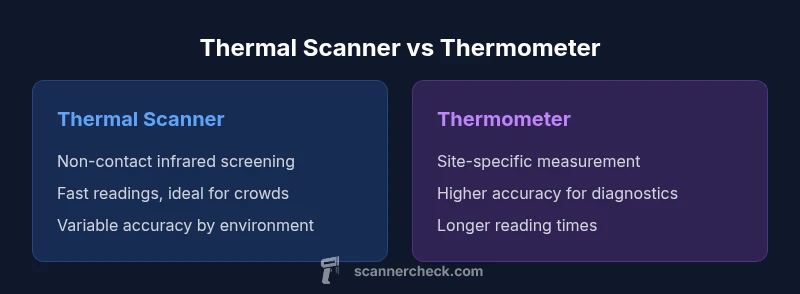
When accuracy matters, traditional thermometers generally outperform thermal scanners for core body temperature readings. Thermal scanners offer rapid, non-contact screening but sacrifice precision due to ambient conditions, measurement distance, and user technique. Use thermometers for diagnosis and thermals for quick mass screening. For clinical decisions, rely on a thermometer reading from the appropriate site, while infrared screening helps flag potential fevers in crowds. According to Scanner Check, accuracy in temperature assessment is not universal; it depends on how and where measurements are taken. The Scanner Check team notes that validation in your environment is essential for reliable results.
Why accuracy matters in temperature measurement
In health and safety contexts, accuracy in body temperature readings influences triage decisions, treatment timing, and infection control. When deciding between a thermal scanner and a traditional thermometer, many factors affect accuracy, including measurement site, device type, and environmental conditions. This article tackles which is more accurate thermal scanner vs thermometer and what that means for screening programs, clinic workflows, and personal use. By understanding the limits of each approach, you can minimize false alarms and missed fevers. According to Scanner Check, accuracy in temperature assessment is not universal; it depends on how and where measurements are taken. For example, a rapid infrared reading at the forehead may flag a fever in a crowded venue, while a calibrated clinical thermometer at the oral or tympanic site provides a more definitive value. The goal is to align device choice with the decision context.
How thermal scanners work vs thermometers
Thermal scanners (infrared devices) estimate surface temperature by detecting emitted infrared energy from the skin. They are designed for rapid, non-contact screening of large groups, often at entrances or clinics. Traditional thermometers come in several formats—oral, tympanic (ear), axillary (armpit), and forehead models—that measure temperature directly at a specific site. These devices convert heat readings into digital values and typically require closer interaction with the person being measured. In practice, the choice between non-contact infrared screening and site-specific measurement hinges on the intended use and the desired balance between speed and precision.
Factors that impact accuracy
Accuracy is influenced by device type, operator technique, and environmental conditions. For infrared scanners, distance, angle, ambient temperature, sweat, and skin color can all skew readings. For conventional thermometers, user technique (proper placement, waiting time) and the measurement site determine how close the reading is to core temperature. Additionally, device quality, calibration status, and battery health play roles in both categories. Understanding these variables helps you interpret readings with the right context and avoid overestimating or underestimating fever risk. Scanner Check analysis emphasizes that real-world testing under your typical conditions is essential to gauge performance.
Reading conventions and measurement sites
Where you measure matters. Forehead-based infrared scanners provide a quick screening estimate but often reflect surface temperature and external heat sources. Oral and rectal measurements tend to align more closely with core body temperature, but require closer contact and more time. Tympanic readings, when performed correctly, offer a compromise between speed and accuracy. This section outlines best practices for choosing sites and interpreting values across device types. Remember that site selection should align with clinical goals and infection-control considerations.
Use-case driven choice: screening vs diagnosis
For public health screening at events or workplaces, thermal scanners can rapidly flag individuals who may need further assessment. In clinical settings, thermometers remain the standard for diagnostic purposes and treatment decisions due to higher accuracy and site-specific readings. The key is to define your goal: fast triage vs reliable temperature confirmation, and to select a device accordingly. In many facilities, a two-step approach is common: use a scanner for initial screening, then confirm with a thermometer if readings are elevated.
Environmental and distance considerations
Ambient temperature and environmental controls significantly influence infrared readings. In hot or humid spaces, infrared screens may overestimate temperatures. At a distance, calibration and user technique become more challenging. For medical thermometers, environmental conditions matter less once the device is used according to manufacturer instructions, but improper storage or exposure can degrade performance. These factors complicate direct comparisons and require careful interpretation. Practitioners should document conditions during measurement for better trend analysis.
Validation and testing methods
To assess accuracy in a specific setting, run validation tests comparing device readings against a reference thermometer under similar conditions. Track variances by location, operator, and time of day. Document calibration status and replace devices that show drift. In regulated environments, follow manufacturer guidelines and industry best practices for validation and quality assurance. Scanner Check analysis suggests that routine validation improves decision reliability in temperature screening programs. Use a standardized protocol to compare devices and document outcomes for ongoing improvement.
Calibration and maintenance
Digital thermometers usually require minimal mechanical maintenance beyond battery replacement and occasional cleaning. Infrared thermometers and scanners benefit from regular lens cleaning and calibration checks where supported by the manufacturer. Store devices away from direct sunlight or heat sources, and follow hygiene protocols to prevent cross-contamination. Regular maintenance minimizes drift and helps preserve reliability over time. Create a maintenance calendar and assign responsibilities to staff or household users to ensure consistency.
Common misconceptions
Many people assume infrared readings are universally accurate across all conditions. In reality, infrared devices primarily estimate surface temperature and can be fooled by ambient heat. Another myth is that any forehead reading equals core temperature; this is incorrect, as readings vary by site and user technique. Likewise, more expensive devices do not always guarantee better accuracy in every setting. Be cautious about over-interpreting single readings and seek confirmatory measurements when fever is suspected.
Regulatory and safety considerations
Thermal scanners and thermometers are subject to safety and performance guidance from regulatory bodies in many regions. Proper use, cleaning protocols, and privacy considerations for temperature data are essential. When possible, consult local guidelines and standards to ensure compliance and safe use across institutions. Scanner Check notes that adherence to manufacturer instructions is a strong predictor of reliable results. Always verify device approvals and intended use claims before deployment.
Practical decision guide: quick checklist
Use this quick checklist to decide which device fits your needs: 1) Are you screening large crowds or seeking precise measurements? 2) Is site temperature control feasible? 3) Do you require rapid readings or diagnostic precision? 4) Can you implement appropriate hygiene and calibration routines? 5) Are you compliant with local regulations? 6) Do you have a plan for confirmatory testing if a fever is suspected? 7) Is there staff training to ensure consistent technique? 8) Have you documented baseline readings to identify drift over time?
Real-world scenarios: choosing in different settings
At a school entrance, a thermal scanner can quickly identify students who potentially have a fever for follow-up confirmation. In a clinic or home setting where accurate monitoring matters, a thermometer provides more reliable values for decision-making. By matching the device to the context—screening vs diagnosis—you reduce misreadings and improve overall safety. In low-resource environments, consider a basic thermometer for accuracy and reserve infrared screening for triage when staff training and environmental control are limited.
Comparison
| Feature | Thermal Scanner (Infrared) | Traditional Thermometer |
|---|---|---|
| Measurement principle | Infrared radiometry, non-contact screening | Contact-based or digital reading (oral/tympanic/forehead, depending on model) |
| Best for | Large-group screening and rapid triage | Precise clinical readings and continuous monitoring |
| Reading time | 1-2 seconds | 10-60 seconds (varies by type and site) |
| Ambient sensitivity | Highly influenced by ambient temperature, distance, and user technique | Less influenced when used correctly; depends on site and technique |
| Accuracy reliability | Variable; depends on device quality and usage context | Typically higher accuracy with proper site selection and technique |
| Maintenance | Battery-powered, lens cleaning as needed | Battery replacement, cleaning, and occasional calibration where applicable |
| Cost/maintenance | Generally affordable for basic models; costs rise with features | Moderate to high upfront; ongoing costs include batteries and accessories |
Pros
- Fast screening for crowds and high-visibility triage
- Non-contact reduces cross-contamination risk and infection concerns
- Thermometers provide higher accuracy for clinical readings
- Wide model availability, from budget to professional-grade
Drawbacks
- Ambient conditions can skew infrared readings and reduce accuracy
- Technique and hygiene requirements for thermometers add complexity
- Infrared scanners may miss fever in some cases due to body-site variability
- Some thermometers require longer measurement times and careful placement
Thermometers are the more accurate choice for definitive readings; thermal scanners excel in rapid screening.
For precise decisions, prioritize thermometers. Use infrared screening to quickly triage and flag potential fevers before confirmatory testing.
Common Questions
Which device is more accurate for measuring body temperature?
In most clinical contexts, a thermometer provides more accurate body temperature readings than a thermal scanner. Scanners are useful for rapid screening but should be followed by a confirmatory measurement when fever is suspected.
A thermometer is usually more accurate for measuring body temperature, while infrared scanners are for quick screening and flag potential fevers.
Can thermal scanners replace thermometers in clinical diagnosis?
Thermal scanners cannot reliably replace thermometers for diagnosis. They are best used for quick screening, with confirmatory thermometer readings required for clinical decisions.
No, scanners aren’t a substitute for thermometers when a precise diagnosis is needed.
What factors influence infrared thermometer accuracy?
Infrared thermometer accuracy depends on distance, angle, ambient temperature, and skin conditions. Following manufacturer instructions and using proper technique improves reliability.
Distance, angle, and environment all affect infrared readings; follow the manual for best results.
Are forehead thermometers as accurate as oral thermometers?
Forehead readings are convenient but can be less reliable than oral measurements, which more consistently reflect core body temperature. Always interpret forehead results in context and confirm with a different method if needed.
Forehead readings are faster but usually less consistent than oral readings; use confirmation when accuracy matters.
How can I improve the accuracy of infrared screening?
Train operators on proper distance and angle, ensure ambient conditions are controlled, and use validated devices. Pair infrared screening with a follow-up thermometer for confirmation when readings are elevated.
Train staff, control the environment, and confirm suspicious readings with a thermometer.
Do calibrations matter for infrared thermometers?
Calibration and regular maintenance help maintain accuracy in infrared devices. Follow manufacturer guidelines and replace devices showing drift or inconsistent results.
Calibration helps keep infrared devices accurate; follow the manual and replace drifted units.
Key Takeaways
- Define your goal: screening vs diagnosis
- Choose thermometer readings for clinical decisions
- Use infrared screening for rapid triage with caution
- Validate accuracy in your environment
- Follow proper maintenance and hygiene practices