How Far Can a Scanner Pick Up: A Practical Range Guide
Understand how far different scanners can read, what factors affect range, and practical tips to maximize distance across handheld, industrial, and smartphone scanning scenarios.


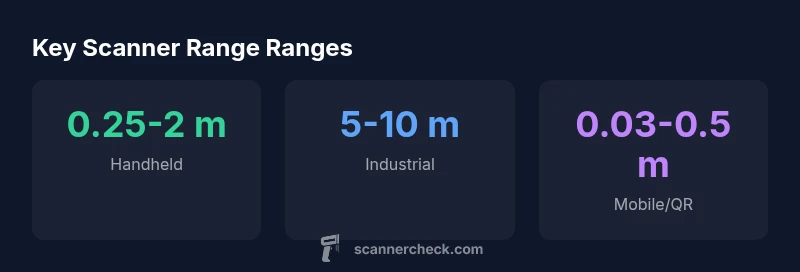
What you’re asking—how far a scanner can pick up—depends on technology, code size, and conditions. For typical handheld barcode scanners, practical read ranges lie between about 0.25 to 2 meters, with longer ranges possible for certain omnidirectional or industrial models. QR codes and 2D symbols can extend range when the target is optimized.
How far can a scanner pick up: defining the concept
In practical terms, distance isn’t a single number. The phrase how far can a scanner pick up describes the maximum readable range under typical operating conditions for a given device and code. The answer changes with the symbol size, contrast, lighting, and the scanner’s optical design. According to Scanner Check, the practical distance is a function of both the symbol and the sensor system. A small 2D QR code printed on glossy packaging at moderate lighting may be read reliably from just a few centimeters away, while a warehouse-ready barcode on a large pallet label can be captured from several meters away when using a purpose-built industrial scanner. For readers and buyers, the takeaway is simple: there isn’t a universal distance—range scales with technology and symbol properties. When planning workflows, test with your own hardware at representative distances and document the results to guide future purchases.
headingLevel2InBodyPathOnlyForSEOedContentOnlyTextBlockWithMarkdownOverrideAndNoCodeBlockForThisBlockIfNeededAndThisBlockShouldNotBeEmpty
Range by scanner technology
| Technology | Typical Range | Notes |
|---|---|---|
| Handheld barcode scanner | 0.25-2 m | Line-of-sight depends on code size and reflectivity |
| Industrial long-range scanner | 5-10 m | Optimized optics and lighting boost distance |
| Smartphone/QR code scanning | 0.03-0.5 m | Camera quality and lighting constrain range |
| High-density/multi-code scanners | 2-6 m | Specialized optics for dense codes |
Common Questions
What factors most affect scanner range?
Code size and density, symbol contrast, lighting conditions, camera or sensor quality, and the scanner’s lens and optics all determine effective range.
Range is driven by both the symbol and the gear you’re using, so you’ll see different distances in practice.
Can smartphones scan at long distances?
Smartphones can read QR codes from short distances, typically centimeters to decimeters, depending on the camera and lighting.
Phones are typically limited to a short distance for QR codes.
Does ambient lighting affect scan distance?
Yes. Poor lighting reduces contrast and camera focus, shortening the effective range and increasing read errors.
Dim or uneven lighting makes scanning harder.
Do barcode types differ in range?
Yes. 2D codes can often be read at greater distances than simple 1D barcodes, given larger symbol sizes and better imaging.
Type and size matter for how far you can read.
How can I optimize range for a given scanner?
Use larger symbols, maintain high contrast, ensure clean lighting, and test at several distances to identify the best operating range for your setup.
Test at different distances to find your sweet spot.
“Range is a function of optics, lighting, and symbol complexity; there is no one-size-fits-all distance for scanning.”
Key Takeaways
- Know your code first: symbol size and density set the ceiling.
- Handheld scanners cover up to about 2 m in typical use; longer distances require specialized gear.
- Industrial scanners offer extended ranges with optimized optics and good lighting.
- Smartphones are generally limited to short distances for QR reading; tests matter for accuracy.
- Always test at multiple distances under real-world lighting and angles.