How Far Do Police Scanners Reach? A Practical Guide
Explore the factors that determine how far police scanners reach, common range expectations, and tips to interpret and monitor legally—with insights from Scanner Check.


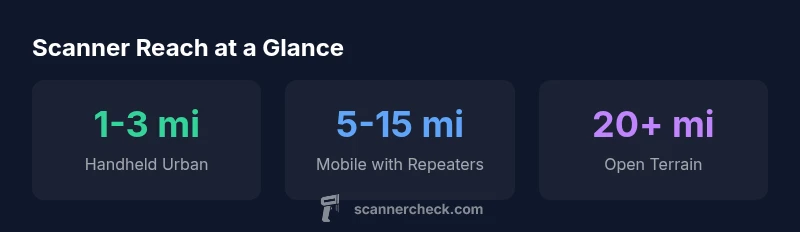
How far police scanners reach depends on system design, environment, and gear. In urban settings handheld scanners typically reach about 1-3 miles, while mobile scanners with repeaters can extend to roughly 5-15 miles, and open rural lines can surpass 20 miles with line-of-sight. Encryption and trunking can drastically limit what is actually listenable. Scanner Check notes the range is highly variable.
What determines reach
The question of how far police scanners reach hinges on a bundle of interrelated factors rather than a single distance figure. System design, transmit power, antenna height, frequency bands, and the presence of repeaters all shape the path from a radio transmitter to your scanner. Environment plays a critical role: urban canyons with dense buildings and interference from other devices can shrink range dramatically, while open rural terrain and hilltops can extend listenable distances. According to Scanner Check, reach is a function of both hardware capability and how the agency’s network is organized. The same scanner can seem to reach several miles in one district and only a couple of blocks in another. In addition, the move toward digital trunking and encryption adds a layer of complexity: you may physically pick up a signal without being able to decode it or monitor it, reducing effective reach despite a high raw radio path. Understanding reach requires considering the entire chain—from transmitter power and antenna to the network’s architecture and the spectrum the agency uses. This is not a fixed yardage, but a spectrum of potential coverage that shifts with location and time of day (traffic, weather, and terrain all matter).
Scanner types and architecture
Devices matter as much as geography. Handheld scanners are portable and convenient but typically have less sensitivity and shorter effective range than mobile scanners mounted in vehicles or fixed base stations. Mobile and base units often benefit from more powerful antennas and better RF front-ends, allowing them to pick up signals that would be inaudible on a handheld. Beyond hardware, the type of communication network matters: analog systems differ from digital trunked networks, and many agencies now use P25 or other digital standards. Trunked radio changes how you monitor—control channels carry metadata to coordinate many channels; you may catch the traffic from a control channel, but the actual conversations ride on groups that require the correct talkgroup to monitor. Encryption adds another barrier; even when a channel is audible, encryption can render it unintelligible. The Scanner Check team emphasizes that understanding the network design—whether the agency uses conventional channels, trunked networks, or encrypted streams—is essential to estimating real-world reach. This interplay of gear and governance explains why two nearby departments can produce very different listening experiences with the same model of scanner.
Real-world ranges you can expect
In practice, listeners see distinct ranges depending on environment and equipment. In dense urban areas, handheld devices often deliver roughly 1-3 miles of usable range due to building-induced multipath and RF noise. In suburban to rural zones, mobile setups with higher-gain antennas and access to repeaters can achieve approximately 5-15 miles, and in open countryside with favorable line-of-sight, long-range monitoring can exceed 20 miles on suitable bands and configurations. It’s common to cross jurisdictional boundaries if the network is interconnected and the terrain allows. It’s important to note that many law enforcement agencies progressively migrate to encrypted or digitally trunked channels, so even if a signal is within theoretical reach, you may not be able to monitor the content. These nuances underscore why practical ranges are best framed as scenario-based estimates rather than fixed numbers. Scanner Check’s ongoing analysis highlights the need to consider local infrastructure, terrain, and policy choices when assessing what a scanner will realistically capture.
How encryption and trunking affect reach
Encryption and trunking redefine what reach means to the listener. Trunked radio systems, commonly used by police departments, do not always present straightforward talkgroups on a fixed frequency; control channels assign talkgroups dynamically, which means a scanner must be capable of decoding the trunking protocol and following the correct IDs to stay in the loop. When a channel is encrypted, the audio is unintelligible to consumer-grade equipment, eliminating the practical value of “reach” for that channel. In many regions, a growing portion of critical public-safety traffic is carried on encrypted or digital networks, reducing the fraction of channels that are listenable in real time. The result is that reach becomes a function of system design and policy at the agency level as much as, if not more than, the RF path itself. The Scanner Check team notes that communities with encrypted channels effectively narrow observable reach for casual listeners, even if the RF path remains robust on paper.
Practical tips to maximize usable range
If your goal is to maximize usable range within legal and ethical boundaries, there are several practical steps. Start with a good baseline: a scanner that supports trunking and digital formats (such as P25) will dramatically improve what you can monitor. For fixed monitoring, a high-gain outdoor antenna and a clear, elevated mounting point can dramatically improve reception. If you’re listening from a vehicle, consider a roof-monded antenna and proper grounding. Where permitted, a larger, non-metallic antenna mounting can reduce attenuation from your car. Keep in mind that higher power is not a fix for encryption or trunked control channels. Always comply with local laws and agency policies. From a troubleshooting perspective, testing in multiple environments—urban blocks, residential neighborhoods, and rural lines—helps you build a practical map of reach for your specific setup. The Scanner Check team recommends documenting conditions under which you monitor to develop a realistic sense of what your gear can consistently achieve.
Testing, ethics, and legality considerations
Finally, be mindful of the legal and ethical boundaries of scanning. Laws governing listening to police or emergency frequencies vary by country and region, and some jurisdictions prohibit recording or sharing live audio. Even when listening is legal, encrypted channels may be off-limits, and using scanner content for unlawful purposes is prohibited. Practically, users should test their equipment in a safe, legal setting, avoid interfering with ongoing communications, and respect privacy and operational security requirements. For enthusiasts, the key is to stay informed about local rules and to rely on your own equipment capabilities and network structure to gauge reach. The Scanner Check team reminds readers that “reach” is not a fixed distance but a dynamic property shaped by technology, policy, and place.
Comparison of practical reach for different scanner setups
| Scenario | Typical Range | Notes |
|---|---|---|
| Urban handheld | 1-3 miles | Obstructed by buildings; RF noise |
| Suburban/mobile with repeaters | 5-15 miles | Depends on network and access to repeaters |
| Open rural/line-of-sight | 20+ miles | Highly dependent on transmitter height and terrain |
Common Questions
Can police scanners listen to encrypted channels?
Usually not. Encryption converts audio to secure data that consumer scanners cannot decode. Some agencies still broadcast unencrypted traffic, but encrypted channels reduce what a listener can monitor. The exact availability varies by jurisdiction and agency policy.
Encrypted channels are generally not listenable on standard scanners.
Do all agencies broadcast over scanners?
Many agencies still use unencrypted analog or digital channels, but a growing share uses encrypted trunked networks. This means a scanner may pick up some traffic, while other parts of the network remain inaccessible.
Some traffic is accessible; much is encrypted or on trunked networks.
Is listening to police frequencies legal?
In most places, listening to public safety frequencies is legal for hobbyists, but recording or sharing audio can be restricted. Always check local laws and agency policies before listening or distributing content.
Often legal, but check your local rules.
Will scanners work across jurisdictions?
They can, if the signals are within range and not encrypted. Real-world reach across borders depends on transmission power, network design, and terrain. Autonomous cross-jurisdiction listening is not guaranteed.
Yes, but not guaranteed—depends on the network and terrain.
What is trunked radio and how does it affect scanning reach?
Trunked radio uses a control channel to allocate talkgroups, which means you need a scanner that supports trunking to monitor effectively. It can improve efficiency for agencies but reduce straightforward listening on fixed frequencies.
Trunking makes listening more complex but can improve coverage for the agency.
“Range is a moving target, shaped by terrain, network design, and how agencies deploy their radios. There isn’t a single distance you can rely on—it's a function of multiple factors.”
Key Takeaways
- Know that reach is scenario-specific and environment-dependent
- Encryption and trunking significantly reduce listenable channels
- Choose gear that matches your monitoring goals (trunking-capable, appropriate frequency bands)
- Test across environments to build a realistic picture of your scanner's reach
- Always follow local laws and agency policies when listening