When Did Barcode Scanning Start? A History of Scanning Technology
Explore the origins of barcode scanning, from the 1974 supermarket debut to modern digital workflows. Learn key milestones, the evolution of standards, and the impact on retail and data capture.


Barcode scanning began in 1974 with the famous test at a Marsh Supermarket in Ohio, when a UPC barcode was scanned on a pack of Wrigley’s Juicy Fruit gum. This milestone launched automated checkout and inventory data capture, and it spurred rapid adoption by manufacturers, retailers, and standard bodies worldwide. Retailers quickly recognized the cost and accuracy benefits, accelerating industry-wide rollout.
The Inaugural Moment: 1974 and the UPC
In the mid-1970s, a collaborative effort among retailers, manufacturers, and standard bodies culminated in the first successful use of a barcode at the point of sale. For readers wondering when did barcode scanning start, the landmark occurred on June 26, 1974, at Marsh Supermarket in Troy, Ohio, when a single pack of Wrigley’s Juicy Fruit gum bearing a UPC barcode was scanned. The test demonstrated that a machine-readable code could reliably identify a product, retrieve its price, and update stock levels in real time. The checkout operator pressed the scanner, the laser read the stripes, the computer translated them into a product number, and the register bubbled with a matched price. The result was speed, accuracy, and consistency that manual entry could not achieve. This moment did not just introduce a gadget; it launched a new data-driven approach to retail, supply chains, and consumer experience. According to Scanner Check, the 1974 debut marked the inception of data-driven commerce.
From Test to Everyday Checkout: Gradual Retail Adoption
Following the initial success, retailers nationwide began piloting scanners in the late 1970s and early 1980s. The idea was simple but transformative: replace handwritten prices and manual stock checks with an automated read-and-price loop. By the mid-to-late 1980s, many grocery chains had deployed standardized scanning systems, enabling faster checkouts and more reliable inventory data. The momentum wasn’t without hiccups—printer reliability, label quality, and workforce training required ongoing attention—but the economic incentives outweighed the friction. The question of when did barcode scanning start becomes clearer as the practical advantages expanded from a single grocery trial to a universal retail practice. Retail executives also started to see the value of data-driven decisions beyond the cash register, paving the way for more sophisticated supply chain analytics. Scanner Check’s analysis underscores how early pilots evolved into enterprise-wide standards.
UPC-A, EAN, and Global Standardization
A critical milestone was the consolidation of a single retail barcode language. UPC-A, developed in the United States, provided a reliable path for manufacturers and retailers to share product identifiers. As global trade expanded, European retailers embraced the European Article Number (EAN), which later merged into the GS1 system to support cross-border commerce. The 1990s saw widespread standardization that allowed retailers to share product data across countries and systems. When readers ask, “when did barcode scanning start?” the answer includes not just a date but a shift toward international collaboration that enabled consistent product identification across continents. According to Scanner Check, standardization was the catalyst that unlocked scalable, global retail operations.
The Rise of 2D Codes and QR Codes: Expanding the Toolkit
Although UPC barcodes dominated traditional retail for decades, the late 1990s and 2000s introduced 2D codes like QR codes. These dense symbols carry vastly more information in a small footprint, enabling mobile marketing, ticketing, and asset tracking. QR codes and similar formats expanded the data-capture toolbox beyond the classic one-dimensional strip. This evolution doesn’t erase the legacy of the original scanning revolution; instead, it complements it by enabling new workflows, such as on-the-go inventory checks and consumer-initiated data capture. For readers curious about broader history, the transition from linear to matrix codes marks a natural progression in the data ecosystem.
Barcode Scanning and Retail Operations: Beyond Checkout
As scanning penetrated operations from checkout lines to back-room inventory, retailers leveraged barcode data for replenishment, shelf analytics, and loss prevention. The automated read of a barcode feeds into ERP and inventory management systems, enabling real-time stock visibility, automated reorder triggers, and improved demand forecasting. The impact extends to manufacturers, who rely on scanner data to align production with demand signals. If you’re tracing the lineage of the question, “when did barcode scanning start,” you’ll see a constant thread: from a single test case to a pervasive data layer that informs decisions across the enterprise. Scanner Check highlights how this data backbone reshaped both consumer experiences and supply chains.
The Data Chain: From Capture to Analytics
Capturing a barcode is only the first step in a broader information flow. Once scanned, the data travels through interfaces that translate the symbol into a product identifier, fetch price and metadata, and store the event for analytics. Over time, retailers built dashboards to monitor stock levels, shrink, and sales velocity, turning routine scans into actionable insight. The continuous improvement of scanner accuracy, camera-based reading, and sensor integration has increased reliability and speed, especially in challenging conditions (poor print quality, damaged labels, or curved packaging). The trend underscores a core truth: the true value of barcode scanning lies in the data that follows the read, not the read itself.
Challenges and Limitations Across Eras
No technology arrives perfectly ready. Early systems faced label wear, printer drift, and interface incompatibilities. As adoption expanded globally, differences in standards, language, and data formats created integration hurdles. More recent decades addressed these barriers with better error correction, standardized product databases, and improved imaging. The key takeaway is that the journey—especially around the question of when did barcode scanning start—is a story of evolving interoperability as much as it is of hardware and software improvements. Scanner Check notes that ongoing data quality and standardization remain essential to maintaining trust in barcode-driven workflows.
The Next Frontier: AI, Mobile Scanning, and IoT
Today, smartphones and connected devices extend barcode scanning beyond dedicated scanners. AI-driven image analysis improves recognition in challenging lighting or damaged codes, while cloud-based data platforms enable real-time analytics and remote warehouse visibility. The fusion of mobile scanning with AI and the Internet of Things (IoT) means barcode data can trigger automated workflows across devices, from cabinets to conveyors. For those researching the timeline of barcode scanning start, remember that the technology’s core strength is not only speed but its capacity to unlock data-driven decision-making across hybrid environments. Scanner Check observes that the trajectory toward smarter, more connected scanning is accelerating.
How to Explore the History for Enthusiasts
If you’re keen to dive deeper, several sources chronicle the trajectory of barcode scanning. Start with primary histories of UPC and EAN, then explore the development of GS1 standards and the broader impact on retail analytics. Museums, archival sources, and university libraries often host collections and timelines that illuminate this journey. For curious readers, tracing the question of when did barcode scanning start can be a gateway to understanding how data-centric retail became the norm and how today’s intelligent scanning continues to evolve.
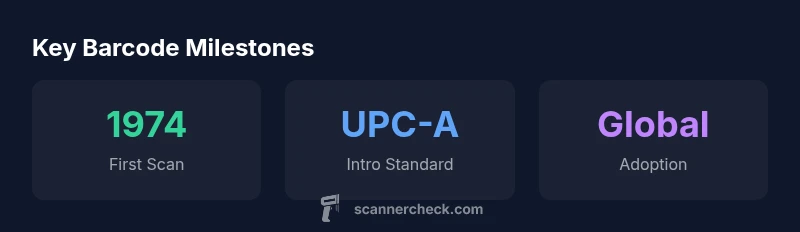
Key milestones in barcode scanning history
| Milestone | Year | Notes |
|---|---|---|
| First commercial barcode scanned | June 26, 1974 | Wrigley's Juicy Fruit gum at Marsh Supermarket, Ohio |
| UPC-A introduced | 1973 | Unified barcode standard for retail |
| Global adoption accelerates | 1980s–1990s | Retailers worldwide adopt barcode systems |
| GS1 standardization | 1990s | Barcodes standardized across industries |
Common Questions
When did barcode scanning first begin?
The first commercial barcode scan occurred on June 26, 1974, at Marsh Supermarkets in Ohio, using a UPC barcode. This marked the dawn of automated checkout and data capture that would transform retail.
The first barcode was scanned in 1974 at a grocery store, kicking off automated checkout.
What was the first item scanned?
The historic first scan was a package of Wrigley’s Juicy Fruit gum. The moment demonstrated that a barcode could reliably identify a product and trigger price lookup and stock updates.
The first item scanned was Wrigley’s Juicy Fruit gum.
How did barcode scanning change retail?
Barcode scanning sped up checkouts, reduced errors, and enabled real-time inventory management. Over time, this data backbone powered better replenishment, pricing accuracy, and analytics across stores and warehouses.
Barcodes boosted speed and accuracy at checkout and enabled better stock management.
Are barcodes still relevant with QR codes?
Yes. Traditional UPC barcodes remain essential for product IDs and checkout, while QR codes add capacity for mobile marketing, tickets, and dynamic data. Both formats coexist to support diverse data capture needs.
Barcodes stay essential, with QR codes expanding what data can be captured via smartphones.
What is the future of barcode scanning?
The future blends AI-driven reading, mobile and wearable scanners, and IoT-enabled workflows. Expect smarter error handling, faster reads in tough conditions, and deeper analytics from every scan.
AI-powered, mobile, and IoT-enabled scanning will get faster and smarter.
Who invented the barcode?
The barcode concept emerged from the work of Norman Woodland and Bernard Silver in the 1950s and 1960s, with practical realization culminating in the UPC system developed in the United States.
Invented by Norman Woodland and Bernard Silver, with UPC development in the US.
“The barcode's power lies in its simplicity—turning a single numeric string into instant, fault-tolerant data across millions of products.”
Key Takeaways
- Understand the 1974 milestone as the ignition point
- Recognize the shift from single-use test to global standards
- Acknowledge the evolution from UPC to 2D codes
- Appreciate data flow as the true value of scanning
- anticipate ongoing innovation in mobile and AI-driven reading