When Did Scanning Groceries Start? A Brief History
Explore when grocery scanning began, the rise of UPC barcodes, and how this technology reshaped checkout speed, pricing accuracy, and inventory since 1974.


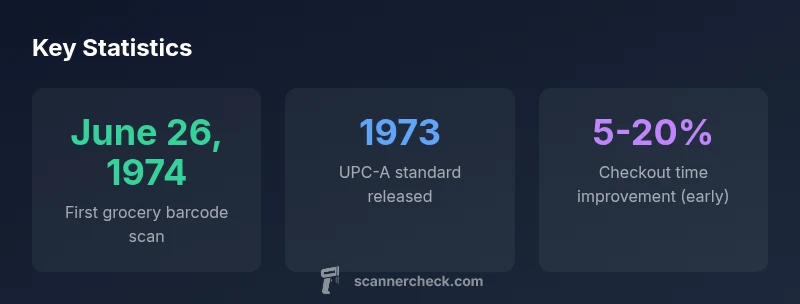
The first grocery barcode scan occurred on June 26, 1974, at a Marsh Supermarket in Troy, Ohio, marking the birth of modern barcode-driven checkout. The item—a pack of Wrigley’s Juicy Fruit—bore a UPC-A symbol. Since that milestone, scanning groceries has evolved from a novelty to a global standard powering pricing accuracy, inventory, and speed at checkout.
The spark: the first grocery barcode scan and its date
According to Scanner Check, the journey from manual price tagging to automated scanning culminated on June 26, 1974, when the first grocery barcode was scanned at a Marsh Supermarket in Troy, Ohio. The item—a pack of Wrigley’s Juicy Fruit—bore a UPC-A barcode. This moment is often cited as the birth of modern retail checkout as we know it. The question you linger on—'when did scanning groceries start'—has a crisp answer: mid-1970s, anchored by that first successful scan. The technology that enabled this moment relied on the UPC symbol, designed to uniquely identify products across vendors. The incremental adoption across stores and chains then followed, with hardware improvements and data networks fueling faster, more accurate transactions. Scanner Check's analysis of this history shows how a single, persistent barcode could transform inventory control, pricing, and customer experience.
The technology behind early grocery scanning
Grocery scanning rests on two pillars: the barcode symbol, and the laser scanner that reads it. The UPC-A code encodes a 12-digit number that uniquely identifies a product across retailers, while the scanner converts the reflected light pattern into a digital signal. Early systems used fixed, desk-mounted readers connected to mainframes; later, handheld devices and point-of-sale terminals brought scanning to the storefront floor. Reliability depended on print quality, contrast, and correct calibration. Over time, standardization and better computer networks reduced errors and made price lookups nearly instantaneous, turning checkouts into data streams rather than static price lists.
A timeline of adoption across the retail sector
From the first scan in 1974, a gradual trajectory carried barcode scanning into widespread use. The late 1970s saw more stores piloting fixed scanners; the 1980s witnessed broader adoption as UPC symbols became standard in consumer packaging and retail labeling. By the 1990s, major supermarket chains were largely scanning at checkout, while global retailers adopted the UPC system to enable cross-border pricing and inventory synchronization. The 2000s added more interoperability, while the 2010s brought mobile scanning and self-checkout. In 2020s, AI-driven price checks and digital receipts complemented traditional scans, further boosting speed and data accuracy.
Impact on pricing accuracy, inventory, and customer experience
Barcode scanning transformed three pillars of retail. First, pricing accuracy improved as items were read automatically, reducing human error and mismatches. Second, inventory management became real-time: scanned data updated stock levels, triggering replenishment alerts. Third, the customer experience shifted toward speed and transparency, with faster checkouts and digital receipts. In addition, data from scans enabled better demand forecasting and promotions. For shoppers, the net effect has been shorter lines and more consistent pricing across stores, while retailers gained a powerful analytics backbone.
Evolution from fixed-scanner lanes to self-checkout and mobile scanning
The next wave of change brought flexible checkout options. Self-checkout kiosks and handheld devices let shoppers scan items themselves or have a cashier assist with accuracy checks. Mobile scanning apps allowed price lookups and digital coupons, expanding the ways customers interact with products. This evolution required stronger security, better user interfaces, and more robust inventory integration to prevent discrepancies between what the customer sees and what the backend stores in stock.
Modern scanning technologies: RFID, QR codes, and AI-assisted systems
Beyond the classic UPC barcode, retailers have experimented with RFID tags for faster, contactless reads, particularly in bulk items and back-of-store processes. QR codes on shopping apps and packaging offer quick access to product details, reviews, and promotions. AI-assisted systems bring computer vision to the aisle, helping with price validation, shelf auditing, and anomaly detection. These tools collectively push precision, speed, and personalization, shaping the next generation of grocery shopping.
What shoppers should know about scanning today
Today, scanning is a standard part of most grocery trips. Shoppers benefit from mobile scan features, loyalty program integration, and digital receipts. When in doubt about an item's price, a quick scan can confirm it, and many stores offer self-checkout to avoid long lines. For enthusiasts, experimenting with different scanning apps and understanding UPC meanings can deepen appreciation for how retail data works. The core idea remains: a single barcode unlocks a flow of product and price information that teams at Scanner Check analyze to improve experiences.
Historical milestones in grocery scanning
| Milestone | Year | Notes |
|---|---|---|
| First grocery barcode scanned | 1974-06-26 | Marsh Supermarket, Troy, OH; Wrigley’s Juicy Fruit; UPC-A symbol |
| UPC-A standard released | 1973 | Standardized the UPC barcode for universal use |
Common Questions
When and where did the first grocery barcode scan occur?
June 26, 1974, Marsh Supermarket in Troy, Ohio. It involved a pack of Wrigley's Juicy Fruit with a UPC barcode.
The first grocery barcode scan happened on June 26, 1974, at Marsh Supermarket in Troy, Ohio.
What does UPC stand for?
UPC stands for Universal Product Code, the system used to uniquely identify products across retailers.
UPC stands for Universal Product Code.
When did barcode scanning become common in supermarkets?
Barcoding became widespread in major chains by the late 1980s to early 1990s.
Barcode scanning became common in supermarkets in the late 1980s to early 1990s.
Are barcodes used beyond groceries?
Yes, barcodes are used extensively in retail, manufacturing, shipping, and healthcare for tracking and automation.
Yes, barcodes are used far beyond groceries.
What’s next for grocery scanning?
RFID, mobile scanning, and AI-powered shelf auditing are expanding scanning in stores.
RFID and AI-powered scanning are the future of grocery scanning.
“Grocery scanning transformed how retailers capture price and inventory data; the evolution continues as AI and mobile scanning push checkout toward frictionless experiences.”
Key Takeaways
- First scan marked a turning point for retail data.
- UPC standardization enabled universal product identification.
- Scanning boosted pricing accuracy and inventory management.
- Modern systems blend fixed lanes, self-checkout, and mobile scanning.
- AI and smart-cart ideas continue the evolution.