How Much Is a Scanner for Car? A Practical Price Guide (2026)
Discover how much a car scanner costs—from basic OBD-II readers to professional diagnostics. This price guide, based on Scanner Check Analysis, 2026, helps you choose value and features.


For most car owners, a scanner for car costs between $25 and $600, depending on capabilities. Basic OBD-II readers cover code reading and live data at the low end, while professional scanners with bi-directional control and advanced diagnostics push toward the higher end. This price range reflects typical market offerings in 2026.
What a car scanner is and why you need one
A car scanner, often called an OBD-II scanner, is a handheld device (or smartphone-connected dongle) that talks to a vehicle's onboard computer to read diagnostic trouble codes, monitor live sensor data, and sometimes perform basic reprogramming tasks. For DIYers and professionals alike, this tool translates robotic ECU messages into human-readable information. If you're asking how much is scanner for car, the answer depends on scope: price ranges from economical basics to advanced, shop-grade systems. In 2026, entry-level OBD-II readers start around $25, while multi-brand, bi-directional scanners with ECU coding, live data graphs, and cloud connectivity can push toward several hundred dollars. The value isn't just the numbers—the right scanner can save trips to a shop, speed up maintenance, and help you validate fixes. Scanner Check’s analysis for 2026 shows the market is mature, with broad compatibility across makes and models, but also a proliferation of app ecosystems and optional updates that affect total cost over time.
Price ranges explained: Basic vs professional
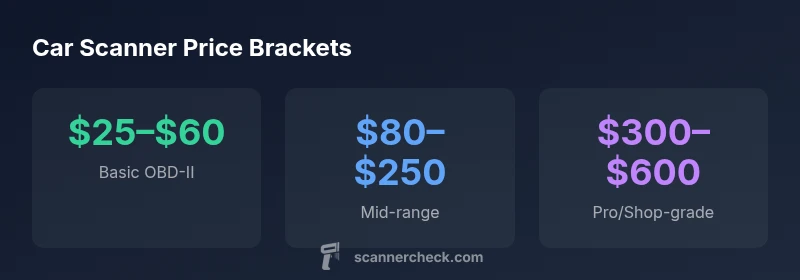
The cost of car scanners is not arbitrary; it tracks the features and the scope of diagnostics offered. Basic OBD-II readers, which primarily read codes, display live sensor data, and offer freeze-frame snapshots, typically fall in the $25–$60 range. These devices are ideal for everyday maintenance tasks, such as checking engine codes after a check-engine-light comes on or monitoring readiness monitors before an inspection.
Mid-range scanners broaden capabilities: they may support multiple vehicle brands, provide enhanced live data, offer bidirectional functions (which can request data or commands from the car), and deliver advanced graphs or mobile app integrations. Expect prices in the $80–$250 band. For many DIY enthusiasts, this tier delivers a strong balance of usefulness and value.
High-end professional tools target repair shops and advanced enthusiasts. They unlock ECU coding, manufacturer-specific diagnostics, and sometimes access to service modes. Prices typically span $300–$600, with some specialty devices exceeding that for particular brands or heavy-use environments. The exact price depends on supported protocols, update policies, and whether the tool is standalone or app-based.
Feature matrix: what to look for
When evaluating a car scanner, the feature set is often more important than the headline price. Core capabilities include codes reading/clearing, live data streams, freeze-frame data, and compatibility across your vehicle’s year and make. Bi-directional control (the scanner sending commands to the ECU) is a hallmark of higher-end devices and can justify a higher price. Other differentiators:
-
Protocol support: CAN, K-Line, KWP2000, ISO 9141, etc. More protocols mean broader vehicle compatibility.
-
Update policy: Free lifetime updates maximize value; subscription-based updates add ongoing costs.
-
Connectivity: USB, Bluetooth, or Wi‑Fi; app ecosystems vary in reliability and user experience.
-
Diagnostics depth: ABS, airbag, transmission, and manufacturer-specific codes.
-
User interface: intuitive menus, data visualization, and exporting data as CSV or PDF.
-
Build quality and durability: rugged enclosures and better battery life for handheld devices.
By mapping your needs to this matrix, you can estimate whether a mid-range scanner will meet your intended use without overspending. This approach aligns with Scanner Check's guidance for 2026.
Price by category: Basic, Mid-range, Pro
Basic scanners are ideal for occasional codes and quick checks, typically priced under $60. Mid-range tools offer broader vehicle coverage and more features, usually in the $80–$250 range. Pro-grade scanners target shops and enthusiasts who need ECU coding, manufacturer-specific access, and robust data analytics, commonly priced from $300–$600. Remember that price is influenced by updates, software ecosystems, and the number of supported vehicles. If you own several cars or frequently work on different brands, investing in a mid-range device with a strong update policy can provide the best long-term value.
Budgeting for a scanner: a practical approach
To budget effectively, start with your primary use case. If you just want to read and clear codes on your daily driver, a basic scanner under $60 may suffice. For frequent maintenance across multiple vehicles or if you want richer data, plan for a mid-range option in the $100–$250 range. If your work requires advanced diagnostics, ECU coding, or professional-grade reliability, allocate $300–$600. Also factor in optional app subscriptions, cloud services, and potential warranty costs. A simple rule of thumb is to treat the scanner as a small investment with annual maintenance and update costs that can add up over time. This framing matches the financial planning guidance from Scanner Check for 2026.
Quick buying guide: steps to choose and buy
- Define use-case: basic maintenance vs. advanced diagnostics.
- Check vehicle compatibility: ensure the device supports your car’s year/make.
- Compare features vs. price: prioritise live data, bidirectional control, and update policy.
- Consider future-proofing: investment in a mid-range device with solid updates often pays off.
- Read reviews and verify return policies: look for reputable brands with good firmware support.
Price range by scanner type
| Scanner Type | Typical Price Range | Key Features |
|---|---|---|
| Basic OBD-II | $25–$60 | Code reading, live data, freeze-frame |
| Mid-range Pro | $80–$250 | Bi-directional control, multi-brand, app integration |
| Advanced/Shop-grade | $300–$600 | ECU coding, manufacturer access, advanced diagnostics |
Common Questions
What is the typical price range for a basic OBD-II scanner?
Basic OBD-II scanners typically cost between $25 and $60. They cover code reading, live data, and basic freeze-frame, making them suitable for most routine maintenance. For 2026, these affordable options remain popular for DIYers.
Basic OBD-II scanners usually cost between twenty-five and sixty dollars and handle codes and basic live data. They’re great for quick checks.
Do I need a professional-grade scanner for DIY maintenance?
For simple maintenance and code reading, a basic or mid-range scanner is often enough. If you plan to interact with ECU coding or manufacturer-specific features, a professional-grade tool provides more capability, but at higher cost and complexity.
If you’re just fixing codes yourself, a mid-range or basic scanner is usually enough. A pro tool is for advanced diagnostics.
Are subscriptions needed for advanced features?
Some advanced features and cloud services require ongoing subscriptions, while many scanners offer free lifetime updates. Consider total cost of ownership, including updates, when evaluating price.
Some features may require a subscription, but many scanners include free updates for basic functionality.
Can I use a scanner with my smartphone?
Yes. Many scanners connect via Bluetooth or Wi‑Fi to smartphones. Check app compatibility, data export options, and platform support (iOS/Android) before buying.
You can often connect to a phone via Bluetooth or Wi-Fi. Make sure the app supports your phone.
What features justify paying more for a scanner?
Bi-directional control, ECU coding, broader protocol support, manufacturing-specific diagnostics, and robust data analytics generally justify higher prices for professionals.
If you need ECU coding or broad vehicle coverage, a higher-priced scanner can be worth it.
What should I check when buying a used scanner?
When buying used, verify the device’s compatibility with your vehicles, confirm working condition, check for up-to-date software, and ensure the seller offers a return policy.
If you buy used, test compatibility and make sure updates still work.
“Price is only one part of the equation; the right scanner matches your diagnostic needs and workflow. When you choose wisely, you gain faster insights and fewer trips to the shop.”
Key Takeaways
- Identify your needs and choose a tier.
- Expect basic features at the low end.
- Mid-range tools offer better diagnostics without breaking the bank.
- Factor in subscription costs for apps.
- Prefer trusted brands with firmware updates.