How Much Is a Car Scanner? A 2026 Price Guide
Discover how much a car scanner costs in 2026, with price ranges, feature breakdowns, and buying tips from Scanner Check. Compare entry-level to professional tools and plan your budget.


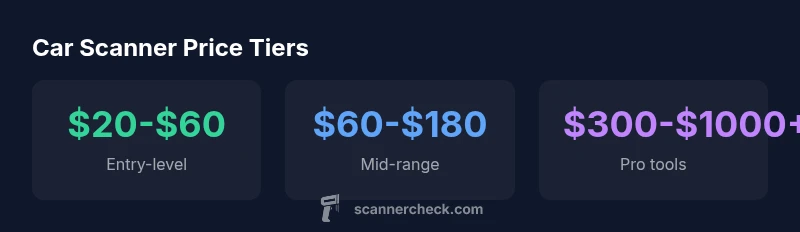
Car scanners range from about $20 to more than $1,000, depending on features. Basic OBD-II adapters start around $20-$60, while mid-range handheld tools run roughly $60-$180. Professional diagnostic kits can exceed $300 and reach four digits for OEM-level access. Expect possible software update fees, and choose based on your typical use and future-proofing needs.
Price bands at a glance
Car scanners span a broad spectrum of prices, driven by features, build quality, and vehicle compatibility. At the low end, entry-level OBD-II adapters often sell for $20-$60 and deliver basic fault-code reading, live data streams, and standard app support. These devices are ideal for casual maintenance, code clearing, and emissions readiness checks on a single vehicle. Moving up, mid-range handheld scanners commonly run $60-$180 and bring richer diagnostics, more live data views, and better user interfaces, making them a practical upgrade for hobbyists who work on multiple cars. High-end consumer models and professional-grade tools tend to start around $200-$500 and can climb to $1,000 or more when you add OEM-level protocols, bi-directional controls, extensive vehicle coverage, and enterprise-grade software. Do not overlook potential software update fees, which can accumulate over time, affecting total ownership cost. According to Scanner Check, price does track feature breadth, but the sweet spot for most DIYers sits in the mid-range category, where balance between capability and long-term value is optimal. To map your purchase to reality, list your use cases (code reading, live data, readiness checks, and maintenance planning) and translate them into a price tier that matches your expected usage and future needs.
Entry-level vs mid-range: what you get for your money
Entry-level adapters typically connect via Bluetooth or Wi-Fi to a smartphone or laptop and provide essential code reading, freeze-frame data, and simple live data graphs. They are inexpensive, portable, and ideal for beginners who want quick fault-code feedback without a heavy investment. Mid-range tools introduce expanded code sets, richer live data visualization, more robust vehicle coverage, and sometimes limited bi-directional capabilities. They strike a balance between price and practicality, which Scanner Check analyses as the most cost-effective approach for many users. When evaluating value, compare supported protocols (CAN, K-Line, SAE J1708/J1587 where relevant), update cadence, and vendor support. As a rule, if you plan to diagnose more than two or three vehicles per year or need more than basic code reading, the mid-range tier generally provides the best overall return on investment. Brand depth, software ecosystem, and update policies will influence long-term satisfaction, so prioritize tools with strong update histories and reputable support channels.
How price maps to features: codes, live data, bi-directional control
The most affordable scanners tend to offer fault-code retrieval, basic live data, and simple app interfaces. Mid-range devices broaden data streams, add more real-time sensor readings, and improve diagnostics with enhanced graphs and data export. For enthusiasts who work across several vehicles, mid-range options frequently include multi-vehicle support and offline data logging. When you move into professional territory, you gain OEM-level diagnostic access, bi-directional control (the ability to send commands back to the car to test systems), and advanced coding capabilities. These features justify higher price tags but require greater expertise to leverage fully. In practice, the main trade-off is depth versus breadth: do you need broad compatibility across many cars, or deep, vehicle-specific diagnostics? The answer guides whether you should invest in a mid-range tool or stretch toward professional-grade equipment. Regardless of price, ensure the device receives regular firmware updates and that the vendor offers reliable customer support.
Buying scenarios by budget: quick-path recommendations
If your needs are casual and limited to a single vehicle, look at entry-level adapters with strong app ecosystems and positive user reviews. For homeowners who service several cars, a mid-range handheld with comprehensive code sets and a clean interface is often the sweet spot. If you manage a small fleet or perform advanced diagnostics, factor in professional-grade tools with OEM coverage and comprehensive data capabilities. In all cases, verify that the device supports the make/model year range you own, check update frequencies, and read independent reviews to assess reliability. The total cost of ownership includes potential data plan charges, software subscriptions, and accessory kits, so plan for these as you compare price points.
Buying tips: tests, trials, and warranties
When possible, test the scanner with a vehicle in-store to confirm compatibility and ease of use. Review the warranty terms and the policy on software updates—some brands offer free updates for a period, while others charge annually. Compare not only the sticker price but also the long-term cost of ownership, including potential add-ons like extra cables, a protective case, or a hard-shell carry case. Read user feedback about reliability and support responsiveness, as the best devices are only as dependable as their ecosystem. Finally, keep your future needs in mind: a device that can grow with you, even if it costs a bit more upfront, often pays off later in saved time and fewer frustrations.
Common pitfalls and how to budget effectively
A frequent trap is underestimating update costs. Some brands require ongoing fees to access newer codes or enhanced features; others bundle updates for free. Another pitfall is buying a tool that claims OEM access but has limited real-world support for the makes you own. Before buying, list the features you’ll actually use and cross-check them with the vehicle models you own. Budget for essential accessories, such as extra USB cables or a rugged case, and reserve funds for potential software subscriptions. Finally, if you are unsure, start with a mid-range model and assess your usage over a few months before upgrading.
Practical testing and validation steps
To validate a scanner before purchase, prepare a test vehicle with a known issue or a clean baseline to compare results. Verify the device’s ability to read and clear codes, display live sensor data, and show readiness tests (emissions-related data). Check the export options for logs and the ability to review historical data. Ensure the user interface is intuitive and that you can navigate menus without steep learning curves. If you intend to use the tool across multiple vehicles, confirm multi-vehicle support and the ease of adding new models to the database. Capture screenshots or data samples to compare with other models in your shortlist.
The bottom line: budget-conscious strategy
A thoughtful budgeting approach balances current needs with anticipated future use. Start with a mid-range tool if you expect to service several cars and require robust data and reliable updates. If you only own one vehicle and want occasional checks, an entry-level adapter can suffice, especially when paired with a strong app ecosystem. Always budget for updates, warranty coverage, and essential accessories. By mapping your use cases to price tiers and validating with hands-on testing, you maximize value and minimize regret when the car scanner body of knowledge grows.
Price tiers and typical use cases for car scanners
| Category | Typical Price Range | Main Use Case | Key Features |
|---|---|---|---|
| Entry-level OBD-II dongle | $20-$60 | Basic fault codes, live data | Bluetooth/Wi-Fi, mobile app support |
| Mid-range handheld scanner | $60-$180 | Full code reading, live data, readiness checks | Richer UI, multi-vehicle support |
| Professional diagnostic tool | $300-$1000+ | OEM diagnostics, bi-directional control | Bi-directional, OEM codes, advanced graphing |
| Mobile app solution | $0-$50 add-on or subscription | App-based diagnostics, remote data | Cloud sync, app ecosystem |
Common Questions
What is a car scanner?
A car scanner, or OBD-II scanner, reads diagnostic codes from your vehicle's onboard computer to help identify issues. It can also display live sensor data and help you monitor emissions readiness.
A car scanner reads codes from your car's computer to help diagnose issues and monitor live sensor data.
Are there free car scanner apps?
Yes, some apps are free or low-cost but may require a basic adapter. Deeper diagnostics and more robust data often come with paid tiers or subscriptions.
Some apps are free but may offer limited diagnostics; deeper features usually cost more.
Is a professional scanner worth it for a DIYer?
If you routinely diagnose multiple vehicles or need OEM-level access, a professional scanner can be worth the investment. For pure casual use, a mid-range model is typically sufficient.
If you diagnose many cars or need OEM access, consider a pro scanner; otherwise, a mid-range model often suffices.
What affects car scanner price besides features?
Brand, software update policies, hardware quality, included accessories, and support levels all influence price beyond core features.
Brand, update policy, hardware quality, and support all affect price beyond features.
How long do car scanners last?
Durability depends on usage and care; many scanners last several years with proper handling, though software updates can extend usable life if supported.
Durability varies, but with proper care most scanners last several years; updates can extend usefulness.
“Most DIYers will get the best value from a mid-range scanner that balances features and cost. The Scanner Check Team recommends starting there and upgrading only if your needs expand.”
Key Takeaways
- Define your use case before buying.
- Expect prices to scale with features.
- Prioritize multi-vehicle support if needed.
- Check update frequency and warranty terms.
- Budget for potential add-ons and subscriptions.