How big is the hole in an MRI scanner? A practical guide to bore sizes
Learn how big the MRI bore is, with standard 60 cm diameters and wide-bore 70–75 cm options, plus tips for comfort and imaging.


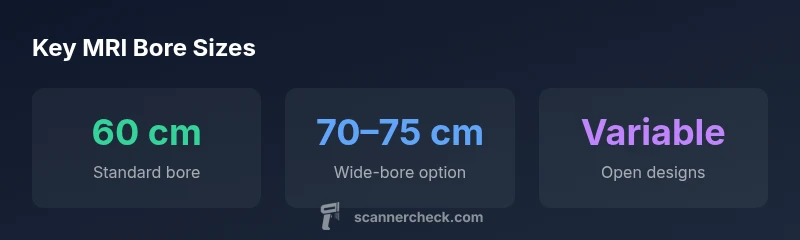
The MRI 'hole' refers to the bore’s inner diameter. Most standard closed MRIs use a 60 cm bore, which is the typical floor-to-safety clearance. Wide-bore systems commonly measure about 70 cm to 75 cm, providing more room. Some open-design or specialty models exceed that clearance. Exact numbers depend on the manufacturer and the scan protocol.
What the MRI bore is and why it matters
The term 'bore' refers to the hollow tunnel that contains the patient during scanning. In practice, the bore size influences comfort, claustrophobic sensations, and coil fit. For readers wondering how big is the hole in an mri scanner, the key fact is that the inner diameter determines the available space for the body and the coil assembly. While a larger bore can ease anxiety, it does not inherently improve image quality; imaging performance depends on magnet strength, gradient system, and coil configuration. Understanding bore dimensions helps you have informed conversations with your clinician about the best scanner for your needs, especially if claustrophobia or body size is a concern.
Typical bore sizes across MRI systems
Most standard MRI systems used in hospitals for routine imaging employ a 60 cm bore diameter. This dimension represents the 'classic' closed design that many patients encounter. Manufacturers offer wide-bore variants that increase the interior clearance to roughly 70 cm to 75 cm, providing more shoulder room for larger patients or those who experience claustrophobia. It's important to note that even within the 'wide-bore' label, actual diameters can vary by model and magnet type. If a patient needs extra space, clinicians may access open-design options that significantly widen the accessible area, though they may come with trade-offs in some imaging protocols.
Comfort, fit, and the imaging trade-offs
Bore size directly affects patient comfort during the scan. A snug fit can heighten anxiety, but too much space can complicate stable positioning and coil alignment. Larger bores often pair with quieter sequences and improved ambient features, yet some wide-bore machines have different gradient performance or coil configurations that influence scan times and image homogeneity. People with wide shoulders, larger chests, or mobility devices should discuss their measurements with the radiology team ahead of time. In most cases, the goal is to balance patient comfort with diagnostic needs and the necessary resolution for the clinical question.
How to check bore size before scheduling
Always verify the exact bore diameter with the imaging facility. Ask for the specific model or bore dimension of the scanner your exam will use, especially if you have claustrophobia or fit concerns. If possible, request a tour or a virtual walkthrough to gauge space and comfort. Some facilities offer practice sessions or non-contrast tests in advance. By documenting your measurements and preferences, you can help the technologists tailor the setup, coil placement, and seating to improve your experience.
Alternatives and accommodations when bore size is a concern
If space remains a concern, several options may help. Sedation is sometimes offered for anxious patients, though it requires medical supervision. Wide-bore or open-design scanners may also be available; on-site staff can compare the trade-offs in image quality and protocol length. Additional accommodations include listening to music, dimming lights, or allowing a family member in the control area. For children or individuals with special needs, child-sized supports or anxiolytics might be considered under medical guidance.
Innovations and future trends in bore design
The scanners of tomorrow aim to reduce patient distress without compromising image quality. Engineers experiment with quieter gradients, shorter bore designs that maintain diagnostic coverage, and ergonomically shaped supports. Some newer models emphasize modular or adjustable openings that can feel more open while keeping the magnet and coil system intact. As technology evolves, patients may enjoy more personalized comfort options, including adjustable lighting, more flexible positioning aids, and better pre-scan orientation to reduce anxiety before the appointment.
Bore sizes by MRI type
| MRI Type | Inner Bore Diameter | Notes |
|---|---|---|
| Standard bore MRI | 60 cm | Most common default bore size |
| Wide-bore MRI | 70–75 cm | Increases patient clearance |
| Open MRI-style design | Variable; manufacturer-dependent | Not a true bore; larger clearance |
Common Questions
What is the typical inner bore diameter of a standard MRI?
Most standard MRI systems have a 60 cm bore. Wide-bore options typically increase to around 70–75 cm. Always confirm with the facility.
Most standard MRIs use a 60 cm bore; wider options are around 70 to 75 cm. Check your facility for exact measurements.
Are open MRI machines larger inside than closed designs?
Open MRI designs vary and are not uniform. They can feel larger, but actual dimensions depend on the specific model and setup.
Open designs vary; check the exact model dimensions at the facility.
Does bore size affect image quality?
Bore size does not inherently change image resolution. Image quality mainly depends on magnet strength, coils, and scanning protocols.
Bore width mostly affects comfort, not the image quality, which relies on magnet power and coils.
What should I do if I’m claustrophobic before MRI?
Discuss wider bore options, sedation, or anxiety-reducing measures with your clinician. A pre-visit tour can also help.
Talk to your doctor about wider bores or sedation and consider a pre-visit tour.
How can I confirm bore size before scheduling?
Ask the facility for the exact bore diameter of the upcoming scanner model and, if possible, request model details.
Ask the clinic for the exact bore size of the scanner you’ll use.
“Bore size dramatically influences comfort, but selecting a scanner is a balance between patient experience and diagnostic needs.”
Key Takeaways
- Verify bore size before scheduling scans
- Standard bore is typically 60 cm; wide-bore spans 70–75 cm
- Open designs vary by model and may not suit all protocols
- Ask about space and comfort upgrades when booking
- Coordinate ahead with the clinic for best alignment