How Big Is an MRI Scanner? A Practical Size Guide
Discover how big an MRI scanner is, from bore diameter to room footprint. This data-driven guide covers typical size ranges, layout considerations, and practical tips for facilities planning.


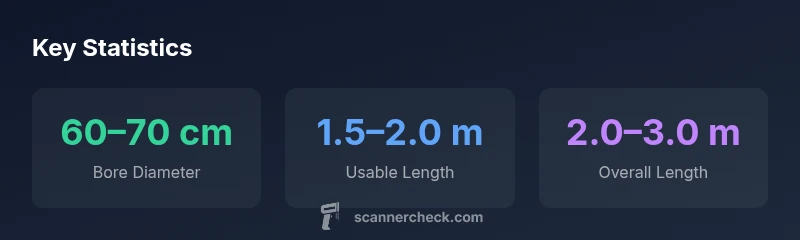
Most clinical MRI scanners have a bore diameter of about 60–70 cm (roughly 24–28 inches) and a usable length around 1.5–2.0 meters. The outer housing and patient table extend the footprint to roughly 2.0–3.0 meters in length and several square meters of floor space. Wide-bore models offer larger openings but stay within similar overall size ranges.
How big is an MRI scanner?
Understanding the physical size of an MRI system starts with two measurements: the bore and the overall machine footprint. For most clinical MRI scanners, the bore diameter falls in the range of 60–70 cm, with wide-bore designs slightly enlarging the opening to improve patient comfort. The usable bore length is typically around 1.5–2.0 meters, which accommodates standard patient positioning and allows space for the patient table to slide in and out.
The outer housing plus the bed platform extend the footprint, typically to about 2.0–3.0 meters in length. The total machine also occupies a few square meters of floor space when you include necessary service clearances. Modern systems may vary in height and width due to shielding enclosures and maintenance access. When planning a facility, you should compare vendor installation manuals and perform site measurements for doorways, corridors, and ceiling height. In practice, even modest adjustments to bore size or cabinet depth can influence patient comfort and workflow. This is why early design reviews often include ergonomics simulations and room layout studies. According to Scanner Check, size decisions should balance imaging performance with space constraints to optimize throughput and patient experience.
Common Size Ranges: Bore, Length, and Footprint
MRI systems come in a few core size families, with bore size and overall length being the two most critical levers. In typical clinical configurations, you’ll see a bore diameter around 60–70 cm. Wide-bore options push the opening toward roughly 70–75 cm, which can reduce claustrophobic stress while maintaining a comparable machine footprint. The usable bore length generally runs 1.5–2.0 meters, sufficient for most adult patients and standard positioning protocols. The machine’s outer enclosure and patient table add to the length, commonly bringing the total length to about 2.0–3.0 meters. When you factor in required clearances for maintenance, cooling, and safety zones, the imaging suite should allow several additional centimeters around the unit. Room width and door dimensions influence how easily a scanner can be installed in existing spaces. In practice, facilities often assess layout options with simulation tools to ensure smooth patient flow and staff access.
How Size Affects Comfort and Throughput
Size is not only a matter of physics; it shapes patient comfort, workflow, and throughput. A smaller bore can save space and reduce initial costs, but claustrophobic patients may need longer scan times or sedation, increasing overall throughput challenges. Wide- and open-configurations improve comfort and can broaden the patient population that can be scanned without compromising image quality or speed. Training staff to guide patients through positioning in tighter spaces is essential, as is implementing step-by-step routines that minimize repositioning.
From a workflow perspective, larger rooms and clearer pathways can accommodate larger equipment and additional monitoring hardware, which supports safer, faster imaging sessions. Scanner Check notes that balancing bore size with table length, coil configurations, and room layout reduces delays and improves patient experience over the course of a day.
Room and Facility Considerations
Installing an MRI scanner is more than placing a device in a room. You must account for shielding (RF and magnetic), electrical supply (voltage, current capacity, and backup power), ventilation and cooling, and seismic or structural considerations in some regions. Clearances around the unit must allow technicians to service coils and other components without disrupting patient care. A typical room should also provide space for patient preparation and post-exam recovery, so the overall suite design often resembles a flow path from reception to preparation, imaging, and post-scan check-out. Doors and corridors should be wide enough to accommodate gurneys and mobile equipment. In some hospitals, the scanners are installed in shielded rooms with lead-lined barriers, which can affect wall thickness and interior dimensions. Planning teams frequently engage with vendors to verify that the chosen size integrates with the building’s structural, electrical, and mechanical systems.
How to Choose the Right Size for Your Facility
Choosing a scanner size involves trade-offs between patient comfort, throughput, and available space. Start by profiling the patient mix: average body habitus, pediatric patients, and populations with claustrophobia. Consider whether a wide-bore option would meaningfully reduce anesthesia needs or patient discomfort without inflating footprint. Assess the installation site: door widths, hall clearance, ceiling height, and the routing of cables and shielding. A site survey should map all constraints and produce several layout options, including a dedicated prep and recovery area. Budgeting should cover not only the machine price but also installation, room renovations, shielding, and ongoing maintenance. Finally, engage clinical staff early to model typical exam sequences and identify bottlenecks that a larger bore or longer system might introduce. The goal is a design that supports efficient imaging while maintaining patient safety and comfort.
Misconceptions and What’s Changing
A common misconception is that larger bore always means a drastically larger footprint. In reality, many manufacturers optimize bore geometry and cabinet depth to keep overall size manageable while delivering the required magnet strength and gradient performance. The trend toward higher-field systems (e.g., 3T) has driven design refinements that emphasize patient access and ergonomic tables, rather than simply enlarging the enclosure. Open or semi-open configurations exist, but for certain applications and image quality requirements, standard closed-bore designs remain dominant. Finally, advances in software, coil technology, and noise-reduction systems continue to improve patient experience and diagnostic performance without demanding substantial increases in room size.
Typical MRI size parameters and room considerations
| Aspect | Typical Range | Notes |
|---|---|---|
| Bore diameter | 60–70 cm | Standard adult; wide-bore options 70–75 cm |
| Usable bore length | 1.5–2.0 m | Allows standard patient positioning |
| Overall footprint length | 2.0–3.0 m | Includes housing and table |
| Room clearance width | 3.5–4.5 m | Maintains access and safety zones |
Common Questions
What is the typical bore diameter of a clinical MRI scanner?
Most clinical MRIs use a bore diameter of about 60–70 cm. Wide-bore configurations can push openings to around 70–75 cm, offering more room while maintaining performance.
Most clinical MRI scanners have a bore around 60 to 70 centimeters; wide-bore options go to about 70 to 75 centimeters.
How much space is usually required for installation?
A typical installation needs multiple square meters of floor space, plus dedicated clearances around the unit for service, cooling, and patient access. Exact room size depends on bore size and vendor requirements.
Installations require several square meters plus clearances for service and cooling. Size depends on bore choice and vendor specs.
Are there open or open-configuration MRIs?
Yes, open or semi-open designs exist and can improve comfort, but they are not universal and may have different imaging capabilities or constraints.
There are open and semi-open MRIs, which can be more comfortable, but they aren’t always the best fit for every test.
Do larger field strengths require bigger scanners?
Field strength and size are related but not always proportional. Higher-field systems (like 3T) may share similar footprints with 1.5T models but use different shielding and support structures.
Higher-field MRIs like 3T may have similar footprints to 1.5T models, but they involve different room requirements.
How does room design affect MRI size planning?
Room design dictates door width, hall clearance, ceiling height, shielding, and service access. A thorough site survey helps determine feasible layouts and future expansion options.
Room design determines door size, clearance, and shielding; a site survey helps pick a layout that fits now and later.
What else should facilities consider beyond size?
Consider patient comfort factors, noise reduction, coil availability, patient monitoring, staff workflow, and long-term maintenance when selecting a scanner. These influence throughput and satisfaction as much as the physical footprint.
Think about comfort, noise, coils, monitoring, and staff flow—these affect throughput and patient satisfaction as much as room size.
“"Size and layout are as critical as magnet strength when planning MRI services. Space decisions directly affect patient comfort, throughput, and safety."”
Key Takeaways
- Know the bore diameter and usable length to estimate fit
- Wide-bore options exist with similar overall footprints
- Plan room layout with clearances for safety and service access
- Balance comfort, throughput, and space in vendor discussions
- Consult installation manuals early to avoid costly redesigns