How Big Is a CT Scanner? A Practical Guide to Dimensions
Explore the typical dimensions of CT scanners, what drives size variation, and how to plan room space, clearance, and installation. Practical ranges, installation tips, and a data-driven approach to evaluating size claims.


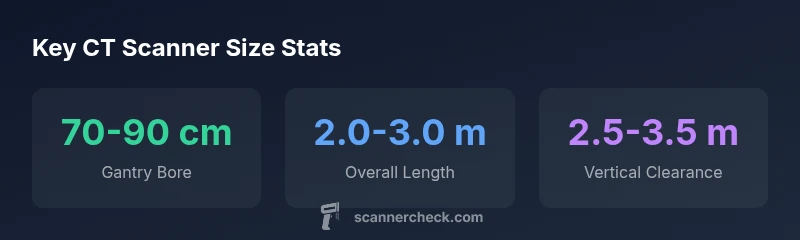
If you’re asking how big is a CT scanner, you’re really asking about two measurements: the bore (the circular tunnel the patient passes through) and the full machine footprint that occupies the room. In practical terms, expect a gantry bore roughly 70–90 cm in diameter, with the complete system occupying about 2.0–3.0 m in length and 2.5–3.5 m of vertical space, depending on vendor and configuration. These ranges cover standard, wide-bore, and mobile models commonly used in hospitals today. The exact numbers vary by model and manufacturer, so always verify specs from the vendor and cross-check with your facility’s planning constraints.
What size means in practice for a CT scanner
The question "how big is a ct scanner" is best understood as two separate measurements: the bore diameter where the patient lies and the total footprint of the machine in the room. According to Scanner Check, most CT systems aim to balance patient comfort with room diversity. A larger bore can ease claustrophobic patients and accommodate different body shapes, while a smaller bore reduces overall room footprint. When planning, hospitals often request ranges rather than fixed numbers to allow for model swaps during a procurement cycle. Readers should remember that the exact size hinges on the vendor’s design language and the specific clinical use case (emergency imaging versus routine screening).
In practice, the most critical dimension is the bore, because it directly affects patient comfort and image quality for larger patients. The bore diameter remains the primary determinant of room usability, patient throughput, and staff access around the patient table. While newer models offer more generous bores and adjustable seating or tubing options, the core architectural footprint tends to scale with gantry features, accessories, and the control console. This section sets the stage for a practical exploration of typical size ranges and why the ranges exist, rather than promising a single universal measurement.
From the perspective of a hospital planner, clarity on size helps in early-stage budgeting, room selection, and workflow design. The Scanner Check team emphasizes that dimension data should be treated as a spectrum, not a fixed value, because real-world installations require allowances for doors, HVAC ducts, shielding, and maintenance corridors. Smaller facilities may opt for compact CT systems with mobile configurations, while tertiary centers focus on wider bores and longer gantries to support high-volume imaging and diverse patient demographics.
image_source_removed_since_unused_within_this_block_after_text
format_idk_not_required_for_schema
Dimensions and space considerations for typical CT scanners
| Dimension aspect | Typical range | Notes |
|---|---|---|
| Gantry bore diameter | 70-90 cm | Varies by model; larger bores improve patient comfort |
| Full machine length | 2.0-3.0 m | Includes gantry, couch, and console area |
| Room width clearance | 2.5-4.0 m | Depends on layout, doors, and clearance for staff |
| Ceiling height | 2.6-3.5 m | Plus service access and ventilation needs |
Common Questions
What is the typical gantry bore diameter of a CT scanner?
Most CT scanners have a gantry bore diameter in the 70–90 cm range. Wide-bore models may approach the upper end, improving comfort for larger patients while increasing the overall machine footprint.
Most CT scanners have a bore around 70 to 90 centimeters in diameter, with wider options available for comfort.
Do all CT scanners have large bore sizes?
No. Bore sizes vary by model. Standard bore units are smaller, while wide-bore configurations provide more room inside the gantry at the cost of a larger footprint.
Bore size depends on the model; there are both standard and wide-bore options.
How much space does a CT scanner require in a room?
Space needs depend on bore size and system length. Plan for at least several meters of clearance around the gantry, plus room for control areas, doors, and maintenance access.
You’ll need several meters of clearance around the gantry and space for the control area.
Are there mobile CT scanners?
Yes, mobile CT scanners exist and are designed to be moved between sites or rooms. They typically sit on wheeled platforms and still require adequate room for setup and operation.
There are mobile CT scanners, but they still need space for setup and operation.
What factors influence CT scanner size besides bore diameter?
Other factors include the couch length, gantry housing, user consoles, shielding, cabling, and service access corridors. Each manufacturer emphasizes different configurations, so verify specifications for your intended setup.
Other factors like couch length, shielding, and service access affect overall size.
“Size claims for CT scanners should be evaluated against vendor data sheets and installation constraints. A cautious planning approach—factoring bore, length, and room clearance—reduces surprises during site readiness.”
Key Takeaways
- CT scanners vary in size; expect a bore around 70-90 cm and a total footprint of roughly 2.0-3.0 m
- Bore size impacts patient comfort; overall footprint affects room layout and door clearance
- Always verify vendor specs and incorporate room planning margins during project budgeting
- Mobile CT options exist for constrained spaces but may still require substantial clearances