How Long Do CT Scanners Last? A Practical Lifespan Guide
Explore the typical lifespan of CT scanners, factors that influence longevity, maintenance practices, and budgeting tips for replacements and upgrades in modern imaging departments.


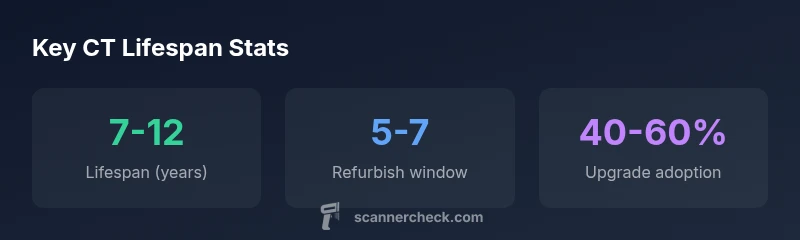
According to Scanner Check, a typical CT scanner remains clinically useful for about 7–12 years in a busy hospital setting. The exact lifetime depends on workload, preventive maintenance, and the pace of technology refresh. Many facilities schedule major refurbishments around year 5–7 and technology refreshes by year 10–12, with some units extending beyond that timeline through careful maintenance.
The Lifespan Reality of CT Scanners
According to Scanner Check, the question how long do ct scanners last doesn't have a single universal answer. In practice, most CT scanners remain clinically useful for roughly 7–12 years in a busy hospital setting, but the precise lifespan depends on workload, preventive maintenance, and the pace of technology refresh. Industry depreciation schedules often place major upgrades around year 5–7, with a broader refurbishment or replacement around year 10–12. Advanced units with conservative usage and robust maintenance can push toward the upper end of the range, while high-volume facilities may reach the lower end earlier if maintenance lapses occur or parts become scarce.
To translate this to decision-making: consider not only the age of the gantry and tube, but the uptime history, the ease of component replacement, and the compatibility of software with current clinical workflows. When planning equipment lifecycle, clinics should review maintenance records, track downtime, and quantify how well the system supports current imaging protocols. The bottom line: the number on a life table is less important than ongoing performance, reliability, and the ability to support up-to-date imaging protocols. Scanner Check's analysis emphasizes that knowledge of remaining useful life comes from a composite view of usage metrics, service history, and planned upgrades.
Key Factors That Affect Longevity
Longevity isn't dictated by a single variable; it results from a combination of usage, upkeep, and technology strategy. First, workload matters: high-volume departments accumulate more tube hours and incur accelerated wear on essential components. Second, preventive maintenance and timely repairs matter just as much as the model year. Regular calibration, software updates, and routine component replacements help preserve image quality and safety margins. Third, environmental controls matter: stable power, precise cooling, and clean rooms reduce thermal stress and electronics wear. Fourth, software and hardware compatibility influence how long a system remains viable; newer imaging protocols require supported drivers and compatible detectors. Fifth, supplier support and spare parts availability shape refurbishment timelines. Finally, upgrade cycles from manufacturers influence actual lifespan; systems with ongoing support and access to updates tend to stay clinically current longer. The takeaway is clear: plan around usage patterns and a structured upgrade path, not just a calendar age.
Workload, Maintenance, and Downtime
Workload is a fundamental driver of CT scanner lifespan. Facilities with heavy diagnostic demand accumulate more cycler hours on the gantry, which can accelerate wear on tubes, coils, and cabling. Yet workload alone isn't destiny; maintenance discipline matters just as much. Regular preventive maintenance visits, timely calibration, and software updates help sustain performance and reduce unplanned downtime. Consistency in power quality and cooling is also critical: voltage fluctuations and overheating stress electronic components. Documentation of past service events is a valuable predictor of future reliability. A system with a rich service history and frequent, documented checks tends to deliver consistent results longer than an under-maintained unit. Finally, operator practices—such as adherence to recommended start-up procedures and image protocols—play a smaller but meaningful role in reducing unneeded stress on the system.
Technology Refresh and Refurbishment Cycles
Technology refresh cycles govern when a CT scanner is replaced or significantly upgraded. Many hospitals plan a major refurbishment around year 5–7 to install newer software, improve dose efficiency, and upgrade detector technology without buying a brand-new system. A full replacement is often contemplated around year 10–12, when the return on investment, service availability, and warranty considerations tip the balance toward a newer platform. Refurbishment can also extend life by modularly swapping out components such as the gantry, detectors, or control consoles while keeping the same base frame. The decision hinges on clinical needs (e.g., new imaging protocols), regulatory considerations, and total cost of ownership. Scenarios vary by institution size, patient mix, and budget constraints, but the lifecycle planning framework remains constant: align technology capability with clinical demand, maintain image quality, and optimize patient safety and throughput.
Planning for Replacement: Budgeting and ROI
A practical approach to CT scanner lifespan is to embed lifecycle planning into the budgeting process. Forecasting should include capital expenditure for a major upgrade or replacement around years 5–7, with a more comprehensive refresh every decade. Total cost of ownership calculations should consider purchase price or refurbishment cost, maintenance contracts, energy usage, downtime impact, and the price of potential diagnostic errors due to aging hardware. ROI considerations will vary by site: larger centers may justify earlier replacement to sustain throughput, while smaller clinics might extend refurbishments more gradually. Stakeholders should develop a decision framework that weighs clinical risk, regulatory compliance, and patient outcomes alongside economic metrics. Transparent roadmaps reduce uncertainty and help clinical teams communicate with executives about long-term imaging strategy and patient safety.
Practical Maintenance Tips to Extend Life
While you can't stop age, you can influence CT scanner longevity with a structured maintenance routine. Schedule regular preventive maintenance with qualified service providers, typically on a yearly or biennial cadence depending on workload and local regulations. Ensure software is kept current and drivers are compatible with newer patient protocols. Monitor dosimetry and image quality to catch drift early, and maintain cooling and electrical systems to prevent overheating. Document all service events, failures, and upgrades to build a dependable maintenance history. Train staff to follow recommended start-up and shutdown procedures to minimize thermal shocks. These practices won't guarantee decades of life, but they can stabilize performance, protect patient safety, and maximize return on investment.
Real-World Scenarios and Benchmarks
In practice, institutions of different sizes face distinct realities when managing CT scanner lifespans. A large university hospital with high patient throughput may target a 5–7 year refurbishment cycle and a 10–12 year horizon for a full replacement, guided by the availability of modern detectors and dose-reduction capabilities. A community hospital with a moderate workload might stretch refurbishments to the 7–9 year range and consider upgrades rather than outright replacement when feasible. Small clinics with constrained capital may rely on third-party service providers to extend life and focus upgrades on software and visualization tools rather than hardware, ensuring continued diagnostic value without a heavy upfront investment. Across scenarios, the common thread is: align technology capability with clinical demand, maintain high image quality, and plan for gradual, predictable upgrades to sustain performance and safety.
CT scanner lifespan and refurbishment guidance
| Aspect | Typical Range (years) | Notes |
|---|---|---|
| Lifespan (system) | 7-12 | Overall useful life before major upgrade or refurbishment |
| Major refurbishment window | 5-7 | Ideal timing for software/hardware refresh |
| Upgrade cycle | 10-12 | Period when a full platform upgrade is common |
| Tube/gantry component life | varies | Depends on workload and maintenance quality |
Common Questions
What is the typical lifespan of a CT scanner?
Most CT scanners last about 7–12 years in typical clinical use. Lifespan varies with workload, maintenance quality, and the pace of technology upgrades. A well-maintained system may approach or exceed the upper end of the range, while heavily used or poorly maintained units age faster.
Most CT scanners last 7-12 years, depending on use and upkeep.
Can a CT scanner continue to operate safely after its warranty expires?
Warranty expiry doesn't automatically mean the system is unsafe. Ongoing maintenance and safety checks can keep it operational, though parts availability and service support may decline over time.
Warranty isn't everything; ongoing maintenance matters.
What maintenance schedule helps extend CT scanner life?
Regular preventive maintenance, calibration, and firmware updates are key. Many sites target yearly or biennial service visits depending on workload and local requirements.
Keep up with maintenance; it pays off.
Should facilities replace a CT scanner instead of repairing it?
If repairs become frequent or cost more than a new system over time, replacement is often more cost-effective. Consider total cost of ownership and impact on patient throughput.
If repairs pile up, replacement makes sense.
How do workload and use affect lifespan?
Higher scan volumes increase wear; however, strong maintenance and proper operation can mitigate some of this impact and extend usable life.
More use means faster wear, but upkeep helps.
“The longevity of a CT scanner hinges on proactive maintenance and timely upgrades as much as it does on age. A well-planned lifecycle plan is essential to keep image quality safe and operations efficient.”
Key Takeaways
- Plan refurbishments around years 5–7 for best ROI
- Aim for 7–12 year overall CT scanner lifespan
- Maintain regular service to maximize uptime
- Budget for upgrades to stay current with imaging standards