How Much Is a CT Scanner? A 2026 Price Guide
Understand CT scanner pricing in 2026, including upfront costs, ownership expenses, and practical budgeting tips. This data-driven guide covers new vs refurbished units, maintenance, financing, and how to get accurate quotes for clinics and buyers.


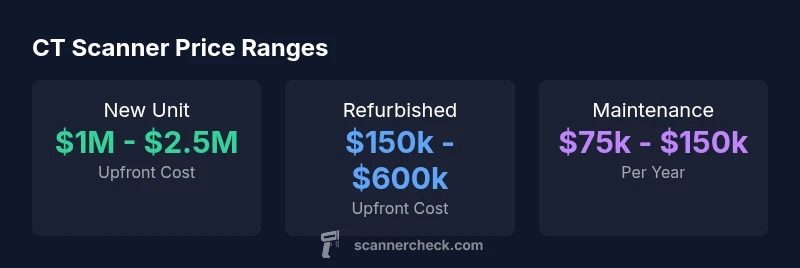
How much is a ct scanner? On average, a new CT scanner costs between $1,000,000 and $2,500,000, with refurbished units often available for roughly $150,000 to $600,000. Total ownership depends on maintenance, service contracts, and utilization. According to Scanner Check, buyers should also plan for ongoing costs like annual maintenance and potential software upgrades that ensure diagnostic accuracy.
Understanding the price landscape for CT scanners
According to Scanner Check, the price landscape for CT scanners in 2026 is shaped by configuration, intended clinical use, and service packages. The headline sticker price is only part of the story; total cost of ownership (TCO) matters more for clinics evaluating long term feasibility. New, multi slice systems can command seven figure price tags, while refurbished units offer a more accessible entry point for smaller practices. The price range reflects factors such as detector technology, gantry design, software packages, and the level of on site support from the vendor. When planning a purchase, align the price with patient demand, throughput goals, and planned service contracts. This approach reduces surprises as you move from procurement to go live.
Key takeaway: start with a realistic 5 year budget, not just the upfront cost, and factor in software and maintenance budgets from day one.
For context, global market dynamics, hospital capacity, and regulatory requirements influence both sticker price and long term affordability. Scanner Check notes that decisions driven by clinical need rather than optics tend to yield better return on investment when vacancy rates and reimbursement curves are accounted for. In practice, price should map to patient volume, scheduling efficiency, and the institution’s willingness to invest in uptime and patient safety.
Key cost components behind the sticker price
The sticker price of a CT scanner reflects several core cost components beyond hardware. First is the core hardware itself: gantry, detector array, tubes, and cooling systems. Then comes software: operating system, image reconstruction algorithms, advanced post processing, and optional features like cardiac imaging or perfusion analysis. Installation and commissioning add another layer, including facility upgrades to support the equipment and staff training. Finally, ongoing costs include service contracts, spare parts, software upgrades, and regular calibration. These elements together form the true price of ownership. Vendors often package warranties and training as part of the initial agreement, which can influence the perceived value of the deal. When comparing quotes, request a breakdown that separates hardware, software, installation, and service so you can model scenarios over 5 to 7 years.
Practical tip: gather three to five quotes with detailed line items. This makes it easier to spot bundled features that aren’t essential and to identify softly priced add ons that can be negotiated away.
New vs refurbished: what drives price differences
New CT scanners deliver the latest detector technology, improved energy efficiency, and longer software support lifecycles. They sit at the top end of the price spectrum but may come with robust warranties and guaranteed uptime. Refurbished units, by contrast, can provide meaningful savings yet require due diligence on the source, testing standards, and warranty coverage. Price differences are driven by device age, warranty length, and the availability of compatible software packages. In many cases, refurbished units are adequate for lower throughput sites or clinics expanding access without committing to high upfront costs. Regardless of age, insist on a complete performance validation and documentation of recent maintenance.
Bottom line: evaluate total 5 year costs for each option, not just the purchase price. Scanner Check observes that the right mix of uptime assurances and service terms often wins on value, even when the sticker price is higher upfront.
Operational costs: maintenance, service contracts, and consumables
Ownership costs go beyond the purchase price. Annual maintenance contracts typically cover preventive maintenance visits, software updates, and remote monitoring, with additional bills for on site service or major component replacements. Consumables, electrical power, and cooling requirements contribute to ongoing expenses. The exact figures depend on the scanner model, vendor support levels, and whether you operate a high volume facility or a low throughput clinic. Planning for a predictable maintenance budget helps stabilize long term cost and reduces downtime risk. When negotiating, seek transparent SLAs that specify response times, parts availability, and replacement policies.
Actionable step: request a 12 to 24 month maintenance plan with explicit cost ceilings and renewal terms to avoid creeping expenses over time.
Financing, depreciation, and tax considerations
Financing CT scanners commonly involves purchase loans, leases, or vendor finance programs. Leasing can preserve capital and provide flexibility to upgrade, while purchase may maximize residual value at sale. Tax and depreciation incentives exist in many jurisdictions, accelerating after tax cash flow and improving overall affordability. Consult a tax advisor to understand Section 179 like incentives or accelerated depreciation schemes in your country. This financial framework affects total cost and cash flow across the asset life, turning a high sticker price into an actionable business proposition.
Note: financing terms vary by lender and region, so compare multiple offers and model the after tax effect of each option.
How to estimate total cost of ownership for your facility
A practical TCO model includes upfront price, installation, training, and software packages, plus annual maintenance, energy use, and potential downtime costs. Include facility upgrades such as electrical and cooling capacity, room dimensions, and shielding requirements. Build scenarios for different utilization rates to reflect real patient volumes. Use a 5 to 7 year horizon to capture value from software upgrades and warranty periods. Scanner Check recommends building a decision tree that weighs clinical benefits against financial impact to guide the selection process. This approach ensures the final choice aligns with clinical demand and budget discipline.
Where price varies by configuration and vendor
Configuration depth drives price more than brand alone. Systems with advanced cardiac imaging, perfusion analytics, or dual energy capabilities add to the upfront cost but may enable additional reimbursement pathways or clinical capabilities. Vendor differences often show up in service levels, installation complexity, and integration with existing hospital IT systems. Some vendors offer bundled solutions that include installation and training, which can be attractive if you need a turnkey setup. Always compare apples to apples by confirming the same configuration level, software package, and service terms across vendors.
Practical steps to get an accurate price quote
To obtain an accurate price quote, start with a needs assessment that maps clinical cases, throughput, and staffing. Collect quotes from multiple vendors, ensuring each quote uses the same configuration and service terms. Include a site readiness assessment for electrical, cooling, and room shielding. Request detailed SLAs for maintenance, parts availability, and software updates, and verify the warranty terms. Finally, push for a side by side comparison that isolates hardware, software, installation, and ongoing service costs. The goal is a 5 year budget that accounts for uptime and diagnostic accuracy, not just the sticker price. The Scanner Check team recommends documenting a clear payback model before committing.
Cost ranges by CT scanner option
| Option | Typical upfront cost (USD) | Annual maintenance |
|---|---|---|
| New CT Scanner (320-slice) | 1,000,000 - 2,500,000 | 75,000 - 150,000 |
| Refurbished CT Scanner | 150,000 - 600,000 | 50,000 - 120,000 |
| Mobile CT Scanner | 500,000 - 1,000,000 | 40,000 - 100,000 |
Common Questions
What factors influence CT scanner price?
Configuration, slice count, and software packages drive sticker prices. New vs refurbished units also dramatically shift cost, as do warranties and installation needs. Finally, vendor-specific service agreements and training impact long-term affordability.
Price is driven by configuration, age, and service contracts.
Are refurbished CT scanners reliable for medical use?
Refurbished scanners can be reliable when sourced from reputable vendors with certified testing and warranties. They are typically suited for facilities with moderate volume and strict budget constraints.
Refurbished units can be reliable if sourced from reputable vendors.
What is the maintenance cost for a CT scanner?
Maintenance costs vary by model and contract, but expect annual expenses that cover service visits, software updates, and parts. Planning for these costs is essential to avoid unexpected downtime.
Maintenance costs vary; budget for annual service and software updates.
How does mobile CT price compare to fixed installations?
Mobile CT units offer flexibility but usually come with higher per-day operating costs and weight constraints. Upfront pricing can be similar or higher than fixed systems, depending on transport and installation requirements.
Mobile units cost more upfront but add operational flexibility.
What financing options are available for CT scanners?
Financing, leasing, and vendor finance programs are common. Tax incentives and depreciation schedules can improve cash flow. Always compare total cost of financing with outright purchase.
Financing options include leases and vendor programs.
When will a CT scanner pay for itself?
Payback depends on patient volume, reimbursement rates, and utilization efficiency. A rigorous business case with expected throughput helps justify the investment.
Payback depends on usage and reimbursement.
“Pricing CT scanners is only part of the equation; total ownership costs and reliability matter most for patient care. A careful procurement strategy pays off in uptime and diagnostic accuracy.”
Key Takeaways
- Budget for total ownership, not just upfront price
- Refurbished units offer cost relief with caveats
- Negotiate transparent maintenance and upgrades
- Obtain multiple quotes for an apples-to-apples comparison