Is CT Scan Better or Endoscopy? A Practical Comparison
A rigorous, evidence-based comparison of CT scans and endoscopy to help clinicians and patients decide when is ct scan better or endoscopy, considering indications, risks, and costs.


Is ct scan better or endoscopy? The answer isn’t universal; CT scans excel for rapid, noninvasive surveys of anatomy and trauma assessment, while endoscopy provides direct mucosal visualization and targeted biopsies. This comparison outlines indications, risks, and costs to help clinicians and patients choose the right test for the situation.
is ct scan better or endoscopy: A practical orientation
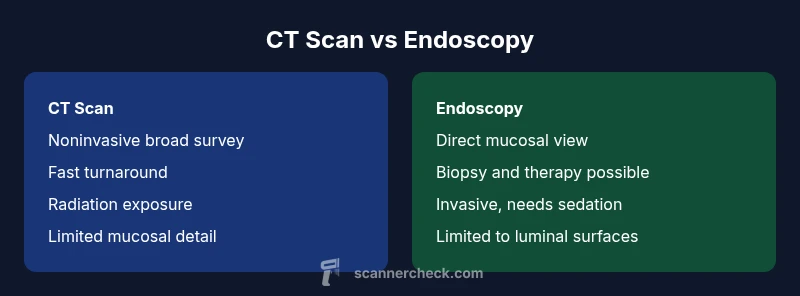
The is ct scan better or endoscopy question is common across specialties. In practice, clinicians evaluate the suspected pathology, patient safety, and the need for tissue diagnosis before selecting a test. The phrase is ct scan better or endoscopy frames the cross-over between noninvasive imaging and direct visualization. According to Scanner Check, the choice hinges on clinical goals rather than a blanket rule. CT scans offer rapid, noninvasive overviews of thoracic, abdominal, and pelvic structures, enabling quick triage in emergencies. They reveal bone fracture, organ injury, calcifications, and large masses with broad coverage. However, CT lacks the ability to see mucosal detail or obtain tissue samples without additional procedures. Endoscopy, conversely, allows direct visualization of mucosa, airway or GI tract surfaces and enables real-time biopsies or therapeutic interventions but is invasive and requires anesthesia or sedation in many cases. In short, the question is whether you prioritize speed and broad anatomy (CT) or mucosal detail and biopsy capability (endoscopy). The remainder of the article walks through indications, safety considerations, and cost factors, with practical decision guidelines.
How CT scanning works and typical indications
Computed tomography (CT) uses ionizing radiation to create cross-sectional images of the body. Modern scanners are fast, widely available, and capable of producing high-resolution pictures of the chest, abdomen, and pelvis in seconds. In the context of the is ct scan better or endoscopy question, CT is often the first-line imaging choice when a broad survey is needed or when patient stability does not permit longer procedures. Indications include acute trauma, suspected pulmonary embolism, stroke triage, abdominal pain, and complex multisystem injuries. CT with contrast enhances vascular and organ delineation but carries risks such as contrast reactions and, for some patients, nephrotoxicity. The technology has evolved to minimize radiation through adaptive dose reduction and iterative reconstruction. CT can also guide subsequent procedures, such as planning endoscopic access or identifying targets for biopsy. Clinicians balance speed, coverage, and diagnostic yield when deciding whether a CT scan should precede or accompany endoscopy.
How endoscopy works and typical indications
Endoscopy encompasses a family of procedures that insert a flexible tube with a camera into a natural lumen to visualize mucosal surfaces. Esophagogastroduodenoscopy (EGD) assesses the upper GI tract; colonoscopy checks the colon; bronchoscopy examines the airways. Indications include GI bleeding, chronic abdominal pain, reflux symptoms with alarm features, and abnormal imaging suggesting mucosal lesions. A key advantage is real-time visualization with the ability to obtain tissue biopsies, perform polypectomies, or deliver localized therapy during the same session. Risks include sedation-related complications, infection, bleeding, perforation, and discomfort. Preparation varies by procedure: fasting, bowel preparation for colonoscopy, and careful medication review for anesthesia. Endoscopy excels where tissue diagnosis or targeted therapy is essential, but it is more invasive and resource-intensive than CT. When deciding is ct scan better or endoscopy, clinicians weigh the need for mucosal detail against the desire for rapid, broad anatomical assessment.
Safety, risks, and patient considerations
Safety profiles differ markedly between CT and endoscopy, which informs the is ct scan better or endoscopy decision in practice. CT involves ionizing radiation and potential contrast-related risks, though modern protocols emphasize dose optimization. Many patients tolerate CT well, with minimal preparation and quick throughput. Endoscopy carries anesthesia or sedation risks, infection risk, and a small but real chance of perforation. Recovery time varies; CT generally requires no recovery, while endoscopy may require monitoring post-sedation. Patient factors such as pregnancy status, renal function, prior contrast exposure, and airway/anatomical considerations influence risk assessment. In the bigger picture, the is ct scan better or endoscopy question often centers on safety trade-offs: noninvasive imaging versus invasive visualization with tissue sampling. Clinicians should document informed consent, discuss risk/benefit trade-offs, and tailor imaging plans to the individual patient.
Preparation and logistics for each test
Preparation for CT and endoscopy reflects their different natures. CT often requires fasting only if contrast is used and may involve oral or intravenous contrast administration; hydration and allergy history are reviewed. Some patients may need a kidney function test prior to iodinated contrast. Endoscopy requires bowel preparation for colonoscopy or fasting and often sedation, with pre-procedure assessment by nursing and anesthesia teams. Scheduling considerations include availability of imaging slots or endoscopy suites, potential need for anesthesia, and the patient’s mobility or comorbidity burden. In cases where is ct scan better or endoscopy is debated, a common approach is to perform a CT for rapid screening and reserve endoscopy for cases where mucosal visualization or biopsy would change management. A coordinated, patient-centered plan reduces delays and improves overall diagnostic yield.
Diagnostic capabilities and limitations
CT excels at providing cross-sectional anatomy, detecting acute pathology such as fractures, organ injuries, and large masses, and guiding urgent management decisions. It is less effective for detecting subtle mucosal lesions or early neoplasia in the GI tract unless contrast-enhanced protocols are used or CT colonography is employed. Endoscopy offers superior mucosal visualization and the ability to obtain biopsies, allowing definitive histopathologic diagnosis and immediate therapeutic interventions. However, it is limited to accessible luminal surfaces and may miss extraluminal disease. In practice, is ct scan better or endoscopy is answered by a complementary approach: use CT for initial mapping and risk stratification, then proceed with endoscopy when direct visualization or tissue sampling will alter treatment. Understanding these capabilities helps clinicians select the most informative test at each step.
Cost, access, and turnaround times
Cost and access are practical determinants in the is ct scan better or endoscopy decision. CT generally has faster turnaround and broad availability, especially in emergency rooms and urgent care settings, and is often less expensive than a full endoscopic session when considering anesthesia and facility charges. Endoscopy can be more expensive per procedure due to sedation, specialized equipment, and bowel preparation, but it provides diagnostic and therapeutic value that CT cannot. Turnaround times vary by facility: CT reports can be available within minutes to a few hours, whereas endoscopy may require scheduling with pre-procedure evaluation and pathology processing for biopsies. Payer coverage, regional practice patterns, and patient comorbidities influence costs. When deciding between CT or endoscopy, clinicians weigh the clinical yield against financial and logistical considerations to minimize delays in care.
Special scenarios and patient considerations
Certain clinical scenarios strongly influence the is ct scan better or endoscopy choice. In acute trauma or chest pain with suspicion of pulmonary embolism, CT may rapidly clarify anatomy and guide immediate decisions. For suspected upper GI bleeding or mucosal lesions, endoscopy may be superior due to direct visualization and biopsy capability. Pediatric patients, pregnant individuals, and those with renal impairment require careful risk-benefit analysis. Patients with a history of allergic reactions to contrast media or prior anesthesia complications need tailored plans. CT may be preferred when a noninvasive survey is needed, while endoscopy is favored when tissue diagnosis or localized therapy is necessary. Ultimately, each patient’s clinical picture, risk tolerance, and goals shape the optimal diagnostic pathway.
Decision framework: when to choose CT vs endoscopy
To translate theory into practice, use a simple decision framework. Start with the patient’s presenting symptoms and stability. If rapid visualization of multisystem pathology is essential or you need a noninvasive survey, consider CT. If there is a high probability of mucosal disease, bleeding, or a need for biopsy, prioritize endoscopy. Consider staging for cancer, where CT helps with anatomy and endoscopy provides tissue for histology. In ambiguous cases, a sequential approach—CT first, followed by targeted endoscopy—can maximize diagnostic yield while minimizing risk. Always align the plan with patient preferences and institutional protocols.
Combining modalities: why they are complementary
Candidly, is ct scan better or endoscopy is not an either/or decision in many cases. Rather, these tests complement each other. CT can identify sites requiring direct mucosal evaluation, guide biopsy targets, and monitor treatment response. Endoscopy can confirm CT findings, sample suspicious lesions, and deliver therapeutic interventions. Multimodal pathways reduce unnecessary procedures and support precise staging and management. Practically, clinicians often sequence imaging to minimize risk while preserving diagnostic accuracy: CT first for broad assessment, then endoscopy for confirmation and treatment when indicated.
Patient-centered guidance: communicating with your care team
Patients and caregivers should advocate for a clear rationale behind test choices. Ask your clinician to explain what information each test will provide, the risks involved, and how results will influence management. If cost, anesthesia, or radiation exposure is a concern, request alternatives or staged approaches. Shared decision-making improves satisfaction and adherence. Remember that test selection is dynamic; if initial imaging is nondiagnostic, next steps can include endoscopy or additional imaging depending on evolving symptoms and test results. Your active participation helps ensure the most informative, safe, and cost-effective diagnostic pathway.
Comparison
| Feature | CT scan | Endoscopy |
|---|---|---|
| Nature | Noninvasive imaging using X-ray data | Direct visualization with a scope; potential biopsy |
| Typical indications | Acute trauma, rapid triage, multisystem survey | GI tract or airway mucosal assessment; biopsy and therapy |
| Procedural risks | Radiation exposure; contrast allergy/nephrotoxicity risks | Sedation risks; infection; perforation (rare) |
| Preparation | Contrast may be used; fasting not always required | Fasting or bowel prep; sedation planning |
| Recovery time | Usually none; quick discharge | Recovery varies by sedation and procedure type |
| Cost considerations | Moderate to high; varies by facility and contrast | Typically higher due to equipment, sedation, pathology |
| Biopsy capability | Limited to CT-guided biopsy; indirect tissue targets | Direct tissue sampling during the procedure |
| Best for | Broad anatomical survey and rapid triage | Direct visualization with tissue diagnosis |
Pros
- CT scans are fast and widely available for quick triage
- Endoscopy allows real-time visualization and immediate biopsy/therapy
- CT provides comprehensive anatomical mapping in multisystem cases
- Endoscopy enables tissue diagnosis essential for many GI conditions
Drawbacks
- CT involves radiation exposure and potential contrast risks
- Endoscopy is invasive and carries sedation and perforation risks
- CT may miss subtle mucosal lesions without adjunct procedures
- Endoscopy requires specialized facilities and scheduling
CT scans are typically preferred for rapid broad assessment; endoscopy is superior for mucosal visualization and biopsy when tissue is needed.
Choose CT for quick surveys and stabilization. Choose endoscopy when biopsy or direct mucosal assessment will change management; in many pathways, both tests are used sequentially or complementarily.
Common Questions
What is the primary difference between CT scan and endoscopy?
CT scan provides noninvasive cross-sectional imaging of internal structures, while endoscopy offers direct visualization of mucosal surfaces with biopsy or therapy. The choice hinges on whether tissue diagnosis or rapid anatomical mapping is the priority.
CT gives a broad image of your insides without entering the body; endoscopy looks directly at the inner lining and can sample tissue.
When should CT be preferred over endoscopy?
CT is often preferred for rapidly surveying multiple regions, evaluating trauma, and triaging unstable patients. If a patient needs a quick, broad view to guide initial management, CT comes first.
Use CT when you need speed and a wide-area view to guide urgent decisions.
Can both tests be done during the same hospital visit?
Yes, in many cases CT and endoscopy are scheduled in sequence during the same hospitalization or follow-up visit if initial findings require tissue diagnosis or endoscopic therapy. Coordination with radiology and gastroenterology teams is common.
Often yes—your team can plan both tests in a coordinated pathway.
Do these tests require anesthesia?
CT does not require anesthesia in most adults, though contrast studies may require screening. Endoscopy often requires sedation or anesthesia, depending on the procedure and patient factors.
CT usually doesn’t need anesthesia; endoscopy often does.
Which test is safer in general?
Both tests are safe when performed in appropriate settings, but their risks differ: radiation and contrast for CT, and sedation, infection, or rare perforation for endoscopy. Your clinician weighs these against the diagnostic yield.
Safety depends on the clinical context and patient risk factors.
What factors affect cost and insurance coverage?
Costs vary with facility, region, and whether biopsy or therapy is performed. Insurance coverage typically aligns with the indication, necessity, and whether staging or treatment steps follow imaging.
Cost depends on the test type, required facilities, and treatment plan.
Key Takeaways
- CT is ideal for speed and multisystem coverage
- Endoscopy excels at mucosal detail with biopsy capability
- Safety and patient factors drive test choice
- A staged approach often yields the best diagnostic accuracy
- Coordinate care with your team to minimize risk and cost