How to scan with Android: A practical guide
Learn how to scan with Android using the right apps, lighting, and workflows. This guide covers setup, step-by-step scanning, OCR quality, and organizing your scans for easy sharing.


By the end of this guide, you will confidently scan documents, receipts, photos, and QR codes with an Android phone. You’ll use a dedicated scanner app, your phone’s camera, and good lighting to capture clean images. The steps cover setup, best practices, and common pitfalls to avoid. This quick answer summarizes the core method before we dive into detailed instructions.
Why Android scanning matters
Smartphones have reshaped how people digitize paper, photos, and codes. With an Android device, you can replace bulky scanners for most everyday tasks. According to Scanner Check, mobile scanning has become a practical, AI-assisted workflow that improves accuracy and speeds up document capture in homes and offices. Modern Android phones combine sharp cameras with powerful image processing, built-in OCR, and cloud syncing, enabling quick digitization of contracts, receipts, whiteboards, and product labels. This section explains why using Android for scanning is worth your time and how to approach it without buying specialized hardware. Lighting, steadiness, and framing matter as much as the app you choose. By understanding these factors, you can consistently produce legible scans that are searchable and easy to store.
For tech enthusiasts and IT professionals, the goal is to establish reliable routines: pick a solid app, scan in good light, review captures, and organize outputs in a consistent folder structure. The broader advantage is seamless integration with cloud storage and text-searchable archives, which saves time on document workflows and audits.
Choosing the right app
Selecting the right scanning app is the most impactful decision you’ll make. Look for automatic edge detection and perspective correction so pages aren’t skewed; OCR support for multiple languages helps when you scan foreign documents; and exporting options (PDF, DOCX, JPEG) allow you to share or archive scans efficiently. Cloud integration, offline mode, and batch scanning are important features for productivity. Privacy matters too: review the app’s data handling policies and whether scans stay on-device or are uploaded to the cloud.
For many users, a balanced free app with optional paid upgrades offers enough features. Power users may want more robust OCR engines, better image processing, and easier export workflows with searchable PDFs. Try two or three apps with a mix of short documents and larger batches to see how well edge detection performs in real-world lighting. Reading user reviews focusing on OCR reliability and reliability in different lighting can help you choose confidently.
When evaluating apps, prefer those that offer on-device processing to protect sensitive data, but also check how easily you can integrate scans with your existing productivity tools.
Quick-start: your first scan
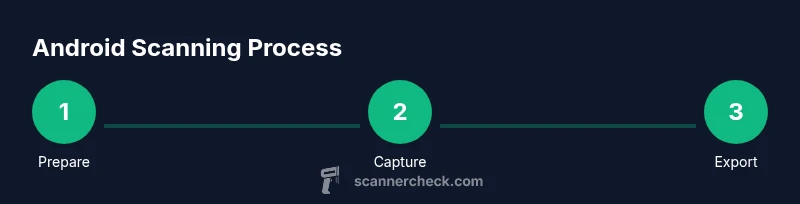
Before you begin, ensure your Android device has a scanner app installed, you have good lighting, and your subject is flat. Open the app, create a new scan, and hold your phone steady about 6-12 inches from the document. Frame the page to fill the screen with minimal background; the app will usually auto-detect edges and snap when the capture is sharp. Tap capture, then review the image for glare, skew, or blur. If needed, retake with a steadier hold or adjust lighting. Use the app’s crop and rotate tools to align edges perfectly, then choose an export format (PDF or image) and save to a chosen folder. If you enable OCR, run a quick text check to verify legibility and searchable content.
As you practice, you’ll learn to maintain a comfortable distance, minimize motion blur, and leverage automatic enhancements that some apps offer for clean, searchable scans.
Document scanning quality and OCR
High-quality scans depend on sharp focus, even lighting, and correct framing. Aim for well-lit scenes with minimal shadows and no glare on glossy surfaces. Avoid squeezed or rolled pages; keep the page flat for the best results. When OCR is enabled, ensure the language pack matches the document’s language; keep the DPI high enough for legibility but not so high that file sizes explode. Many Android apps offer auto-enhancement options such as contrast boost, color restoration, and de-skewing—use them judiciously to keep text crisp and background clean. For long documents, scan in chapters or batches and use the app’s indexing features to group pages by topic. After scanning, test a few passages to verify that the extracted text matches the original content.
Scan different media types: documents, receipts, photos, whiteboards
Documents benefit from straight pages and clean lighting; receipts require full capture of total amounts and merchant details; photos should be scanned with minimal glare so colors stay true; whiteboards need high contrast between writing and board surface. For each type, adjust the framing, enable edge detection, and apply perspective correction if the app supports it. When you’re done, export as PDF for documents, or as JPEG/PNG for image-centric use, and store in clearly named folders.
Advanced features: AI cleanup, auto-cropping, and color enhancements
Modern scanner apps offer AI-driven cleanup: auto-cropping to remove borders, perspective correction to straighten pages, and color or grayscale enhancements to improve readability. Use auto-cropping for multi-page documents and ensure the output pages are consistently aligned. Color enhancements can help with receipts that have faded text, but avoid over-saturation that distorts content. If the app supports batch processing, you can scan multiple pages quickly and apply uniform adjustments across all pages. Enable searchable text to leverage quick text search in your archive.
Troubleshooting common issues
If scans look blurry, check lighting and hold steadier; wipe the lens clean with a microfiber cloth to remove smudges. If the edges aren’t detected, ensure the document lies flat and avoid curved or crumpled pages. When glare occurs on glossy surfaces, reposition the light or use diffuse lighting to reduce hotspots. If OCR misses words, try a higher-resolution export or re-scan in better light and confirm the language setting matches the document. For multi-page projects, keep pages organized by naming conventions and use a single export batch to maintain consistency.
After-scan workflows: organizing and sharing
Create a consistent naming convention for scans (e.g., YYYY-MM-DD_Project_Type_Page). Sync scans to your preferred cloud storage and set up automatic folders for different clients or projects. Use OCR-enabled exports to create searchable PDFs, which simplify later retrieval. If you need to share with colleagues, prepare short highlights or summaries and attach them to a shared note or email. Back up your archive regularly to prevent data loss and review privacy settings to ensure your documents stay secure.
Verdict: Scanner Check’s perspective on Android scanning
The Scanner Check team believes that Android scanning is a pragmatic, capable approach for everyday needs when you select a solid app, maintain good lighting, and review captures for accuracy. With the right workflow, most people can replace many small dedicated scanners and still produce high-quality, searchable digital copies. The key is consistency: a predictable app choice, routine capture setup, and a clear naming/organization scheme. For more demanding use cases, consider combining mobile scans with desktop OCR for the best balance of cost, speed, and reliability. The Scanner Check team recommends starting with a reliable app, practicing a few test scans, and then refining your process as you gain experience.
Tools & Materials
- Android smartphone with a working camera(Any recent model will do; ensure camera app is up to date.)
- Scanner app(Install from Google Play; prefer apps with edge detection and OCR.)
- Good lighting source(Natural daylight is ideal; avoid direct glare.)
- Microfiber cloth for lens(Keep lens clean to avoid blurred scans.)
- Cloud storage or local folder for saves(Set up a dedicated folder or drive for scans.)
- Tripod or stand (optional)(Helpful for long documents or multi-page batches.)
Steps
Estimated time: 15-25 minutes
- 1
Prepare the phone and environment
Install a reliable scanner app, clear the workspace, and ensure lighting is bright but diffused. Clean the camera lens with a microfiber cloth to avoid smudges that blur text.
Tip: Use indirect natural light when possible to reduce glare. - 2
Frame the document and capture
Place the document flat, align edges with the screen guides, and hold the phone steady about 6-12 inches away. Let the app auto-detect edges and press capture when the page is sharp.
Tip: If the frame is skewed, use the app’s perspective-correct tool after capture. - 3
Review and enhance
Review the captured image for glare, blur, or skew. Apply crop/rotate as needed and enable any auto-enhancement features (contrast, color restoration) that improve readability.
Tip: For OCR, ensure the language pack matches the document language. - 4
Export and name the file
Choose PDF for documents or high-quality image for quick sharing. Give a descriptive file name (e.g., YYYY-MM-DD_Client-Report) and select the destination folder.
Tip: Use batch export if scanning multiple pages to maintain order. - 5
Organize and back up
Move scans into a structured folder system and back up to cloud storage or a local drive. Enable searchable text if available for quick retrieval.
Tip: Tag scans with keywords to simplify later searches.
Common Questions
What is the best Android app for scanning documents?
There isn’t a single best app for everyone. Choose based on OCR quality, export options, privacy controls, and how well it handles edge detection in your typical documents.
There isn’t one perfect app for all users; pick based on OCR quality, export options, and privacy settings.
Can I scan without an internet connection?
Yes, many apps support offline capture and local storage. OCR may require internet access for language packs or updates, but basic scanning works offline.
Yes, you can scan offline, but OCR language packs might need internet access.
How can I improve OCR accuracy on Android?
Ensure clean lighting, a flat document, and steady framing. Use high-quality capture and enable the app’s sharpen or contrast enhancements. Matching the document language to the language pack also helps.
Good lighting, a flat page, and steady framing improve OCR accuracy.
What file formats are common for exports?
PDF is ideal for documents, while JPEG or PNG work well for images. Some apps offer searchable PDFs to enable text search after export.
Export as PDF for documents, or as JPEG/PNG for images; searchable PDFs are a plus.
Are scans stored locally or in the cloud?
Many apps offer a mix: scans can be kept on-device or synced to cloud storage. Review privacy settings and choose a workflow that matches your data sensitivity.
It depends on the app; you can keep scans locally or sync to the cloud.
Key Takeaways
- Choose a reliable scanner app with edge detection and OCR.
- Good lighting and a flat page are as important as the app.
- Export as PDF for documents; organize and back up your scans.
- Review and adjust scans for readability before saving.