Can You Scan with Your Phone? A Practical How-To for 2026
Discover how to scan with your phone using built-in tools or apps. This educational guide covers techniques, best apps, privacy tips, and a step-by-step workflow to get clean, searchable scans fast.


Yes—can you scan with your phone? The short definition is that modern smartphones can capture high‑quality images and, with built‑in or third‑party apps, convert them into searchable, editable documents. This quick answer highlights what affects quality, how to choose tools, and a reliable workflow. According to Scanner Check, phone scanning has become a practical, everyday solution for students, professionals, and DIYers.
Can you scan with your phone? A practical yes
Yes—can you scan with your phone? The short answer is yes in most cases, and the quality you achieve today is enough for many everyday tasks. Smartphones pair advanced camera sensors with intelligent software to produce readable images, and OCR-powered apps extract text so you can search, edit, or archive. According to Scanner Check, this has become a mainstream capability for students, home offices, and small businesses. The key is understanding what affects quality: lighting, perspective, document condition, and the software you choose. If you’re new to this, expect decent results for standard documents like receipts, letters, or class handouts. For archival-grade needs or multi-page projects, you’ll want to pay attention to tips on lighting, edge detection, and file formats. This guide will equip you with a practical mental model and actionable steps so you can start scanning right away with the device you already own.
How smartphone scanning works: cameras, OCR, and AI
Smartphone scanning relies on three interconnected components: the camera, the software that frames and crops the image, and OCR (optical character recognition) to turn the image into text. The camera captures a high-resolution image; software hints detect edges and perspective, then automatically crop and straighten the shot. OCR analyzes the text and converts it into searchable characters, while optional AI-based enhancement adjusts contrast, removes shadows, and improves readability. The result can be a multi-page PDF or a set of image files, depending on your app and export choices. In practice, a good scan combines proper lighting with clean, flat documents and stable holding to minimize blur and distortion. Remember that color and texture matter: glossy receipts may reflect light if shot at the wrong angle; in contrast, plain text documents often scan more reliably even in modest lighting.
Built-in scanning vs third-party apps: options explained
Most smartphones offer built‑in scanning in some form, such as Notes on iOS or the camera app on Android that includes document capture features. Built-in options are convenient, fast, and privacy-preserving since you control where files are saved. Third‑party apps (Microsoft Lens, Adobe Scan, Google Drive Scan, and others) extend capabilities: better OCR engines, auto-cropping, multi-page PDFs, cloud backups, and advanced export formats. The choice depends on your goals: if you’re digitizing a few pages for personal storage, a built‑in tool may suffice; for professional workflows, a dedicated app may deliver stronger OCR accuracy and better file management. Regardless of the app, ensure you enable permissions for camera access and storage, and test a few sample pages to calibrate settings like resolution (300 dpi is a common target for clear text).
Use cases: documents, receipts, business cards, images
Phone scanning shines in practical, everyday use cases. Document scans let you store contracts, forms, or school papers digitally with searchable text. Receipts become expense-ready PDFs or images you can attach to reports. Business cards can be converted into VCards for contact management, while photos, whiteboard notes, or handwritten notes can be preserved for reference. For each case, adapt your approach: use higher resolution for text-heavy documents, enable OCR with language packs appropriate to the content, and decide whether color or grayscale preserves important details. If you frequently share files, choose app options that provide easy export to email, cloud storage, or collaboration platforms. Consistency helps: using the same app and the same scan settings across sessions reduces variation and improves long-term organization.
The best apps and built-in features on iOS and Android
On iOS, the built‑in Notes app can scan documents by using the Scan Documents feature. It crops automatically and saves as PDF or JPEG, with OCR-friendly text when connected to the right workflows. Google Drive’s built‑in scan functionality on Android provides quick multi-page PDFs and seamless cloud storage, enhancing collaboration. Other popular options include Microsoft Lens, Adobe Scan, and CamScanner, each offering robust OCR, multi-page management, and automatic edge detection. When selecting an app, prioritize: OCR quality, export formats (PDF, PNG, JPEG), storage options, and security posture (end-to-end encryption and delete policies). Keep in mind platform updates can shift feature availability, so periodic checks help you stay current.
Getting top-quality scans: lighting, focus, and file formats
Quality starts with environment: shoot in bright, diffuse light to minimize shadows and reflections. Place the document on a clean, flat surface and align it with the camera frame to reduce distortion. Tap to focus and, if your app supports it, enable grid lines to help alignment. For the best OCR results, shoot at 300–600 dpi equivalents when possible; choose PDF for multi-page documents or high-resolution PNG/JPG for image-focused scans. After capture, review the scan for skew, contrast, and noise. Use the app’s crop and rotate tools to straighten edges; save with descriptive filenames and a consistent naming convention to improve later searchability.
Privacy and security when scanning with a phone
Your phone scans may include sensitive information, so consider privacy from capture to cloud storage. Check app permissions: camera, storage, and cloud access should be restricted to trusted apps. If you store scans in the cloud, review your provider’s security practices and encryption in transit and at rest. For highly sensitive documents, export to local storage or encrypted archives rather than auto-uploading to the cloud. Regularly review app access and revoke permissions for apps you no longer use. By adopting careful handling, you reduce the risk of accidental data leaks while preserving the convenience of mobile scanning.
Troubleshooting common issues and fixes
When scans look blurry, check focus and lighting; steady the shot and retake. If edges aren’t detected, try a flatter document, move closer, or adjust the distance until the app identifies borders. If the text is faint, increase brightness or switch to color mode; OCR may perform better at higher contrast. For skewed scans, use the crop or perspective correction tool to straighten; for glare, tilt the document or use indirect lighting. For multi-page results, ensure the app is configured for a document mode that preserves spacing between pages. Finally, if export quality is poor, try a different app or lower compression settings to avoid lossy artifacts.
How to build a daily scanning workflow
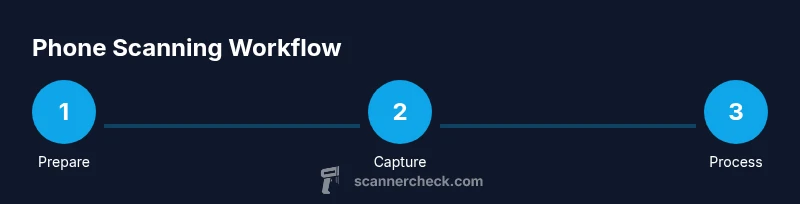
Create a repeatable routine that fits your day. Start by gathering all documents into a single tray, then scan in one session to minimize interruptions. Use a single app to reduce inconsistencies, and store files in a clearly labeled folder structure. Schedule short checks to verify OCR accuracy and file naming; this avoids piling up unorganized scans. Back up your scans to a cloud folder configured for automatic syncing, and periodically review older scans to prune redundancies. Over time, your process becomes faster, more accurate, and easier to search.
Tools & Materials
- Smartphone with camera(Any modern iPhone or Android device with a good camera.)
- Scanning app (built-in or third‑party)(Examples: Notes (iOS), Google Drive (Android), Microsoft Lens, Adobe Scan.)
- Clean, flat document or object(Avoid wrinkled pages; smooth, single-sided items scan best.)
- Good lighting (natural daylight or bright LEDs)(Diffuse light reduces glare and enhances OCR accuracy.)
- Stable surface or tripod(Helpful for multi-page scans or fragile documents.)
- Digital storage (cloud or local)(Plan where your scans will live (cloud or local drive).)
Steps
Estimated time: 25-40 minutes
- 1
Gather materials and prepare workspace
Collect your phone, chosen scanning app, the document, and a stable workspace. Clearing the area reduces distractions and helps you focus on alignment. A clean setup also minimizes accidental shadows and reflections during capture.
Tip: Lay out a plain, light background to improve edge detection by the app. - 2
Open your scanning app and select document mode
Launch the app and choose the document capture option. Document mode optimizes exposure, perspective correction, and edge detection for clean text. If you’re new to the app, run a quick test with a sample page.
Tip: Enable a grid or rule guides if available to help alignment. - 3
Position the document on a flat surface
Place the document flat, with no folds; center it within the frame. Align edges with the screen’s guides to reduce perspective distortion. A stable position minimizes blur during capture.
Tip: Straighten the document using the app’s edge-detection tool after capture. - 4
Capture the image with steady hands
Hold your phone steady or use a tripod. Tap the capture button gently and avoid quick jerks to minimize motion blur. If you’re scanning multiple pages, pause briefly between shots to maintain consistency.
Tip: Take 2–3 shots per page and choose the best one later. - 5
Review and crop for clean edges
Check the scan for legibility, crop to the document edges, and apply perspective correction if needed. Remove any unwanted background and adjust contrast for readability.
Tip: Keep a uniform crop across pages for a tidy archive. - 6
Export to your preferred format
Save as PDF for multi-page documents or as high‑quality images for image‑heavy files. Name the file descriptively and select the export destination.
Tip: If OCR is available, enable it during export to create searchable PDFs. - 7
Organize and store the scans
Place files into a clearly named folder structure and back up to your cloud or local drive. Consistent naming and folder organization speed up retrieval later.
Tip: Create a daily or per-project folder to limit search scope. - 8
Review periodically and adjust workflow
Occasionally revisit settings (resolution, color mode, OCR language) based on what you scan most often. Small tweaks can yield big improvements in accuracy and speed.
Tip: Document the chosen settings so teammates can reproduce your workflow.
Common Questions
Can I scan any document with my phone, or are there limits?
Phones can scan most standard documents like letters, forms, and receipts. Fragile or glossy pages may require extra care or a different method. For bound books, scanning pages individually with care yields better results.
You can scan most common documents, but fragile or glossy pages may need special handling.
Do I need internet access to scan and save my files?
Scanning itself often works offline. Saving to cloud storage or sharing via apps usually requires internet. Local storage keeps you offline until you connect.
You can scan offline; cloud saving needs internet.
Will OCR always be 100% accurate?
OCR accuracy depends on image quality, font, and language. You can improve results with better lighting, clear focus, and selecting a strong OCR engine.
OCR isn't perfect—clarity and lighting matter most.
What file formats should I use for long-term storage?
PDF is standard for multi-page documents with text. JPEG or PNG work for single images. For archiving, PDF/A is preferred and lossless formats preserve detail.
PDF, especially PDF/A for long-term storage, or high-quality image formats.
How can I protect my scanned data on my phone?
Use device security, review app permissions, and avoid automatic cloud uploads for sensitive scans. Encrypt local storage when possible and regularly audit apps.
Secure your device and control where scans go.
Why is my scan blurred despite following steps?
Blur usually comes from motion, poor lighting, or out-of-focus shots. Re-take with steadier hands, better lighting, and careful tapping to focus.
Blurring is often motion or bad lighting—re‑shoot with steadiness.
Watch Video
Key Takeaways
- Choose a consistent app and settings for reliability.
- Lighting and flat surfaces yield higher-quality scans.
- OCR enables searchable, editable text from images.
- Organize files with clear naming and backups.
- Regularly review and adjust your workflow for speed.