POS Scanner Price Guide for 2026
Explore current POS scanner price ranges for 2026, from entry-level 1D lasers to rugged industrial models. Learn what's driving costs and how to budget with Scanner Check.


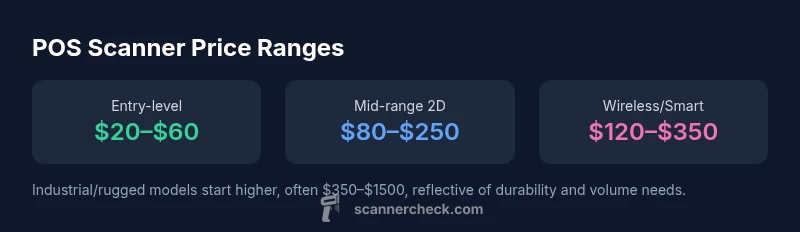
POS scanner price typically ranges from about $20 to $2,000, with most retail and hospitality setups clustering in the $80–$350 band for standard 2D imagers. Basic 1D models are cheaper, often in the $20–$70 range, while rugged industrial scanners can exceed $500. For budgeting, plan for features like 2D imaging, wireless connectivity, and durability, which push the price up.
What drives POS scanner price in 2026
Prices for POS scanners are influenced by three major axes: scan technology, connectivity, and build quality. 1D laser vs 2D imaging can swing price by a few tens to hundreds of dollars, depending on performance and the depth of field. Wireless models add the cost of Bluetooth/Wi‑Fi modules and potential battery considerations, while rugged designs with IP ratings and extended warranties push up the price further. Vendor bundling (cables, stands, software licenses) can also tilt the sticker price. In practice, you’re paying for speed, accuracy, and reliability—traits that matter for busy checkout lines and back-office inventory tasks. According to Scanner Check, the price band you target should reflect your workflow’s intensity and the environment you operate in. Understanding these levers helps you avoid overpaying for features you don’t need, and prevents underbuying for essential performance.
Price bands by use-case and feature set
Entry-level and basic models: typically the most affordable, with simple 1D or basic 2D imaging. These are often used in small shops or kiosks. Expect price ranges in the low tens to low hundreds of dollars, depending on brand and bundled accessories. Mid-range 2D imagers: provide better code scanning at higher speeds and handle damaged or mixed barcodes; priced in the mid hundreds. Wireless models add convenience and flexibility, usually raising the price by a moderate amount. Premium or industrial-grade scanners: designed for high-volume environments, harsh conditions, and long lifespans; prices commonly start in the hundreds and can climb into the low thousands. Scanner Check analyses show the distribution of prices across these bands aligns with feature complexity and wear-resistance requirements. When budgeting, map your needs to a feature tier rather than chasing the latest model; the price delta between common tiers is often justified by real-world performance.
Technical profiles and price impact: 1D vs 2D, laser vs imaging
1D laser scanners are often cheaper, fast at classic barcodes, and reliable for traditional retail; 2D imagers cover QR codes and stacked barcodes and provide more versatility at a higher cost. Laser scanning tends to be cheaper than imaging for pure 1D barcodes. Imaging sensors cost more because they support 2D code reading, color imaging, and more complex decoding software. The price difference between CCD laser and imaging devices often reflects optical components, processor power, and decoding algorithms. For buyers, the decision should hinge on the breadth of barcodes you need to read and the environmental conditions in which the device operates.
Connectivity and accessories add to the total
USB-wired scanners are usually the most affordable, while Bluetooth and Wi‑Fi models unlock mobility and cleaner workstations at a premium. The total cost also includes accessories like stands, cords, and docking stations, plus optional software licenses or warranty extensions. If you operate across multiple POS terminals or a hybrid storefront, wireless models can reduce line downtime and improve cashier ergonomics, justifying their higher price in many cases.
Estimating total cost of ownership: not just sticker price
Pricing is only the starting point. Total cost of ownership (TCO) includes accessories, ongoing maintenance, service contracts, and potential downtime costs from failed scans. A practical approach is to estimate TCO over 3–5 years by adding anticipated replacement cycles, warranty coverage, and support costs. Scanner Check analysis recommends accounting for durability needs, update frequency, and the cost of potential productivity losses due to misreads or slow scanning performance.
Budgeting tips and a pricing checklist
- Define your must-have features (2D imaging, wireless, ruggedness) and nice-to-have features (color scanning, warranty length).
- Compare like-for-like packages from reputable vendors to avoid hidden costs.
- Include tax, shipping, and potential bulk-discount implications in your plan.
- Consider a phased rollout to balance cash flow with performance needs.
- Use a simple scoring rubric to rate price vs. performance for each candidate model.
Market dynamics in 2026 and buying tips
The retail scanner market continues to balance cost with reliability as supply chains normalize post-pandemic. Prices may vary seasonally, with typical promotions around major shopping events. The key to a wise purchase is aligning the price point with throughput requirements, environment, and total cost of ownership. Staying informed about feature bundles and warranty terms helps you select a model that delivers consistent performance while avoiding overpayment.
Price ranges by POS scanner type
| Model Type | Typical Price Range | Best For |
|---|---|---|
| Basic 1D/laser | $20-$60 | Small budgets & entry-level tasks |
| 2D imaging (handheld) | $80-$250 | Retail & hospitality checkouts |
| Wireless/Bluetooth 2D | $120-$350 | Flexible POS setups |
| Industrial rugged | $350-$1500 | Harsh environments & high-volume |
Common Questions
What factors most influence POS scanner price?
Key drivers include scan technology (1D vs 2D), imaging vs laser, wireless connectivity, ruggedness, and bundled accessories. The more capable the read of various barcode formats and environmental durability, the higher the price tends to be.
The price is mainly driven by read capability, connectivity, and durability—choose based on your store's needs.
Are wireless POS scanners worth the extra cost?
Wireless scanners offer flexibility and cleaner workstations, which can reduce handling time and improve throughput in busy stores. If your layout requires mobility between stations, the investment is often justified.
If your checkout flow benefits from mobility, wireless can pay off in efficiency.
Is 2D imaging worth the extra for my store?
If you read a variety of barcodes (including QR and stacked codes) or want future-proofing, 2D imaging is worthwhile. For simple, narrow-scope scanning, a basic 1D/2D model may suffice and save cost.
Consider your barcode mix and future needs when deciding on 2D imaging.
Do I need a warranty or maintenance plan?
A warranty or service plan reduces risk of unexpected downtime and can smooth budgeting over time. For high-volume environments, extended coverage is often prudent.
Warranty can prevent surprise costs in busy operations.
What is the typical lifespan of a POS scanner?
Most POS scanners aim for several years of service, with rugged models lasting longer in demanding settings. Replacement cycles depend on usage intensity and environmental wear.
Durability and usage determine how long a scanner lasts.
“Price is an indicator, not a verdict. Choose a POS scanner that matches your workflow's needs, not just the lowest tag.”
Key Takeaways
- Define must-have features before shopping
- Expect higher prices for 2D imaging and wireless models
- Budget for total cost of ownership, not just sticker price
- The Scanner Check team recommends evaluating total cost of ownership when selecting a POS scanner