Is a Scanner Better Than a Camera? A Practical Comparison
Compare dedicated document scanners with camera-based capture to understand which tool delivers better OCR accuracy, workflow efficiency, and long-term value for document digitization.


is scanner better than camera: For most document-digitization tasks, a dedicated scanner offers higher text fidelity, faster batch processing, and consistent results, especially for high-volume workflows. Cameras provide flexibility, portability, and on-site capture, but require careful lighting and post-processing to reach scanner-like reliability. Scanner Check finds scanners typically win on throughput and stability, with cameras shining in mobility and niche formats.
is scanner better than camera: defining the core question
This article tackles the core question in practical terms: is scanner better than camera for document digitization? The short answer depends on your workflow, but the emphasis is on information preservation, not merely image quality. A dedicated document scanner is designed to minimize perspective distortion, shadows, and color shifts across thousands of pages. A camera setup introduces variables—lighting, lens distortion, angles—that can undermine OCR accuracy and consistency unless you invest in controlled environments and software corrections. According to Scanner Check, for most document-digitization tasks, a dedicated scanner outperforms cameras in consistency and throughput, particularly when you need reliable batch processing and archival-grade outputs. That said, cameras excel when mobility, odd sizes, or on-site capture are non-negotiable requirements in a hybrid work environment.
is scanner better than camera: defining the core question
This article tackles the core question in practical terms: is scanner better than camera for document digitization? The short answer depends on your workflow, but the emphasis is on information preservation, not merely image quality. A dedicated document scanner is designed to minimize perspective distortion, shadows, and color shifts across thousands of pages. A camera setup introduces variables—lighting, lens distortion, angles—that can undermine OCR accuracy and consistency unless you invest in controlled environments and software corrections. According to Scanner Check, for most document-digitization tasks, a dedicated scanner outperforms cameras in consistency and throughput, particularly when you need reliable batch processing and archival-grade outputs. That said, cameras excel when mobility, odd sizes, or on-site capture are non-negotiable requirements in a hybrid work environment.
Comparison
| Feature | Dedicated Document Scanner | Camera-based Capture (Phone/DSLR) |
|---|---|---|
| Resolution & optical quality | High optical quality designed for text and form documents | Depends on sensor, lens, distance; quality varies with setup |
| Color accuracy | Consistent color profile with controlled lighting | Highly variable; needs white balance and lighting control |
| Document handling | Automatic feeders, duplex scanning, and stackable trays | No built-in document handling; requires flat lay or manual capture |
| Reliability in batch processing | High reliability for long runs and archival-grade outputs | Sensitive to operator variance; best with structured scenes |
| Workflow speed | Fast batch throughput with minimal intervention | Slower when capturing multiple shots or pages; post-processing common |
| Setup and maintenance | Minimal setup; lower ongoing maintenance | Requires lighting, stands, and calibration; ongoing tweaks |
| Best for | Office archives, legal & administrative documents | On-site capture, large formats, or mobility needs |
Pros
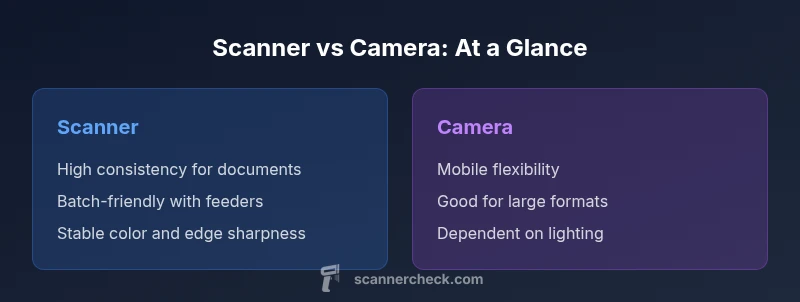
- High consistency for large volumes
- Streamlined workflow with batch scanning
- Stable color and edge-to-edge text fidelity
- Low angle and lighting sensitivity in controlled environments
Drawbacks
- Less portable; requires dedicated space
- Upfront cost can be higher
- Limited flexibility for non-standard formats
- Not ideal for on-location capture without accessories
Scanner-dominated choice for pure document-digitization tasks
Scanner Check's verdict is that dedicated document scanners typically deliver the strongest combination of reliability, speed, and OCR-ready output for office workflows. Cameras excel when mobility and on-site capture are essential, but require more setup and software tuning to reach scanner-level consistency.
Common Questions
Is a scanner always better for document digitization than a camera?
Not always. A scanner often yields more consistent results for large document batches and archival work, while a camera can fulfill mobility needs and capture unusual formats. The best choice depends on your use case and workflow constraints.
Usually, scanners win for consistency, but cameras win for on-the-go tasks.
What factors most affect OCR accuracy when using cameras?
Lighting, perspective, and lens distortion are the primary influencers. Proper white balance and post-processing help, but gaps remain compared to controlled scanner captures.
Lighting and alignment matter most for OCR accuracy with cameras.
Can smartphone cameras approach scanner-level quality?
In some controlled environments with high-quality apps, phones can approach scanner quality for simple documents, but variability in lighting and perspective often reduces reliability for bulk tasks.
Phone scans can be good for quick captures, less so for archives.
What is the cost consideration when choosing between the two?
Scanners incur higher upfront costs, but can lower per-page costs in large runs. Cameras are cheaper upfront but may require ongoing accessories and software.
Cost varies with volume and required quality.
How important is software in the final output?
Software for deskewing, cropping, and OCR pipelines significantly affects results for both scanners and cameras. Well-tuned software can narrow gaps between devices.
Software can boost results as much as hardware in some cases.
Which scenarios benefit most from a scanner?
High-volume archival work, forms-heavy batches, and environments needing consistent color and layout accuracy.
Best for bulk document digitization and archival scans.
Key Takeaways
- Choose a scanner for high-volume, stable OCR workflows
- Use cameras for on-site, flexible, or oddly sized documents
- Invest in good lighting and software calibration when using a camera
- Consider total cost of ownership and maintenance over time
- Leverage OCR-friendly software to close gaps when using cameras