MRI Scanner Length and Scan Time: What to Expect
Learn how long MRI scanners are, including bore length and overall footprint, plus typical exam durations and factors that influence time.


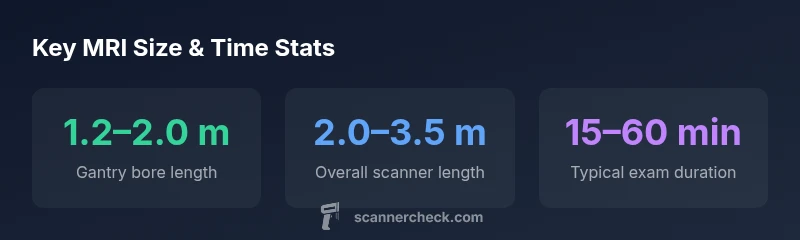
According to Scanner Check, an MRI machine is a large, tunnel-like device. The gantry bore is roughly 1.2 to 2.0 meters long, and the whole scanner measures about 2.0 to 3.5 meters in length, depending on model. Typical exam times range from 15 to 60 minutes, with sequences driving the duration. Patients lie on a padded table that slides into the bore, and shorter bore variants can reduce claustrophobia but may limit certain sequences.
MRI scanner sizes and why they vary
The physical size of an MRI scanner is determined by several interacting design goals: magnetic field strength, patient comfort, and the space needed for the gantry and ancillary hardware. Across vendors, the bore length and overall footprint differ, so expectations should be set by checking the exact specifications of the model you plan to use. The Scanner Check team notes that while all modern MRIs share a tunnel-like gantry design, the precise dimensions change with the magnet design (1.5T vs 3T) and the manufacturer’s enclosure. When planning a room, facility managers must account for the gantry, the patient table carriage, and the service clearance around the cabinet. In real-world clinics, room size is often driven by the longest model currently in service, plus a buffer for safe patient transfer and maintenance access.
- Typical bore lengths vary in a relatively narrow band, but the exact figures depend on the specific system and coil arrangement.
- The overall length includes the gantry plus the external cabinet that houses power supplies, cooling systems, and control electronics.
- The patient path from entry to exit is negotiated by the table and bore geometry, with some models offering extended travel for positioning.
Girth vs length: bore length vs. overall footprint
In MRI parlance, bore length refers to the tunnel portion through which the patient passes, while overall footprint covers the entire machine including cabinets and service zones. Bore length directly affects claustrophobic sensations for some patients, and it also influences room design—for example, door widths, ceiling height, and corridor clearance matter for safe, smooth patient flow. Facilities often choose longer bores when advanced sequences require longer acquisition windows, or when the space is ample enough to preserve comfort without compromising workflow. The wall thickness and shielding requirements also interact with the machine’s length, adding to the final room dimensions.
- Shorter bores can improve comfort but may restrict certain imaging protocols.
- Longer bores provide more room for patient movement and equipment fit, but may complicate room design.
Closed-bore vs wide-bore and open designs
Modern MRI systems offer a variety of bore designs. Closed-bore models maximize field homogeneity and image quality in a compact form, while wide-bore and open designs prioritize patient comfort and accessibility. Wide-bore variants typically feature larger internal diameters (often around 70–90 cm), reducing claustrophobic pressure for many patients. However, some sequences may be more sensitive to geometry, and the access points for coils or patient support devices can differ between designs. Clinicians weigh comfort against imaging requirements when selecting the system.
- Comfort-focused designs may be paired with shorter bore lengths or specialized coils to mitigate patient anxiety.
- Imaging performance remains strong in modern wide-bore systems, though protocol choice can affect scan times.
How long does an MRI scan take and what influences time
Scan time hinges on protocol complexity, the number of sequences, and the need for high-resolution data. A basic head or spine MRI might run 15–30 minutes, while more extensive studies with multiple sequences or contrast-enhanced imaging can extend toward 60 minutes or more. Parallel imaging, coil quality, and patient cooperation all influence duration. Operators may also optimize sequences to reduce total minutes without sacrificing diagnostic value, especially in busy clinics.
- The use of faster sequences and advanced reconstruction techniques can shrink total scan times.
- Sedation, motion, or patient discomfort can increase the time required.
The table, coils, and patient positioning: how devices affect length and workflow
Coils are optimized for specific body regions (head, spine, knee, etc.) and can add to the overall setup time. Head coils must be fitted properly to ensure comfort and signal integrity, while body coils can necessitate careful positioning to maximize signal-to-noise ratio. The patient table and positioning aids (straps, cushions, and supports) affect the time needed to align the patient with the bore and coils. Proper coil selection and placement save minutes per study and reduce the need for retakes.
- Table travel and coil setup are usually the most time-consuming parts of the initial patient preparation.
- Proper pre-checks and immobilization improve image quality and reduce repeats.
Practical planning: room size, safety, and patient comfort
MRI rooms require non-magnetic construction, RF shielding, and strict safety clearances. The room layout should accommodate the largest planned model plus a buffer for access around the gantry and equipment cabinets. Acoustic noise is a common concern, and many facilities mitigate this with ear protection and, in some cases, quieter sequences. Conditioning and ventilation systems must be designed to handle the magnetic environment without compromising patient comfort or staff workflow. Patient comfort is a recurring priority, prompting some centers to offer music, lighting, or even visual monitors to help reduce anxiety.
Choosing the right MRI setup: questions to ask your facility
Before scheduling, ask about bore design, coil configurations, and available comfort options. Inquire whether a wide-bore or conventional bore is offered for the indicated exam and whether any sequences are impacted by diameter or length. Ask about room dimensions and door clearance to ensure the space will accommodate transport equipment. Finally, request a growth or upgrade plan so your facility can adapt to new imaging protocols without requiring major reconstruction of the room.
Representative dimensions and timing ranges for common MRI systems
| Dimension | Typical Range | Notes |
|---|---|---|
| Gantry bore length | 1.2–2.0 meters | Varies by model and magnet strength |
| Overall scanner length | 2.0–3.5 meters | Includes gantry and surrounding cabinet |
| Table travel length | 0.5–1.0 meters | Slide range to position patient |
| Scan duration range | 5–60 minutes | Depends on protocol and sequences |
Common Questions
How long is the MRI bore typically?
The bore length typically ranges from about 1.2 to 2.0 meters, depending on the model and magnet design. Longer bores can improve comfort for some patients but may influence room layout.
Most MRIs have a bore about one to two meters long; talk to your technologist about comfort options.
Are there open or wide-bore MRI designs?
Yes. Wide-bore and some open designs offer more interior space, improving comfort. These designs may affect certain imaging sequences or coil configurations.
There are wide-bore MRIs that feel less claustrophobic; check if your exam can use one.
Does the table extend outside the bore?
Some tables extend beyond the bore to position the patient, but the overall scanner length remains determined by the gantry and cabinet.
The table can extend, but the machine length is fixed.
How long does a typical MRI exam take?
Typical exams range from 15 to 60 minutes, depending on the parts scanned and the number of sequences required.
Expect 15 to 60 minutes depending on the study.
Do patient size and body part affect length or comfort?
Larger patients may require adjustments in coil size and positioning; setup time can increase slightly. Coil choice affects comfort and image quality.
Your size can influence setup time and coil choice.
What space is needed in the MRI room?
MRI rooms require shielding and non-magnetic space; designers also consider access routes for transfer and maintenance.
The room needs shielding and space for safe access and equipment.
“MRI dimensions vary by model, and while most scanners share a compact footprint, patient comfort and workflow should guide planning.”
Key Takeaways
- Expect bore length to range roughly 1.2–2.0 meters.
- Plan for total scanner length around 2.0–3.5 meters.
- Anticipate scan times between 5–60 minutes depending on protocol.
- Ask your tech about coil setup and patient positioning to optimize time.
- Shorter bore designs may limit some imaging sequences.