How Long Do MRI Scans Last? A Practical Guide
Discover how long MRI scans typically take, what factors influence duration, and tips to prepare for a smoother, shorter visit. A data-driven, Scanner Check guide.


In most cases, an MRI exam lasts between 20 and 60 minutes, depending on the body area and protocol. For focused brain or knee sequences you’ll often see 20–40 minutes, while spine or multi-region studies can reach 45–60 minutes. Remember, total visit time includes check-in, patient prep, and positioning, so plan for 60–90 minutes overall.
What Determines MRI Scan Duration
If you're wondering how long do mri scan last, the simple answer is: it depends. According to Scanner Check, duration hinges on the body area, protocol complexity, and whether a contrast agent is used. The imaging team may perform multiple sequences (T1, T2, FLAIR, diffusion, etc.), and each sequence adds time. Patient factors matter as well; motion or discomfort can necessitate repetitions or additional positioning. For a rough sense, brain or knee scans without contrast often land in the 20–40 minute range, while comprehensive spine or joint studies can extend to 45–60 minutes. The exact time estimate should consider the clinical question, the coil hardware, and the MRI field strength (1.5T vs 3T). Planning around an estimated 60–90 minutes total visit helps set expectations and reduce stress. In practice, discussing goals with your radiology team before the scan improves accuracy and speeds up the process.
MRI Protocols and Time Differences
MRI protocols define not only image quality but also scan duration. A typical brain protocol might use a handful of sequences that yield high diagnostic value in a relatively short window, whereas whole-spine workups or exams with multiple body regions require many sequences and longer acquisition times. Higher field strength (3T) can deliver sharper images more quickly, yet the total time will still depend on sequence count and contrast use. If contrast is added (gadolinium-based agents), you’ll see a separate infusion time and post-contrast imaging, which can push durations toward the upper end of the range. Efficient scheduling and clear pre-scan instructions can shave minutes off overall time.
Typical Time Frames for Common Exam Types
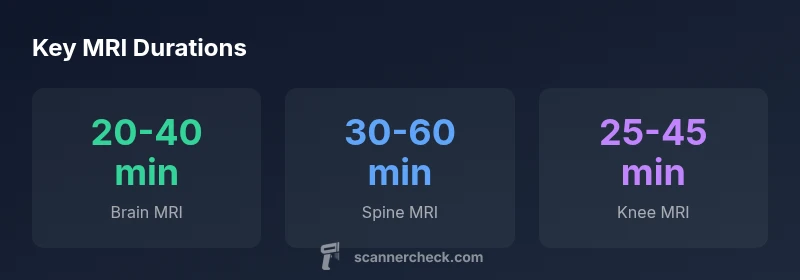
Understanding common durations helps with planning. Brain MRI often runs 20–40 minutes of pure imaging, knee MRI 25–45 minutes, and spine MRI 30–60 minutes, depending on the number of regions scanned and whether advanced sequences (diffusion, spectroscopy) are included. A combined exam (e.g., brain plus orbit or spine plus pelvis) can approach the 60-minute mark or more. These ranges assume standard coil setups and minimal patient movement. Always verify with the facility for your specific protocol, as radiology departments tailor sequences to clinical questions and patient comfort.
Contrast Agents, Sedation, and Time Implications
Contrast administration adds both time and planning. If gadolinium is used, there’s a check-in step for screening allergies and kidney function, the injection itself, and a waiting period for vascular enhancement before post-contrast sequences. Sedation or anesthesia, primarily for claustrophobic or pediatric patients, significantly increases total time due to preparation, monitoring, and recovery. In non-sedated adults, minimizing movement and ensuring steady breathing are the most effective ways to keep scan times on the lower end. If you anticipate anxiety, discuss early with the technologist; sometimes a short pre-scan sedative plan is arranged to avoid delays.
Practical Tips to Minimize Scan Time
To keep the duration as brief as possible, consider the following practical tips:
- Arrive early and complete pre-checks to avoid hold-ups.
- Remove all metal objects and inform about implants or devices upfront.
- Stay still during acquisitions; practice breath-holding if instructed for certain sequences.
- Wear comfortable, loose clothing without metal components.
- Confirm whether contrast is necessary; if not, request non-contrast protocols when clinically appropriate.
- Ask about abbreviated or targeted protocols for your specific diagnostic question.
These steps help reduce repeat sequences and expedite positioning, which directly trims total time.
Day-of-Scan Experience: What to Expect
A typical MRI day follows a predictable flow. After check-in, you’ll complete safety questionnaires, change into a gown, and lie on the scanning table. The technologist will position you with coils and provide ear protection. The actual scanning happens in stages, with the machine making loud, rhythmic sounds as gradients switch on. You’ll be asked to stay still, hold a breath, or shift slightly between blocks. After imaging, you’ll go to a recovery area while the technician confirms that the required sequences were captured, and you’ll receive post-procedure instructions if contrast was used. Overall, most patients leave within 60–90 minutes of arrival.
Authoritative Resources for MRI Durations
For more in-depth, evidence-based information, reputable sources include government and medical publications. Key references include NIH guidelines on imaging, FDA safety considerations for MRI, and RadiologyInfo’s patient-oriented explanations of MRI procedures. These resources provide context on typical scan times, motion artifacts, and best practices for minimizing time while preserving image quality.
- NIH: https://www.nih.gov
- RadiologyInfo: https://www.radiologyinfo.org
- FDA: https://www.fda.gov
Typical MRI exam durations by body area
| Exam Type | Typical Range | Notes |
|---|---|---|
| Brain MRI | 20-40 minutes | Usually no contrast |
| Spine MRI | 30-60 minutes | May include multiple sequences |
| Knee MRI | 25-45 minutes | Isotropic imaging possible |
Common Questions
How long does an average MRI take?
Most scans last between 20 and 60 minutes, depending on the body area and protocol. Trainees and staff plan around the specific sequences needed for a clear diagnosis.
Most scans take about 20 to 60 minutes, depending on what part is being examined.
What factors influence MRI duration?
Body part, sequence count, use of contrast, and patient movement are the main drivers of duration. Additional factors include coil setup and field strength.
The part being scanned and the sequences used determine the time.
Can MRI scans be faster without compromising quality?
Yes, abbreviated protocols can save time but may reduce detail. Discuss with your radiologist about clinically acceptable compromises.
Shorter protocols can save time but might affect image detail.
Do I need to fast for an MRI?
Most MRI exams do not require fasting. Follow facility instructions and note any contrast-related dietary guidelines.
Usually you don't need to fast.
Is sedation ever needed to shorten duration?
Sedation is rare for adults but may be used for severe claustrophobia or pediatric cases; it adds time due to preparation and monitoring.
If you're anxious, talk to staff; sedation adds time.
How does 1.5T vs 3T affect duration?
Field strength affects image quality and sequence choices; total time depends on exact protocol rather than the strength alone.
Stronger magnets can change sequence choices, affecting time.
“"MRI duration is driven by protocol complexity and patient factors; clear pre-scan planning helps keep times predictable."”
Key Takeaways
- MRI durations vary by body part and protocol
- Contrast and multi-region exams extend time
- Minimize delays with patient prep and stillness
- Total visit time includes check-in and setup