Is CT Scan Better or Ultrasound? A Side-by-Side Guide
Compare CT scans vs ultrasound across indications, radiation exposure, speed, cost, and diagnostic accuracy to help clinicians and patients decide which imaging modality is best for different medical scenarios.


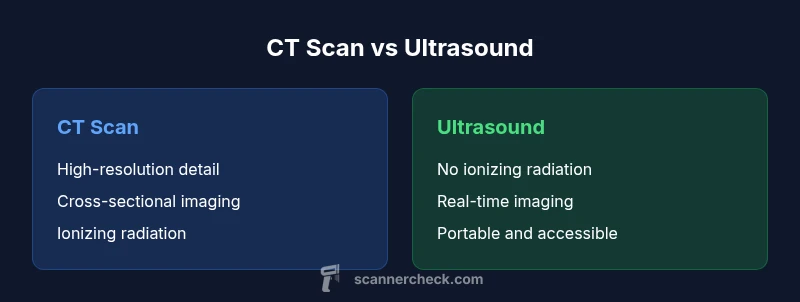
Short answer: There isn't a universal winner. Ultrasound is safe, portable, and inexpensive, making it ideal for quickly assessing soft tissues, guiding procedures, and pediatric cases. CT offers higher spatial resolution and broader anatomical coverage, excelling in trauma, abdominal imaging, and detailed bone or vascular assessment. The best choice depends on the clinical question, patient factors, and availability.
Clinical Context: The Core Question
Is ct scan better or ultrasound? The short answer hinges on the clinical question, patient context, and available resources. According to Scanner Check, ultrasound shines for real-time evaluation, guidance of procedures, and pediatric cases where radiation exposure should be avoided. CT, by contrast, provides rapid, comprehensive detail and superior spatial resolution for trauma, complex intra-abdominal imaging, and cross-sectional anatomy. In practice, clinicians frame decisions around the specific diagnostic question: what exactly needs to be seen, what risks are acceptable, and what the imaging team can reliably deliver. Because imaging choice is situational, patients benefit from a transparent discussion about what each modality can reveal and what it cannot. The phrase “is ct scan better or ultrasound” is thus reframed as “which tool best answers this question with the least risk?” This approach aligns with evidence-based care and patient safety.
Radiation and Safety Considerations
CT uses ionizing radiation and often iodinated contrast, which carries small but real risks, especially in children and pregnant patients. Ultrasound uses no ionizing radiation and is typically safer for routine, bedside assessment. The Radiation Dose in Medical Imaging guidelines suggest minimizing exposure while preserving diagnostic yield; when possible, clinicians start with ultrasound and reserve CT for cases where ultrasound findings are inconclusive or when detailed cross-sectional anatomy is essential. Scanner Check notes that starting with ultrasound can reduce cumulative radiation exposure across a patient’s lifetime, particularly in pediatric populations. However, some scenarios require the detail that only CT can provide, such as evaluating suspected appendicitis with thickened bowel walls, complex trauma, or subtle vascular injury. In these situations, benefits may outweigh risks after careful patient-specific risk assessment.
Image Quality and Diagnostic Scope
Image quality depends on physics, anatomy, and technique. CT delivers isotropic, high-resolution cross-sectional images that allow precise assessment of bone, air-filled organs, and subtle abdominal pathologies. Ultrasound provides real-time, dynamic imaging with excellent soft-tissue contrast for superficial organs, vascular Doppler assessment, and real-time guidance for biopsies or drain placements. Artifacts differ: CT artifacts can arise from metallic implants or motion, while ultrasound artifacts often stem from gas, bone, or limited acoustic windows. In is ct scan better or ultrasound terms, CT tends to outperform ultrasound in detecting small lesions, complex fracture patterns, and multi-organ injuries, whereas ultrasound excels in rapid bedside evaluation, procedures, and fetal or neonatal imaging. The choice depends on where the suspected pathology lies and how quickly a definitive diagnosis is needed.
Use Cases by Body Region
Different body regions guide the choice. For the chest, ultrasound is useful for pleural effusions and certain mediastinal assessments but is limited for lung parenchyma. CT is preferred for thoracic trauma and detailed lung evaluation. In the abdomen and pelvis, CT excels at identifying appendicitis, diverticulitis, and complex intra-abdominal pathology, whereas ultrasound serves as a rapid, first-line screen and is preferred in kids and pregnant patients. In musculoskeletal injuries, CT provides bone detail and fracture mapping, while ultrasound can assess superficial soft tissue injuries and guide injections. For neuroimaging, CT is often the initial study in acute settings due to speed and bone detail, with MRI as a follow-up if soft-tissue details are needed. These region-specific trends help clinicians tailor imaging to the suspected problem and patient safety needs.
Speed, Accessibility, and Workflow
In emergency settings, CT often yields faster, more comprehensive results, which can shorten hospital stays and expedite treatment plans. Ultrasound can be completed at the bedside, sometimes without moving a unstable patient, improving throughput and patient comfort. Operator skill significantly affects ultrasound performance; a trained technologist or clinician can rapidly adjust probe placement and optimize image quality. CT requires access to a CT suite and, frequently, contrast administration, which may introduce delays due to preparation and safety checks. Across health systems, ultrasound serves as a versatile, low-risk first-line tool, while CT is the workhorse for complex or high-stakes diagnostic puzzles. The workflow decision often hinges on patient stability, availability of equipment, and the urgency of the clinical question.
Cost, Availability, and Insurance Considerations
Ultrasound generally incurs lower upfront costs and can be more cost-effective for routine evaluations, follow-ups, and procedural guidance. CT exams are costlier due to equipment, maintenance, and potential contrast use, but the value comes from fast, definitive information in acute settings. Insurance coverage and facility resources influence access; in many centers, ultrasound is available after hours and in outpatient settings, while CT access may be restricted to radiology departments. Cost-effectiveness analyses frequently emphasize a stepwise approach: starting with ultrasound when feasible, with CT reserved for cases where ultrasound is inconclusive or when detailed cross-sectional anatomy is essential for management. Clinicians should balance diagnostic yield with patient burden and financial implications.
Patient Factors That Influence Modality Choice
Patient-specific factors shape imaging decisions. In pregnancy, avoiding ionizing radiation is paramount, making ultrasound the preferred first choice. In pediatrics, the safety profile of ultrasound and its portability are especially advantageous. In obese patients, ultrasound can be limited by penetration, while modern CT scanners with dose-modulation techniques can still provide high-quality images with controlled exposure. For unstable patients, the speed and accessibility of bedside ultrasound can facilitate rapid triage, whereas CT may be preferred when comprehensive evaluation is required and the patient can be transported safely. The clinician’s goal is to maximize diagnostic clarity while minimizing risk to the patient, and often a staged approach (ultrasound first, CT if needed) yields the best balance.
Contrast Agents and Safety Profiles
Contrast use differs between modalities. CT commonly uses iodinated contrast to enhance vascular and parenchymal detail, which can improve diagnostic accuracy but adds risk for allergy or nephrotoxicity in susceptible patients. Ultrasound contrast agents (microbubbles) exist but are less frequently required; many ultrasound studies rely on native tissue contrast and Doppler information. Safety screening before contrast administration is essential: assess kidney function for CT contrast; screen for heart failure, allergies, or prior reactions for both CT and ultrasound. When these risks are significant, clinicians may defer contrast use or select an alternative imaging pathway. Proper selection minimizes adverse events while preserving diagnostic value.
Interpreting Findings and Follow-up Pathways
Interpretation depends on modality context. CT findings often lead to rapid decisions in trauma and acute abdomen. Ultrasound findings guide bedside management and procedural planning, especially when real-time assessment is needed. In many cases, ultrasound results prompt additional imaging with CT or MRI to confirm a diagnosis or to map extent. Follow-up strategies vary: a negative ultrasound with persistent symptoms may lead to CT; CT findings with equivocal results may prompt targeted ultrasound or MRI. Clear communication between radiologists and clinicians is essential to avoid delays in care. Engaging patients in the decision-making process—discussing benefits, risks, and alternatives—helps align imaging choices with therapeutic plans and patient preferences.
Practical Decision-Making Framework for Clinicians and Patients
A practical framework starts with the clinical question and safety profile. Step 1: identify the most urgent diagnostic needs (e.g., identifying free air, vascular injury, or fetal health). Step 2: assess patient factors (pregnancy, pediatric age, obesity, hemodynamic stability). Step 3: select the modality with the highest yield and lowest risk given those parameters. Step 4: use ultrasound as a bridge when possible (for guidance or rapid screening), and reserve CT for confirmation when necessary. Step 5: discuss the plan with the patient, including the rationale, potential risks, and follow-up steps. By applying this structured approach, clinicians can optimize resource use and minimize patient burden while maintaining diagnostic confidence.
AI and Future Trends in CT and Ultrasound Imaging
Artificial intelligence is increasingly integrated into both CT and ultrasound workflows. In CT, AI assists in automated organ segmentation, lesion detection, and dose optimization, potentially speeding interpretation and reducing variability. In ultrasound, AI-enhanced image reconstruction and real-time guidance tools improve image quality and the accuracy of needle placements. As scanners become more connected, AI can help triage studies, predict the most informative imaging approach for a given clinical scenario, and support remote interpretations. While AI cannot replace clinical judgment, it promises to augment accuracy, consistency, and efficiency in comparing CT vs ultrasound and in choosing the most appropriate imaging pathway for patients.
Comparison
| Feature | CT Scan | Ultrasound |
|---|---|---|
| Radiation exposure | CT: high; ionizing radiation | Ultrasound: none |
| Image detail/Resolution | CT: superior cross-sectional resolution | Ultrasound: dependent on operator and patient anatomy |
| Real-time capability | CT: static images, limited real-time | Ultrasound: real-time imaging with Doppler |
| Speed of exam | CT: typically fast in emergencies | Ultrasound: highly variable; operator-dependent |
| Cost per exam | CT: generally higher | Ultrasound: generally lower |
| Best for | CT: complex trauma, detailed intra-abdominal/pelvic imaging | Ultrasound: bedside assessment, guidance, pediatric/pregnant patients |
| Contrast usage | CT: iodinated contrast often needed | Ultrasound: microbubble contrast possible but less common |
| Limitations in obesity | CT: image quality affected by body habitus but mitigated with dose modulation | Ultrasound: penetration issues with high BMI and gas |
Pros
- Ultrasound is radiation-free, portable, and widely accessible
- Ultrasound enables real-time guidance and dynamic assessment
- CT provides high-resolution, comprehensive cross-sectional detail
- CT is fast and highly reliable for trauma and complex anatomy
- Ultrasound is cost-effective for many routine evaluations
Drawbacks
- Ultrasound is highly operator-dependent and limited by patient body habitus
- Ultrasound may miss deep structures or be hindered by gas or obesity
- CT involves radiation exposure and potential contrast risks
- CT requires a dedicated imaging suite and may involve contrast-related delays
CT and ultrasound each have a distinct, valuable role; none is universally superior
Use ultrasound for safety, real-time guidance, and pediatric/pregnant patients. Reserve CT for cases needing detailed anatomy, rapid definitive diagnosis, or when ultrasound is inconclusive.
Common Questions
In acute abdominal pain, is CT or ultrasound preferred?
CT is often more diagnostic and rapid for acute abdominal pain, especially when perforation or obstruction is suspected. Ultrasound remains valuable in children and pregnant patients or when focusing on gallbladder or appendiceal pathology where feasible.
For sudden belly pain, CT is usually more definitive, but ultrasound helps in kids or when looking at gallbladder or appendix first.
Can ultrasound replace CT for chest imaging?
Ultrasound has limited capability for chest imaging compared with CT, which better evaluates lungs, mediastinum, and pulmonary vasculature. Ultrasound may assist with pleural effusions and guiding chest procedures.
Ultrasound can help with some chest findings like effusions, but CT gives a fuller picture of the lungs and chest structures.
Does CT use radiation and how much exposure is typical?
Yes, CT uses ionizing radiation. The dose varies by protocol and body region; modern scanners use dose-reduction techniques to minimize exposure. Discuss risks with your clinician, especially for young patients.
CT uses radiation, but dose can be minimized with modern scanners and protocols; talk to your clinician about risks.
Are contrast agents required in ultrasound?
Ultrasound contrast agents exist but are not always necessary. They are used selectively to improve vascular or organ delineation. CT frequently uses iodinated contrast to enhance imaging.
Ultrasound often doesn't need contrast, but when used, it helps with specific vascular or organ detail.
How do patient factors influence modality choice?
Pregnancy, pediatric status, obesity, and renal function all influence choice. Prefer ultrasound when radiation should be avoided; CT may be preferred when rapid, detailed information is essential.
Pregnant or kids? Ultrasound first. If detailed anatomy is needed or ultrasound is inconclusive, CT may be best.
What is the role of AI in CT and ultrasound?
AI assists with image reconstruction, artifact reduction, and interpretation, potentially speeding workflow and consistency. It does not replace clinical decision-making about which modality to use.
AI helps improve imaging quality and speed but doesn't decide which test you should have.
Key Takeaways
- Define the clinical question before imaging.
- Ultrasound minimizes radiation and supports real-time guidance.
- CT delivers high-resolution detail quickly for complex scenarios.
- Consider pregnancy, obesity, and accessibility in modality choice.
- Adopt a stepwise approach: ultrasound first, CT if needed.