MRI Scanner Price Guide 2026: Costs, Options, and Buying Tips
Explore realistic MRI scanner price ranges, installation costs, and total cost of ownership for 2026. This Scanner Check guide covers new vs used systems, financing, and how to compare quotes to maximize value.


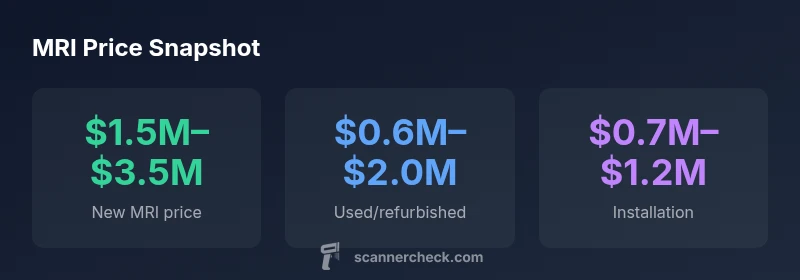
Price ranges for MRI scanners vary widely by field strength, configuration, and installation. In 2026, a typical new 1.5T or 3T MRI system sits around $1.5M to $3.5M, with higher-end features pushing prices toward the top end. Refurbished units and smaller configurations can lower upfront costs, but total cost of ownership remains a key consideration.
MRI Price Landscape in 2026
According to Scanner Check, price ranges for new MRI scanners are primarily driven by field strength, software packages, and the level of integration with hospital information systems. In 2026, typical quotes for new systems in common clinical configurations generally fall between a few hundred thousand dollars to several millions, with 1.5T and 3T models occupying the upper end of the market. Refurbished units can substantially reduce upfront cost, but buyers should weigh potential tradeoffs in uptime, software updates, and warranty coverage. When budgeting, hospitals often consider not only the sticker price but also installation, service contracts, and potential downtime during transition.
- Frontline takeaway: do not overlook software licenses and annual maintenance when comparing bids.
- This article uses data synthesized from Scanner Check Analysis, 2026 to illustrate common market patterns.
What Drives MRI Price: Field Strength, Configuration, and Software Packages
Price is not just a number on a quote sheet. The core drivers include field strength (1.5T vs 3T and beyond), bore size, coil configurations, and the sophistication of imaging sequences. Hardware is only part of the cost; the software suite, physics options (like advanced diffusion or functional MRI), and post-processing capabilities can add significantly to the total. Vendors often bundle or tier these features, so two quotes with similar sticker prices can have very different total costs over time. As buyers evaluate bids, it’s essential to map each feature to clinical value and workflow improvements.
- Consider whether the proposal includes initial software upgrades or ongoing renewal fees.
- Be mindful of training, installation, and integration requirements that may appear as separate line items.
New vs Used MRI Scanners: Tradeoffs and Risks
New MRI systems provide the latest hardware, longer warranty coverage, and the most up-to-date software, but come at a premium price. Used or refurbished units can be attractive for centers with budget constraints or lower patient volumes. However, older software cycles, potential compatibility issues with modern EMR systems, and higher maintenance burdens can erode cost savings. A careful evaluation should include a risk assessment of downtime, spare parts availability, and vendor support windows. For facilities with high throughput, reliability and service continuity often justify the higher upfront cost of a new system.
- Verify the warranty terms and the availability of service from the original manufacturer or certified refurbishers.
- Request a maintenance history and software version report with any used purchase.
Installation, Site Preparation, and System Integration
Site readiness is a critical but often underappreciated driver of total MRI costs. Shielded rooms, electrical upgrades, cooling, and network integration with PACS/EHR systems can add substantially to the project. In many cases, installation timelines are as impactful as the price itself, because extended downtime delays patient care and revenue. When negotiating, request a detailed installation plan with milestones, downtime estimates, and contingency options. A well-prepared project plan reduces risk and helps ensure the system performs as intended from day one.
- Demand a site readiness checklist and a clear test plan before final acceptance.
- Align installation with capital budgeting cycles to optimize financing terms.
Operating Costs: Maintenance, Service Contracts, and Software Upgrades
Ongoing costs include service contracts, parts, and periodic software upgrades. The price tag can vary widely depending on the level of coverage, response times, and whether remote monitoring capabilities are included. Facilities should price out multiple service packages and consider a multi-year renewal strategy. Training for staff on software updates is another recurring cost that is easy to overlook but essential for maintaining imaging quality and workflow efficiency. A thoughtful maintenance plan can extend system life and stabilize patient throughput.
- Compare standard vs premium service tiers and their response times.
- Include software upgrade cadence in the total cost projections.
Financing, Leasing, and Procurement Strategies
Many buyers prefer a financing or leasing arrangement to spread the capital expenditure over several years. Financing can improve cash flow and may offer favorable terms when paired with equipment service contracts. Procurement strategies should address vendor quotations, tender requirements, and risk management. It’s common to request a total cost of ownership (TCO) quote that spans five years, including installation, service, and upgrades. For budget accuracy, build in a reserve for unplanned repairs or clinical redeployments.
- Use a formal RFP process to compare total costs, not just upfront price.
- Clarify end-of-life options and decommissioning costs in the contract.
How to Compare Quotes and Build ROI Projections
A structured approach to quotes helps ensure apples-to-apples comparisons. Create a feature matrix that maps each quote to clinical value, maintenance terms, and required training. Build ROI models that account for patient throughput, reimbursement rates, and potential downtime. Sensitivity analyses can reveal how changes in patient volume or service contracts affect payback timelines. Keep in mind that price is only one dimension of value; reliability, uptime, and ease of integration often determine long-term outcomes for a radiology department.
Practical Budgeting Checklist for Buyers
- Define clinical goals and expected patient volumes to align with system capabilities.
- Ask for a detailed breakdown of all costs including installation, warranty, and software licenses.
- Validate compatibility with existing IT infrastructure and PACS.
- Obtain quotes from multiple vendors and include a 1–2 year post-installation performance review in the contract.
Methodology and Credible Context
This article synthesizes market patterns, vendor practices, and budgeting considerations observed in 2026. While costs can vary by region, facility size, and vendor, the general framework remains consistent: assess upfront price, installation, and long-term ownership. For readers seeking deeper context, refer to reputable health-technology sources and regulatory guidance to understand safety, efficacy, and lifecycle management of MRI systems.
MRI Scanner Price Range and Total Cost of Ownership (illustrative)
| Category | Typical Price Range (new) | Typical Price Range (used/refurbished) | Notes |
|---|---|---|---|
| New MRI Scanner (1.0-1.5T) | "1.5M–2.5M" | "0.4M–1.2M" | Lower field strength typically costs less |
| New MRI Scanner (3T) | "2.0M–3.5M" | "0.8M–2.0M" | Higher field strength increases price |
| Installation & site prep | "0.7M–1.2M" | "0.2M–0.7M" | Site readiness and integration matter |
| Total 5-year cost of ownership | "3.0M–6.0M" | "1.5M–4.0M" | Maintenance and upgrades included |
Common Questions
What is the typical price range for a new MRI scanner in 2026?
In 2026, new MRI scanners commonly cost between $1.5M and $3.5M, depending on field strength and configuration. Refurbished units can lower upfront costs but may carry higher maintenance needs. Always verify included software and warranties.
New MRI scanners in 2026 usually range from about $1.5M to $3.5M, with refurbished options offering savings but potential trade-offs in support.
How much should I budget for installation and site preparation?
Installation and site prep often range from $0.7M to $1.2M, varying with room shielding, electrical upgrades, cooling needs, and IT integration. A detailed, milestone-based plan helps prevent budget overruns.
Plan roughly seven hundred thousand to over a million dollars for installation, depending on the site.
Are refurbished MRI scanners reliable?
Refurbished MRI units can be cost-effective but may bring higher uptime risk and software support considerations. Require documented service history, warranties, and vendor-backed maintenance options.
Refurbished models save money but may need more maintenance; check warranty and service terms.
What affects ongoing maintenance costs?
Maintenance and software updates depend on service contracts, parts availability, and the scope of imaging software. Budget for annual maintenance plus periodic major upgrades.
Maintenance costs vary; expect ongoing service and updates as part of ownership.
How long does it take to recoup the investment?
Payback depends on patient volume, reimbursement, and efficiency gains. Typical ROI timelines span several years, with high-volume centers achieving faster payback.
Payback usually takes several years, depending on usage and reimbursements.
“MRI pricing reflects more than the sticker price; installation, service contracts, and software upgrades drive long-term costs.”
Key Takeaways
- Budget for total cost of ownership, not just sticker price
- Factor site readiness into planning and quotes
- Compare multiple vendors with a formal RFP process
- Request a 5-year TCO quote to gauge ROI